

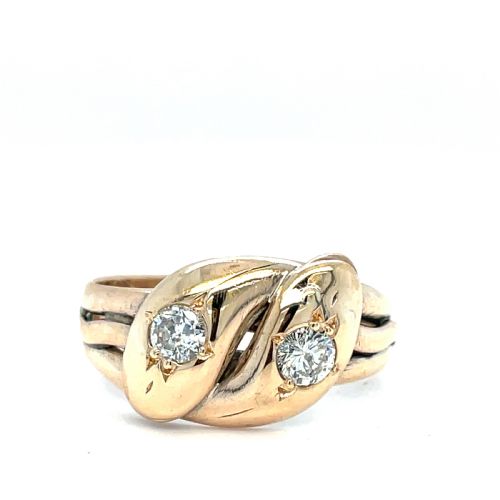


Coiled Snake Jewellery
Coiled snake jewellery brings together Victorian and Edwardian goldwork, diamonds, and gemstones in serpentine forms symbolising eternal love.
Coiled Snake Jewellery
The most common versions met here are rings fashioned from 18ct gold or 9ct gold, often set with diamonds, sapphires, rubies, or pearls. Makers shaped these creatures into single or double coils, sometimes incorporating gemstones as eyes or highlighting the head and tail sections with detailed engraving.
Beyond rings, the listings include wrap-around bangles in gold and pendants featuring coral or gemstone accents. Each object carries the characteristic symbolism of the serpent, a motif deeply favoured across the nineteenth and early twentieth centuries for sentimental and decorative wear.
How they were made
The construction of these pieces relies on yellow gold in 18ct and 9ct standards, alongside silver and gemstone settings. Goldsmiths shaped the metal into flexible or rigid coils, incorporating hollow or solid bands that wrap comfortably around the body.
Gemstones such as old-cut diamonds, rose-cut diamonds, sapphires, rubies, pearls, and coral are flush or claw-set into the heads and bodies of the serpents. Hallmarks stamped into the metal often record assay office locations like Chester and London alongside specific production years.
Coiled Snake Jewellery Retail Price Guide 2026
Typical asking prices for coiled snake jewellery among the pieces listed under this phrase on Sellingantiques today, from the lower quarter to the upper quarter. They describe what is for sale here now, not the wider market.
Several little serpents stare out with rose-cut diamond eyes, watching every room you enter with unblinking antique charm.
What varies in quality
Quality in these serpent pieces rests on the weight and purity of the gold, alongside the calibre of the set gemstones. Heavier 18ct gold bands with substantial diamond or sapphire arrangements sit at the higher end compared to lighter 9ct alternatives.
The crispness of the chasing and engraving on the snake scales dictates the artistic success of the object. Finer examples retain sharp surface detail and secure gemstone collets that show little sign of wear across the coils.
The integrity of the original hallmarks provides a clear indication of provenance, with well-preserved assay marks adding historical value to dated pieces.
The Coiled Snake Jewellery Glossary
- Old-cut diamond
- A hand-cut diamond shape typical of the nineteenth century featuring a small table, high crown, and open culet. These stones catch candle or gas light with a soft, warm sparkle.
- Rose-cut diamond
- A gemstone cut with a flat base and a domed, faceted top resembling an unopened rosebud. This style produces a subtle shimmer rather than modern brilliance.
- Hallmark
- An official stamp applied to precious metals indicating the purity standard, assay office, and year of manufacture. These marks guide dating and attribution.
- Serpent motif
- The visual representation of a snake used in decorative arts to signify wisdom, eternity, and enduring affection. In jewellery, it wraps continuously around the wearer.
- Chasing
- A metalsmithing technique where designs are hammered into the front surface of the metal using punches. This method creates the raised texture of snake scales.
Coiled Snake Jewellery: Frequently Asked Questions
What does a snake ring symbolise?
Serpent motifs in nineteenth-century jewellery stood for eternal love, wisdom, and commitment. Queen Victoria famously received a snake engagement ring featuring an emerald-set head, which popularised the design across Britain.
Because the serpent swallows its tail in certain classical representations, it became an enduring emblem of infinity. This rich symbolism meant these jewels were frequently exchanged between lovers as tokens of lasting devotion.
How do I wear a snake bangle?
Wrap-around bangles are designed to coil securely around the wrist using flexible metal bands or rigid overlapping loops. They sit comfortably alongside other bracelets or as a standalone statement piece.
Care should be taken not to bend the metal too forcefully when putting them on or taking them off. Preserving the original tension of the coil protects the internal structure and any gemstone settings.
How can I tell a Victorian snake ring from an Edwardian one?
Victorian pieces often feature heavier gold weights, deeper chased engraving, and old-cut diamonds with warmer colour tones. The overall aesthetic tends toward robust, naturalistic representations of the reptile.
Edwardian examples frequently display lighter, airier metalwork, sometimes incorporating platinum alongside gold and utilising delicate rose-cut diamonds or calibré-cut sapphires. Hallmarks stamped inside the band provide definitive proof of the exact manufacturing year and assay office.
Are these rings suitable for daily wear?
Gold serpent rings from the nineteenth and early twentieth centuries can be worn regularly provided they receive appropriate care. Solid gold bands and secure stone settings withstand daily use well.
However, delicate pearl or coral elements, as well as hollow-formed bangles, require gentlest handling to avoid impact damage. Removing the jewellery during heavy manual tasks ensures the longevity of the antique metalwork.