
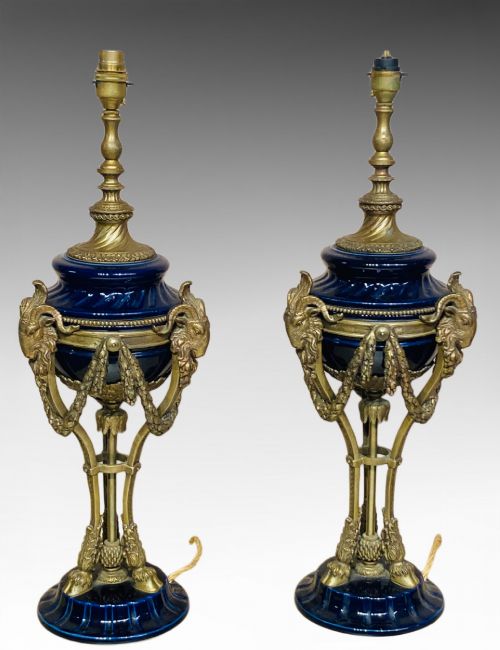


Cobalt Blue Ceramic Lights
Cobalt blue ceramic lights bring deep saturated colour and historical craftsmanship to interiors through converted vessels and mounted porcelains.
Cobalt Blue Ceramic Lights
Cobalt blue ceramic lights encompass table lamps and candlesticks created from historic pottery, porcelain, and converted jars. When searching for cobalt blue ceramic lights, buyers encounter pieces ranging from Victorian brass and porcelain candlesticks to nineteenth-century Chinese and Japanese vases mounted for electrical use.
The selection on this page relies heavily on nineteenth-century craftsmanship, featuring imported Asian export porcelain alongside European table lamps with ormolu and gilt bronze mounts. These objects bridge decorative history and practical illumination, utilising forms originally designed as tobacco jars, apothecary vessels, or display vases.
Many of these items show distinct regional aesthetics, moving between Chinoiserie motifs, Japanese Meiji pieces, and French Sevres style porcelain. Each configuration preserves the character of the original ceramic body while adapting it for contemporary interior schemes.
How they were made
The construction of these lamps combines fired ceramic bodies with metal mounts in brass, ormolu, and gilt bronze. Artisans frequently utilised existing porcelain vessels, such as Chinese blue and white vases or Royal Doulton tobacco jars, adapting them with electrical fittings and stable bases.
Glazed ceramic techniques define the surface texture, showing rich cobalt pigments beneath protective translucent layers. Metal mounts were secured carefully around the porcelain necks and bases, often employing French neoclassical or Victorian design idioms to complement the underlying ceramic work.
Listings incorporate nineteenth-century porcelain, brass, ormolu, and glazed ceramic across diverse styles including Victorian, Chinoiserie, and French Neoclassical.
What varies in quality
Quality in these pieces rests upon the fineness of the ceramic body and the precision of the metal mounting work. Finer examples display hand-painted detail and well-balanced proportions between the porcelain vessel and its ormolu or brass fittings.
The integration of the conversion process also separates standard examples from exceptional ones. Superior pieces maintain the integrity of the original antique vase or jar without compromising the historical surface decoration during adaptation.
Royal Doulton
The Cobalt Blue Ceramic Lights Glossary
- Ormolu
- Gilt brass mounted on decorative objects, common in French furnishings and nineteenth-century lamp bases. This technique provides a bright golden contrast to deep cobalt ceramic glazes.
- Chinoiserie
- European artistic styles reflecting Chinese motifs and decorative patterns. It appears frequently on nineteenth-century porcelain and pottery adapted into lamps.
- Tobacco Jar
- A covered ceramic container originally used to store smoking leaf, often converted into a table lamp. These jars provide robust bodies and rich glaze colours.
- Imari
- Japanese export porcelain decorated in underglaze blue, iron red, and gold. These colourful vases appear frequently among nineteenth-century lamp conversions.
- Sevres Style
- Porcelains produced in imitation of the famous French royal factory, known for rich cobalt grounds and gilt detailing. They frequently feature heavy ormolu mounts.
Cobalt Blue Ceramic Lights: Frequently Asked Questions
Are these lamps converted from old vases?
Many listings feature antique vessels, such as nineteenth-century Chinese vases and Royal Doulton tobacco jars, that were later adapted into table lamps.
This conversion process preserves the decorative value of the original ceramic piece while making it suitable for modern electrical use.
What periods do these lamps come from?
The selection is dominated by nineteenth-century pieces, spanning eras from the 1860s through the Edwardian period.
Styles range from Victorian brass combinations to French neoclassical ormolu mounts and Asian export porcelain.
How do I identify Sevres style porcelain?
Sevres style pieces typically exhibit deep cobalt blue grounds, often accompanied by hand-painted details and gilt bronze or ormolu mounts.
These French-inspired table lamps date primarily to the nineteenth century and lean toward formal decorative schemes.
Where should I place a ceramic lamp?
These lamps suit side tables, desks, or living areas where their rich blue glazes and metal mounts can function as focal points.
Pairing them with neutral fabric shades allows the ceramic base and historical ornamentation to remain the visual centrepiece.