


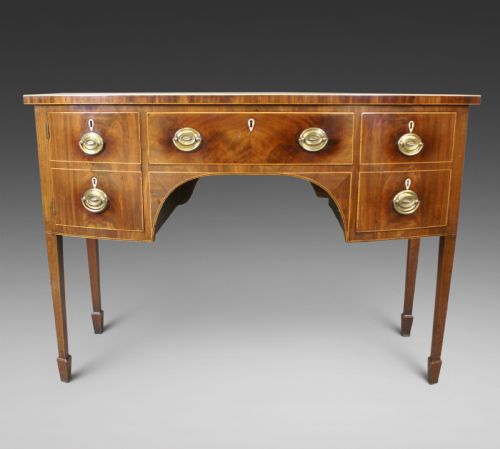


Classical Wooden Sideboard
A classical wooden sideboard anchors a dining room with timber and proportion, offering generous storage alongside centuries of cabinet-making heritage.
Classical Wooden Sideboard
A classical wooden sideboard brings substantial storage and architectural presence to a dining space, uniting utility with formal design. When searching for a classical wooden sideboard, buyers encounter forms ranging from Georgian pedestal types to Regency servers and Victorian credenzas.
The selections span periods from the eighteenth century through the nineteenth, alongside early twentieth-century interpretations. Mahogany dominates the examples, often enhanced by satinwood, walnut, and boxwood inlay.
Makers and designers referenced in the inventory include George Hepplewhite and Pietro Ferrario, reflecting English and Italian craftsmanship. Styles stretch across Georgian, Regency, Neoclassical, and Victorian revivals.
How they were made
Cabinet-makers constructed these pieces using dense hardwoods like mahogany and walnut, frequently applying flame mahogany veneer to create striking grain patterns on drawer fronts and doors. Timber preparation required seasoned stock to prevent warping across wide expanses of sideboard tops.
Decorative detailing relies on precise hand-carving and contrasting stringing such as boxwood and satinwood inlay. Makers incorporated brass galleries, handles, and mounts to accent the timber, combining structural joinery with surface ornamentation.
Classical Wooden Sideboard Retail Price Guide 2026
Typical asking prices for classical wooden sideboard among the pieces listed under this phrase on Sellingantiques today, from the lower quarter to the upper quarter. They describe what is for sale here now, not the wider market.
The listings on this site span the eighteenth, nineteenth, and early twentieth centuries, featuring mahogany, walnut, satinwood, and boxwood inlay.
What varies in quality
Quality rests upon the selection of timber figures, such as the depth of flame mahogany veneer, and the crispness of hand-carved mouldings. Superior examples display seamless veneer matching across large surfaces and meticulous attention to secondary timbers inside drawers.
Proportion and structural integrity dictate the standing of a piece, where restrained classical lines outlast heavy or clumsy alterations. Original brass hardware and intact inlay work elevate the distinction of a sideboard.
George Hepplewhite·Pietro Ferrario
The Classical Wooden Sideboard Glossary
- Pedestal sideboard
- A sideboard featuring distinct outer pedestals connected by a central counter or table section. These configurations often include cellarettes or cupboards within the pedestals.
- Breakfront
- A cabinet or sideboard whose central section projects forward from the flanking sections. This architectural arrangement creates shadow and depth across the front elevation.
- Satinwood
- A durable, yellowish timber native to Ceylon and India used extensively for contrasting inlay and banding. Cabinet-makers prized it for its luminous, reflective grain.
- Gallery
- A raised brass or wooden rail fitted along the back or top of a sideboard or serving table. It prevented serving dishes from sliding off during use.
- Credenza
- A low cabinet or sideboard lacking legs, frequently enclosed by doors and used for storing dining silver and linen. Victorian iterations often featured ebonised finishes and amboyna veneers.
Classical Wooden Sideboard: Frequently Asked Questions
What is a classical wooden sideboard?
A classical wooden sideboard is a substantial dining room cabinet designed for serving food and storing tableware. These pieces utilise traditional timbers like mahogany and walnut, following historical periods from Georgian to Victorian.
They serve as both functional storage units and focal points of interior decoration, characterised by balanced proportions and classical ornamentation.
How do I date a sideboard?
Dating a sideboard involves examining the timber species, construction methods, and stylistic vocabulary. Georgian and Regency pieces typically show native hardwoods, hand-cut dovetails, and restrained classical veneers.
Later Victorian and revival examples often incorporate heavier mouldings, machine-sawn elements, or exotic veneers like amboyna. Hardware styles and secondary woods inside drawers provide further chronological clues.
Where were sideboards placed?
Historical sideboards stood against the dining room wall, positioned conveniently near the dining table for serving dishes and pouring wine. In larger homes, they occupied a prominent position opposite the fireplace or windows.
Their placement allowed servants to prepare courses without crowding the main dining table.
How do I care for antique wood?
Antique timber requires stable environmental conditions away from direct heat sources and strong sunlight, which can dry out and fade old veneers. Maintaining consistent indoor humidity prevents wood movement and cracking in panels.
Periodic application of appropriate furniture wax preserves the finish and nourishes the antique surface without building up excessive residue.