


Classical French Writing Desk
A classical french writing desk brings stately mahogany and gleaming ormolu into a room, offering a serious workspace grounded in nineteenth-century craftsmanship.
Classical French Writing Desk
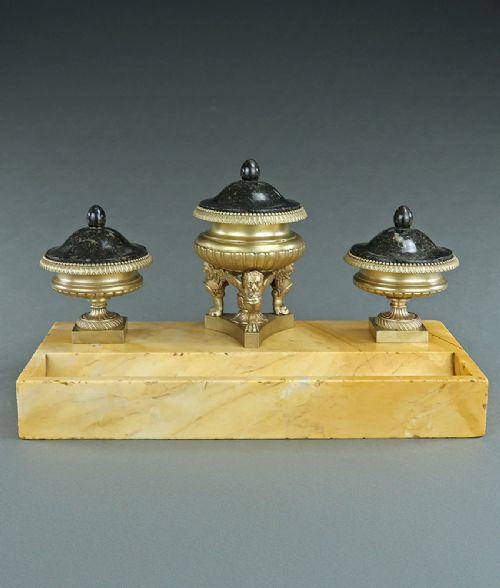
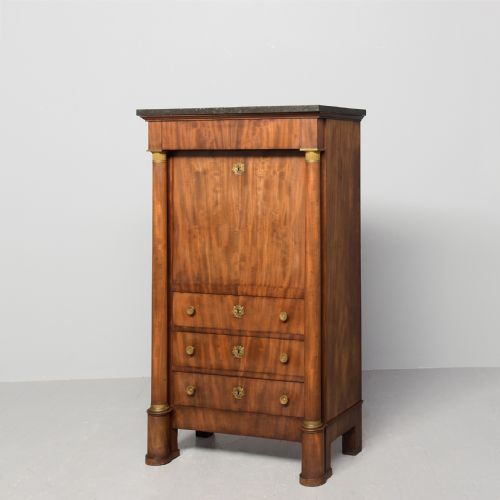
A classical french writing desk encompasses various forms from the nineteenth century, ranging from cylinder desks and bureau-plats to secretaire abattants and smaller desk accessories. These pieces reflect the dominant design movements of the era, notably the French Empire, Neoclassical, French Restoration, and French Second Empire styles. Buyers hunting for a classical french writing desk encounter substantial writing tables alongside intricate inkstands and marble inkwells.
The selections on this page lean heavily toward mahogany, flame mahogany, and diverse marbles such as Sienna and vert, accented with gilt bronze and ormolu mounts. Makers and workshops of the nineteenth century utilised these dense timbers and metallic adornments to project authority and elegance. Whether choosing a drop-front secretaire or a flat writing table, the owner gains a functional antique rooted in French stylistic traditions.
Materials and construction methods
Carpenters built these desks using solid mahogany and figured flame mahogany veneers over secondary timbers, creating smooth expanses for writing surfaces and cylinder fronts. Cabinetmakers then applied heavy brass and ormolu mounts, cast in bronze and fire-gilded, to highlight corners, key escutcheons, and structural borders.
Stonemasons shaped heavy slabs of Sienna marble, vert marble, and onyx to form the bases and pen trays of associated inkstands and desk sets. These stone components were fitted carefully with cast bronze and gilt elements, combining mineral weight with refined metallic detail.
Listings feature nineteenth-century French pieces in mahogany, flame mahogany, and marble, spanning Empire, Neoclassical, and Restoration styles.
Distinctions in construction and finish
The refinement of the cast bronze and ormolu mounts separates standard production from superior pieces, visible in the crispness of chased details like laurel leaves and Napoleonic busts. Heavier use of figured flame mahogany and richly variegated marbles indicates a higher grade of commission.
Structural integrity and the retention of original brass hardware, working locks, and matching marble inserts dictate the standing of a desk. Finer examples maintain the precise alignment of drop-front panels and cylinder mechanisms without sagging or warping.
Lefebvre of Belgium
The Classical French Writing Desk Glossary
- Secretaire abattant
- A tall upright desk featuring a drop-front writing flap that conceals an interior arrangement of small drawers and pigeonholes. This form dominated French neoclassical and restoration interiors for managing correspondence.
- Bureau-plat
- A flat-topped writing table with drawers in the frieze, designed to stand free in the middle of a room. It provides a generous leather-lined or wood-topped workspace.
- Ormolu
- Gilded bronze, where finely ground gold is amalgamated with mercury and applied to cast bronze through heat. This technique creates a durable golden finish characteristic of Empire metalwork.
- Encrier
- A French term for an inkstand or inkwell, usually incorporating mounts of ormolu and wells for ink alongside pen holders. They often sit atop matching marble bases.
- Cylinder desk
- A desk fitted with a quarter-cylinder rolling shutter that conceals the writing surface and interior compartments when closed. It protects correspondence from dust and prying eyes.
Classical French Writing Desk: Frequently Asked Questions
How do I identify French Empire style?
French Empire pieces rely on heavy mahogany timbers, symmetrical architecture, and classical bronze or ormolu mounts inspired by ancient Rome and Greece. Look for motifs like laurel wreaths, military trophies, and sphinxes.
These designs project a formal and monumental presence, differing from the lighter curves of earlier rococo furniture.
Where should I place a cylinder desk?
A cylinder desk works best against a solid wall or floating slightly away from it, depending on the finished back of the piece. Because the writing surface pulls out and the cylinder rolls back, ensure there is adequate floor clearance for a chair.
Keep the timber away from direct heat sources and strong sunlight to protect the French polish and veneer.
What is the difference between a secretaire abattant and a bureau-plat?
A secretaire abattant is a vertical cabinet with a vertical drop-front panel that opens into a writing desk, maximising vertical storage in a room. A bureau-plat is a horizontal table with a low profile and drawers beneath the top.
Choose the abattant if floor space is limited and correspondence needs to be hidden away entirely.