
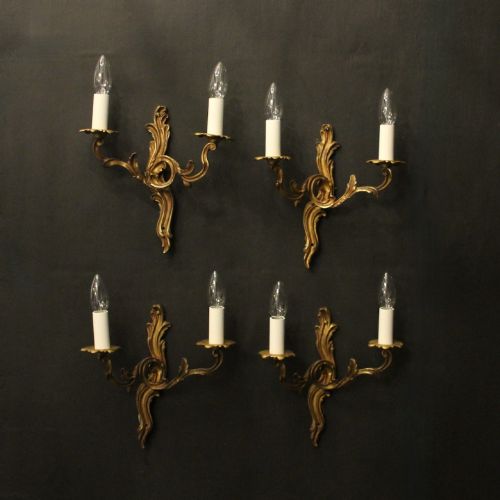
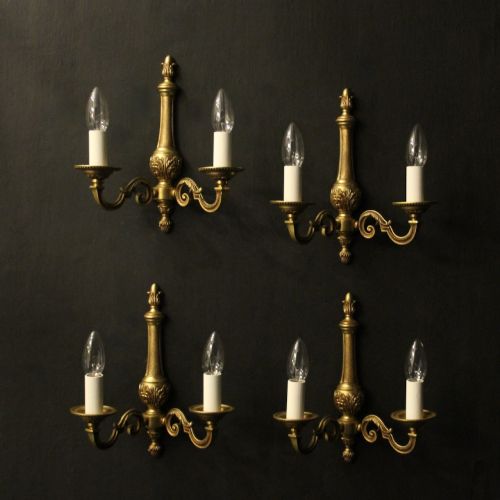
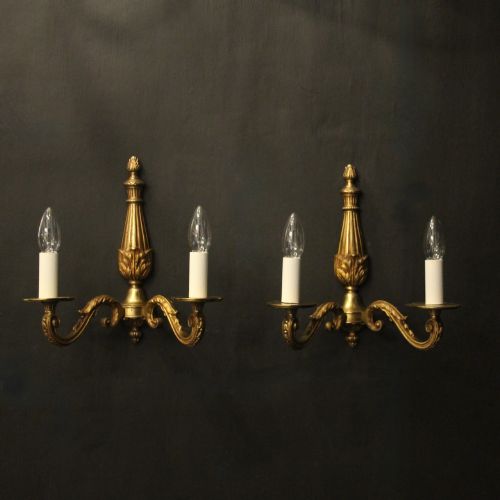
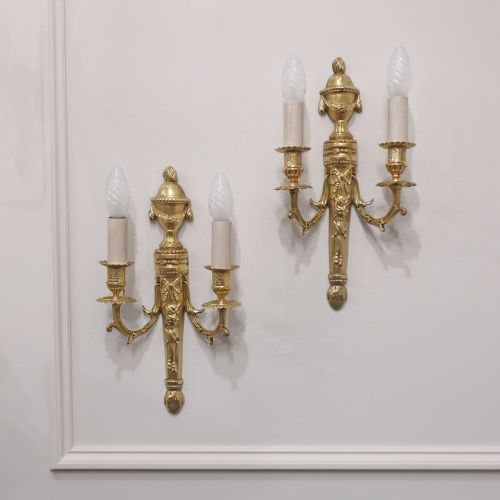




Classical Brass Wall Lights
Classical brass wall lights bring structured illumination and period character to an interior, drawing on French and English neoclassical designs.
Classical Brass Wall Lights
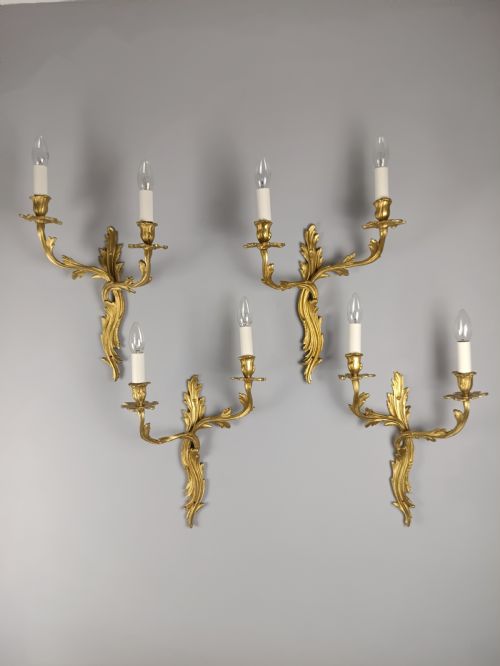
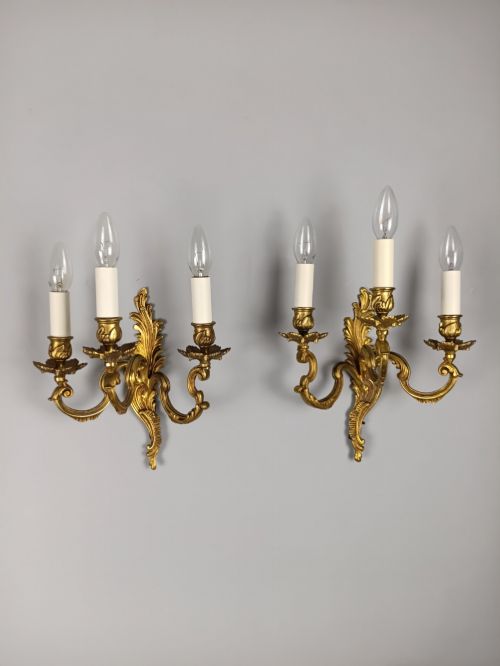
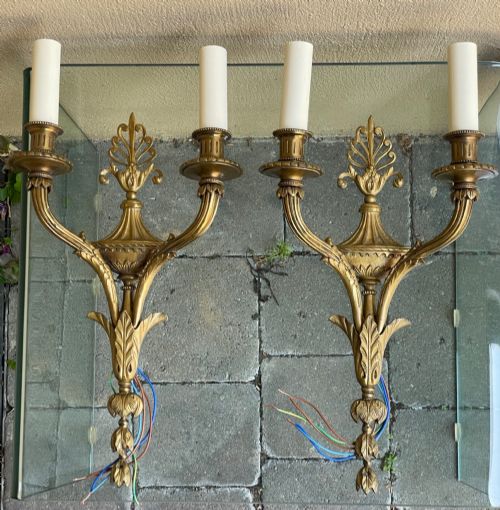
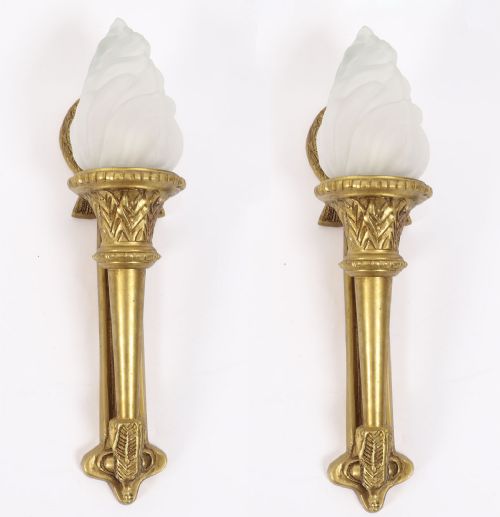
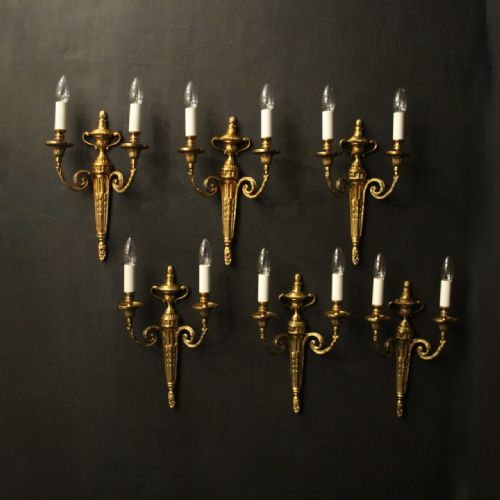
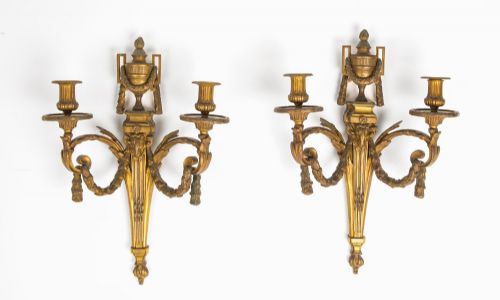
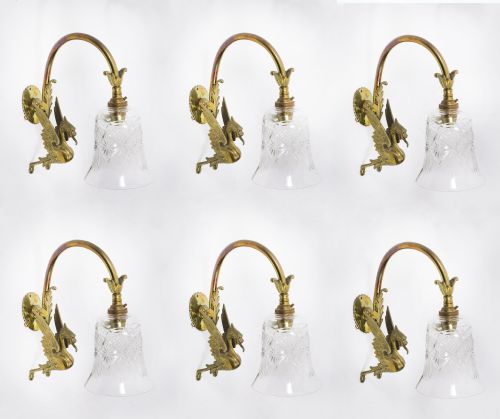
Classical brass wall lights encompass wall sconces, brackets, and girandole mirrors designed with formal symmetry and historical motifs. When searching for classical brass wall lights, buyers encounter pieces configured as twin or triple-arm branches, torch forms, and figural brackets.
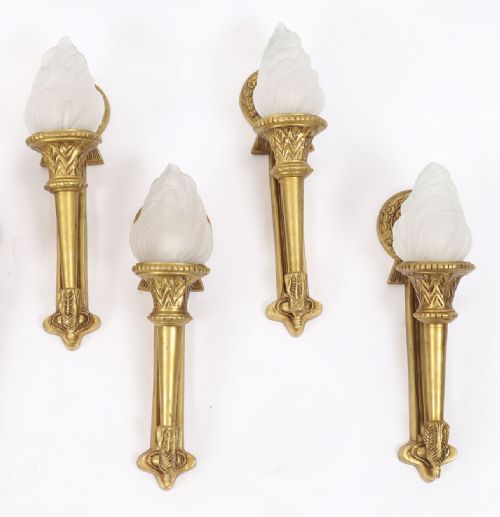
Forms include cast metal sconces decorated with ram's heads, cherubs, and flaming torches, often utilising gilded bronze, ormolu, and brass. Many examples integrate glass elements or reflective mirror plates to amplify the distribution of light across a wall.
How they were made
The construction of these pieces relies primarily on casting bronze and brass, followed by chasing to sharpen ornamental details such as acanthus leaves and classical faces. Manufacturers applied gilding, ormolu, or silvering to the metal surfaces to create rich, light-reflecting finishes.
Makers combined cast metal arms with wired or candle-simulating holders, occasionally incorporating cut glass drops and central mirror panels. Assembly typically involved mechanical joints securing the branches and backplates together to support the weight of multiple arms.
Several designs incorporate mischievous cherubs and ram's head masks peeking out from the brasswork.
What varies in quality
The refinement of the surface finish, whether through fine fire-gilding, well-preserved ormolu, or subtle patination, separates standard production from exceptional decorative work. Harmony within sets, particularly matching backplates and uniform arm alignment, dictates the desirability of multi-piece groupings.
Casier·F. & C. Osler
The Classical Brass Wall Lights Glossary
- Ormolu
- Gilt bronze produced by applying a finely ground mercury and gold amalgam to a bronze object and heating it. This historic technique creates a durable, rich golden finish characteristic of French decorative arts.
- Girandole
- A branched wall light incorporating a mirror plate. The reflective glass serves to multiply the illumination cast by the candles or lamps.
- Louis XVI Style
- A neoclassical design movement originating in eighteenth-century France and revived extensively later. It utilises straight lines, symmetry, classical antiquity motifs, and restrained ornamentation.
- Twin Arm
- A wall light configuration featuring two branching candle holders extending from a central backplate. These are frequently found in balanced pairs or larger sets.
Classical Brass Wall Lights: Frequently Asked Questions
What rooms suit classical wall sconces best?
These fixtures work effectively in formal reception rooms, hallways, and dining spaces where structured symmetry enhances the interior architecture. Placing pairs alongside fireplaces or flanking large mirrors creates a balanced focal point.
Smaller single-arm or twin-arm variants adapt well to libraries, studies, or intimate bedrooms. Their proportion allows them to provide layered ambient light without dominating tighter wall spaces.
How do I clean gilded brass and ormolu?
Maintenance requires gentle dusting with a soft, dry brush to prevent accumulation in recessed chasing and decorative crevices. Water and commercial abrasive cleaners damage historic gilding and should be avoided entirely.
If deeper cleaning is necessary, specialist conservators can advise on non-solvent methods suited to fragile metal finishes. Preserving the original surface patina maintains the character and historical integrity of the piece.
How do I distinguish 19th-century pieces from later revivals?
Nineteenth-century items often exhibit heavier bronze castings and hand-chased surface details that show subtle irregularities from artisan production. Examination of the construction fixings, screw types, and backplate construction helps indicate the manufacturing era.
Twentieth-century revival pieces, including those from the interwar decades, frequently utilise standardised mounting hardware while replicating earlier Neoclassical and Louis XVI styles. Comparing material weight and casting sharpness clarifies the period of origin.