




Chrome Ceiling Pendant
A chrome ceiling pendant delivers clean industrial brightness paired with period geometric elegance.
Chrome Ceiling Pendant
When you search for a chrome ceiling pendant, you encounter lighting fixtures originating primarily from the nineteen twenties and nineteen thirties. These pieces combine metallic frames with glass shades to suspend illumination directly from above in domestic and commercial spaces.
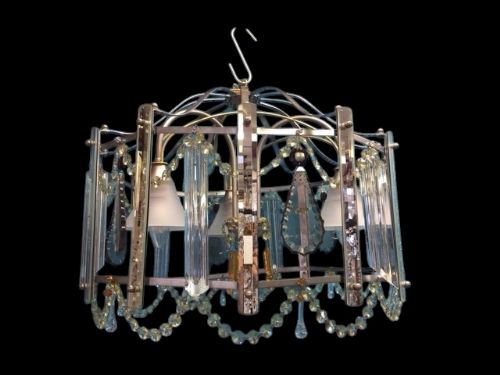
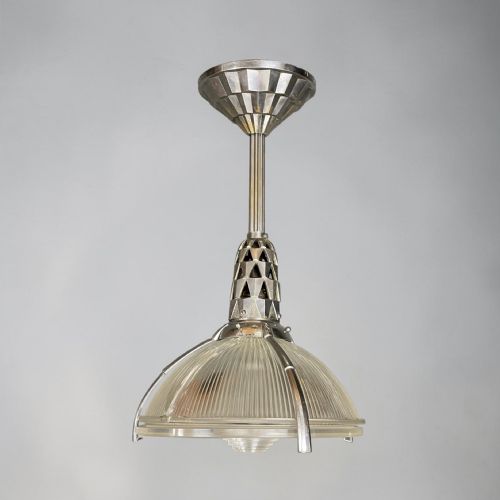
The versions most frequently met on this page belong to the Art Deco style, frequently exhibiting streamlined geometric forms or stepped profiles. Forms range from single pendant lights and lanterns to small chandeliers and suites of glass fittings.
Originating largely from the inter-war decades, these fixtures reflect the era's embrace of modern metallic finishes and architectural glass. They serve as functional illumination while carrying distinct period character.
How they were made
Makers constructed these fixtures using structural metal components paired with decorative glass elements. Chrome plating provided a durable, polished surface over steel or base metal frames, while brass accents occasionally appeared on specific lantern designs.
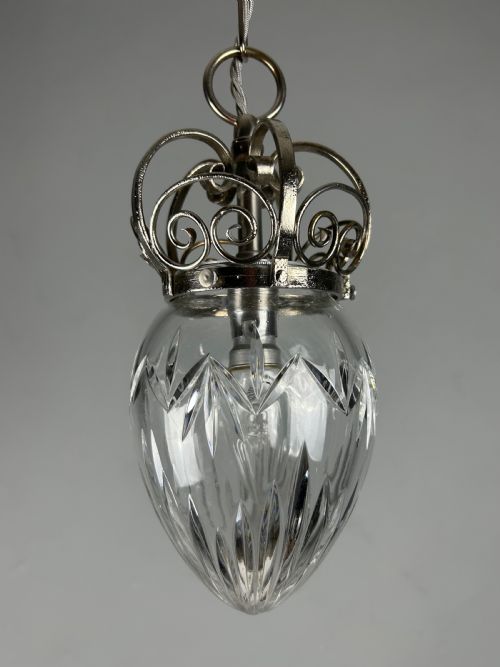
Glass shades were produced using various techniques to diffuse light effectively across the room. Frosted, opaline, cut, and crystal glass were moulded or shaped into clam shell, fish scale, and reeded designs held securely by metal galleries.
What varies in quality
The distinction between standard production items and finer examples lies in the integrity of the metalwork and the complexity of the glass components. Superior pieces exhibit precise casting, substantial gauge chrome plating, and thick, well-formed glass shades.
Design sophistication also sets individual examples apart, moving from basic utilitarian pendants to elaborate multi-light suites or geometric Odeon style assemblies. The harmony between the metal gallery and the specific glass shade defines the overall success of the piece.
Émile-Jacques Ruhlmann
The Chrome Ceiling Pendant Glossary
- Chrome
- A hard, corrosion-resistant metallic coating applied to a base metal to provide a bright, reflective finish. This plating defines the sleek appearance characteristic of inter-war lighting.
- Opaline Glass
- A milky, semi-translucent glass that diffuses light evenly without harsh glare. It was frequently moulded into spherical or patterned pendant shades during the nineteen twenties and thirties.
- Gallery
- The metal collar or ring that grips the glass shade and connects it to the suspension rod or chain. Galleries often feature decorative venting or tightening screws.
- Bag Chandelier
- A lighting fixture featuring a flattened backing and a cascading mass of glass crystals held within a metal frame. The shape resembles a small suspended pouch.
- Reeded Design
- A surface pattern consisting of parallel, rounded ridges running vertically along the glass shade. This texture breaks up light and adds subtle visual depth to the pendant.
Chrome Ceiling Pendant: Frequently Asked Questions
What is a chrome ceiling pendant?
A chrome ceiling pendant is a hanging light fixture featuring a polished metal framework paired with a glass shade, dating predominantly from the early twentieth century.
These pieces typically hang from a chain or rod, directing illumination downward while adding period style to a room.
How do I date a chrome ceiling pendant?
Dating these fixtures relies on identifying stylistic markers associated with the nineteen twenties and nineteen thirties, such as Art Deco geometry and industrial galleries.
Materials like opaline glass, frosted shades, and chrome-plated steel provide clear chronological indicators pointing directly to the inter-war decades.
Where should I hang a pendant light?
These pendant lights suit spaces requiring direct overhead illumination combined with decorative presence, such as over dining tables or in hallways.
Their varied forms, from single drop lanterns to small multi-light chandeliers, allow them to fit both compact and expansive rooms.
What glass types are used?
The glass components encompass frosted, opaline, cut, and crystal varieties, each shaping the quality of light emitted by the fixture.
Patterns range from smooth fish scale and reeded textures to structured clam shell shades designed to soften the bulb's glare.