


Chinese Ceramic Bedside Lamps
Chinese ceramic bedside lamps bring hand-painted porcelain and rich colour into a room, offering practical light with centuries of history.
Chinese Ceramic Bedside Lamps
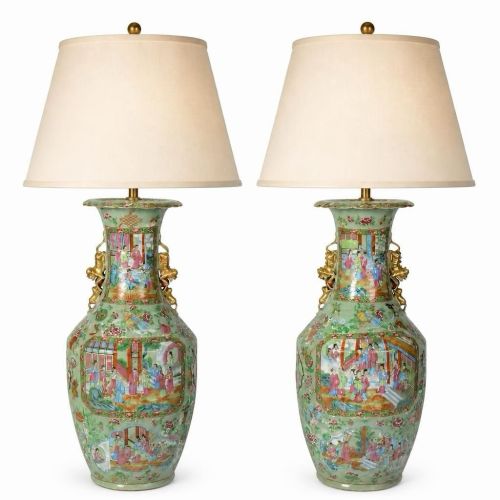
Chinese ceramic bedside lamps take traditional porcelain vessels, including ginger jars, baluster forms and vases, and convert them into functional lighting. These pieces span the nineteenth century and the early twentieth century, incorporating decorative schemes such as blue and white, Famille Verte, Famille Rose, Rose Medallion and Blanc de Chine.
Buyers will most frequently encounter nineteenth-century porcelain bodies paired with modern electrical fittings. Many listings feature matched pairs depicting Shi Lions, prunus blossom motifs or Canton scenes, adapting historic vessels for domestic use.
What varies in quality
The sophistication of the hand-painted enamel work and the clarity of the porcelain body separate the finer pieces from simpler examples. Crisp brushwork on Famille Verte and Famille Rose decoration indicates superior craftsmanship.
The integration of metal mounts, such as brass or ormolu collars and bases, influences the overall finish of the piece. Matching pairs demonstrate greater uniformity than single converted vases.
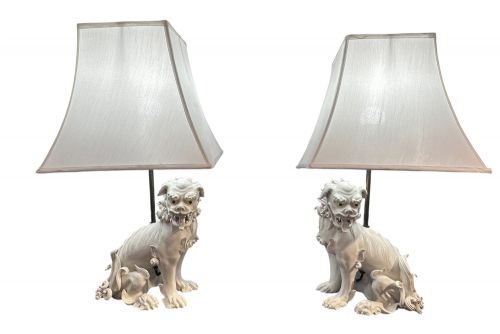
Guard dogs of Fo sit quietly on bedside tables, watching over the room with fierce ceramic expressions.
The Chinese Ceramic Bedside Lamps Glossary
- Famille Rose
- A palette of opaque enamels dominated by pink, introduced during the Qing dynasty. This decoration appears frequently on nineteenth-century vases adapted as lamps.
- Blanc de Chine
- White porcelain produced in Dehua, China, often moulded into figures such as Shi Lions or Dogs of Fo. This material creates a uniform, translucent surface.
- Ormolu
- Gilded bronze used for mounts and decorative fittings on furniture and porcelain. It provides a bright metallic contrast to the ceramic body.
- Ginger jar
- A storage jar with a broad shoulders and a rounded body, commonly decorated in blue and white. These vessels are frequently converted into table lamps.
- Crackleware
- Pottery featuring a network of fine cracks in the glaze, intentionally produced during firing. This texture appears across several nineteenth-century pieces.
Chinese Ceramic Bedside Lamps: Frequently Asked Questions
Are these lamps converted from antique vases?
Many listings utilise historic porcelain vessels, including nineteenth-century ginger jars and baluster vases, fitted for modern electrical use.
This method preserves traditional decorative ceramic forms while adapting them for bedside illumination.
How do I care for silk and fabric shades?
Fabric and silk shades require gentle dusting with a soft brush or a dry microfibre cloth to remove particles.
Keep these materials away from direct sunlight to prevent fading of the fabric over time.
What styles of decoration are common?
Blue and white designs, Famille Rose, Famille Verte and Rose Medallion dominate the painted porcelain surfaces.
These styles feature intricate floral patterns, prunus blossoms, figures and traditional Chinese motifs.
How are pairs matched?
Matched pairs consist of two ceramic vessels sharing identical dimensions, colour palettes and decorative schemes.
Pottery from the nineteenth century often appears in these balanced sets for symmetrical placement.