

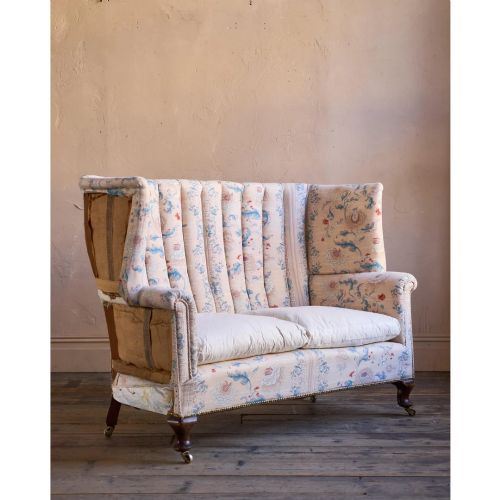


Channel Back Chair
A channel back chair offers a deeply enclosing seat upholstered with vertical fluting.
Channel Back Chair
A channel back chair provides an enclosing seating option defined by vertical upholstered flutes running up the inner back. These pieces appear across several eras, with 19th Century and Edwardian examples featuring prominently among the selections.
The form spans various configurations including standard armchairs, barrel back designs, and larger wingback versions. Examples range from Victorian mahogany tub chairs to 1940s cocktail chairs and walnut upholstered armchairs.
Makers and designers from the Georgian period onward utilised this structural outline to combine comfort with architectural upholstery. Buyers frequently encounter versions upholstered in velvet, linen, damask fabric, or brown leather.
How they were made
Construction relies on a solid timber frame, with mahogany, walnut, and general wood or timber utilised for the structural skeleton and showwood elements. Artisans shaped these frames into curved barrel, tub, or wingback profiles.
The signature vertical channels require precise stitching and internal stuffing to hold the parallel fluted form in place. Upholstery materials such as velvet, linen, damask, and leather are then secured over the padded framework, often accented with brass detailing.
Channel Back Chair Retail Price Guide 2026
Typical asking prices for channel back chair among the pieces listed under this phrase on Sellingantiques today, from the lower quarter to the upper quarter. They describe what is for sale here now, not the wider market.
Listings span from the Georgian era through the 19th Century, Edwardian period, and into the 1940s, featuring woods like mahogany and walnut.
What varies in quality
The rigidity and integrity of the underlying timber frame determine the structural longevity of the piece. Superior examples maintain firm joints in woods like mahogany and walnut without excessive movement.
The execution of the vertical fluting and the quality of the textile upholstery define the visual standard. Uniform stitching in fabrics like velvet, damask, or leather indicates greater craftsmanship than looser, uneven fluting.
The Channel Back Chair Glossary
- Channel back
- An upholstered furniture back divided into vertical padded flutes or channels. This design creates a distinctive ribbed texture that wraps around the sitter.
- Barrel back
- A seating design where the backrest curves continuously around in a circular, tub-like arc. It resembles the open upper half of a wooden barrel.
- Showwood
- Exposed timber framework on an upholstered chair or sofa. This allows the polished wood of the arms or legs to be seen alongside the fabric.
- Wingback
- An armchair featuring protective side panels or wings attached to the backrest. These projections historically shielded the sitter from draughts.
- Damask fabric
- A reversible, figured textile woven on a jacquard loom with patterns created by contrasting warp and weft threads. It offers a formal, textured surface often used on period seating.
Channel Back Chair: Frequently Asked Questions
What is a channel back chair?
A channel back chair is an upholstered seat featuring distinctive vertical flutes sewn into the backrest. This design offers a supportive, enclosing shape that hugs the sitter.
These pieces appear in various forms, from Victorian tub chairs to Edwardian barrel backs and 1940s cocktail seating.
How do I date a channel back chair?
Dating relies on examining the timber frame, upholstery style, and construction methods. Georgian and George III examples display different leg forms and proportions compared to Victorian or Edwardian iterations.
Materials also offer clues, as specific fabrics and woods align with the prevailing fashions of the nineteenth and early twentieth centuries.
Where should I place this chair?
These armchairs suit living rooms, studies, or bedrooms as statement seating due to their curved silhouettes and textured backs. Their enclosing shape makes them practical reading chairs.
Pairing them with appropriate side tables allows the timber frames and fabric choices, such as velvet or leather, to stand out in the room.
What materials were used?
Frames are constructed from timbers such as mahogany, walnut, and general hardwoods. Showwood elements display these polished woods around the edges of the structure.
Upholstery options recorded in the listings include velvet, linen, damask fabric, and brown leather, occasionally complemented by brass hardware.