

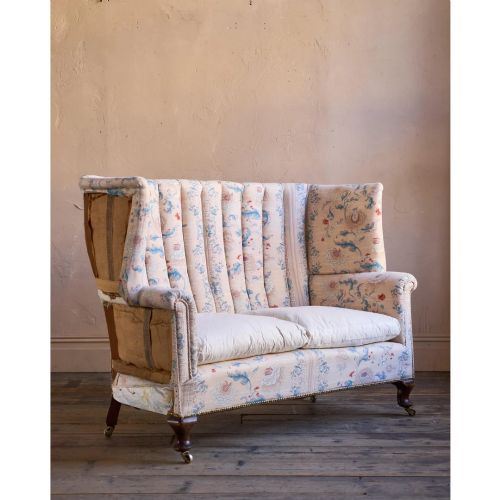


Channel Back Armchair
A channel back armchair delivers deep comfort through its distinct vertical fluted upholstery.
Channel Back Armchair
A channel back armchair provides a deeply supportive seating option defined by vertical upholstered flutes along the interior curve. The examples found here span from the Georgian period through the Victorian and Edwardian eras into the mid-twentieth century. Buyers frequently encounter barrel back variants and wingback designs within this selection.
The forms range from compact cocktail chairs to large Victorian brown leather suites and substantial mahogany frames. Woods such as mahogany, walnut, and ebonised timber appear beneath the fabric or leather upholstery. These seating pieces serve as central reading chairs or statement furnishings in sitting rooms.
How they were made
The construction of a channel back armchair relies on a sturdy wooden frame shaped from mahogany, walnut, or timber. Artisans formed the curved backrests and wings using traditional joinery before applying internal stuffing and springs.
Upholstery materials define the exterior finish, utilising velvet, linen, damask fabric, plain fabric, and brown leather. Brass detailing sometimes accents the woodwork or feet of the heavier Victorian and Edwardian suites.
Channel Back Armchair Retail Price Guide 2026
Typical asking prices for channel back armchair among the pieces listed under this phrase on Sellingantiques today, from the lower quarter to the upper quarter. They describe what is for sale here now, not the wider market.
Listings feature channel back armchairs spanning the Georgian, Victorian, Edwardian, and 1940s periods, utilising mahogany, walnut, leather, velvet, and damask fabric.
What varies in quality
The standard of a channel back armchair rests primarily on the integrity of the timber frame and the precision of the vertical fluting. Superior examples exhibit clean, even vertical channels that maintain their tension and shape across the curved backrest.
Finer pieces feature higher grade upholstery materials like heavy velvet or supple leather paired with robust showwood frames in mahogany or walnut. Lesser examples show simpler construction with basic timber supports and standard fabric coverings.
The Channel Back Armchair Glossary
- Channel back
- An upholstered furniture back divided into vertical padded flutes or channels. This design provides structural support while creating a decorative ribbed texture.
- Barrel back
- A seating form featuring a semicircular curved backrest that wraps continuously around the sides. The shape resembles the top half of a wooden barrel.
- Wingback
- An armchair featuring protective side panels or wings attached to the backrest. These extensions originally shielded the sitter from draughts.
- Showwood
- Exposed polished timber on a chair frame where the wood remains visible rather than being fully covered in fabric. Walnut and mahogany are frequently utilised for this purpose.
- Ebonised
- Timber treated with a dark finish to imitate the appearance of ebony wood. This technique was popular on Victorian and Edwardian frames.
Channel Back Armchair: Frequently Asked Questions
What is a channel back armchair?
A channel back armchair is a seating piece featuring vertical fluted upholstery stitched into the curved interior of the backrest. This design offers structured support and a distinctive ribbed visual texture.
Such chairs appear in various historical styles ranging from Georgian frames to Victorian and Edwardian iterations.
How do I identify a Victorian channel back chair?
Victorian examples often display heavier proportions, robust timber frames in mahogany or walnut, and sometimes exposed showwood or brass accents. Leather and rich velvet are common upholstery choices for this era.
Later Edwardian and 1920s versions tend to feature lighter frames and softer fabrics like damask or linen.
Where should I place this armchair?
These armchairs function well as reading chairs in a study or as statement seating in a living room. Their curved backs allow them to sit comfortably in corners or away from walls.
Matching them with existing mahogany or walnut furniture helps integrate the piece into the room.
What materials are used on these chairs?
The frames are built from timber, primarily mahogany and walnut, occasionally with ebonised finishes. Brass elements sometimes appear on the feet or structural mounts.
Upholstery materials include velvet, linen, damask fabric, plain fabric, and brown leather.