






Carved Wooden Game Board
A carved wooden game board brings both tactical play and tactile warmth to a room, offering tactile timber surfaces shaped for pastimes like chess, cribbage, and solitaire.
Carved Wooden Game Board
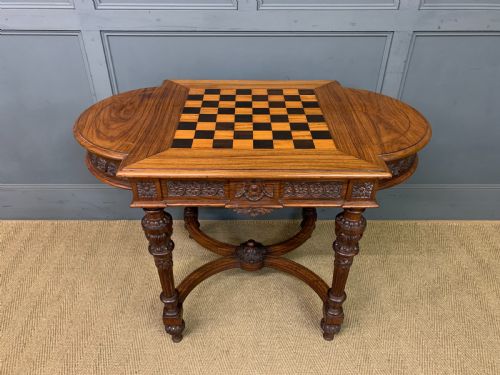
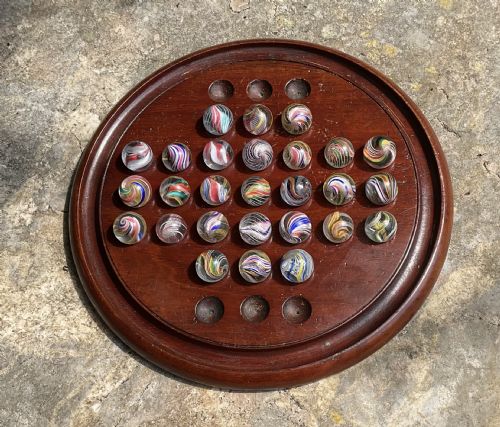
You are most likely to encounter Victorian and nineteenth-century examples fashioned from rosewood, mahogany, and oak. Forms span from cribbage board boxes and solitaire boards with marbles to comprehensive games compendiums and Anglo-Indian chess top tables.
How they were made
Craftsmen shaped these boards from a variety of dense timbers, pairing mahogany, rosewood, and oak with contrasting lighter woods such as boxwood for playing squares and inlays. Brass fittings, bone accents, and slate elements appear across the scoreboards and compendiums to provide durability and functional contrast.
Carpenters utilised traditional joinery for folding mechanisms and box construction, while surface carving and inlay work defined the playing grids. The execution relies on the natural grain of woods like mahogany and rosewood, often left polished to highlight the timber's character.
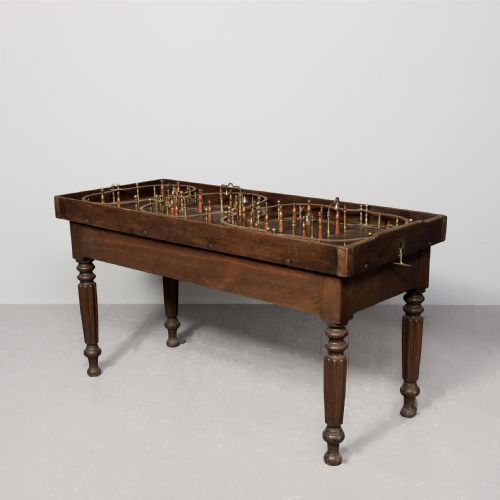
Among the boards designed for quiet parlour strategy, a free-standing oak skittles game waits on the floor to disrupt the peace.
What varies in quality
Quality rests upon the precision of the woodwork and the quality of the timber selection, such as richly figured rosewood or dense mahogany. Superior pieces display crisp inlay work, well-fitted folding hinges, and harmonious proportions between the playing surface and the supporting structure.
The sophistication of secondary elements, like fitted boxes for pieces, integrated brass scoring dials, or hand-turned components, distinguishes finer compendiums and scoreboards from simpler utilitarian items.
The Carved Wooden Game Board Glossary
- Cribbage board box
- A wooden box featuring tracked peg holes used for scoring during the card game cribbage. These often double as storage compartments for playing cards and markers.
- Games compendium
- A fitted box containing the equipment for multiple different pastimes, such as chess, draughts, and dice games. They bring together varied wooden boards and pieces within a single container.
- Solitaire board
- A circular or rectangular timber board drilled with indentations to hold marbles or pegs for a single-player puzzle. They frequently utilise mahogany or other turning timbers.
- Scoreboard
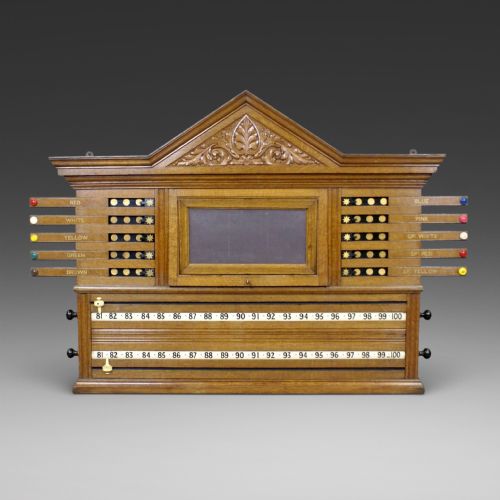
- A wall-mounted or freestanding wooden apparatus utilising sliding pointers or rotating dials to track scores for billiards, snooker, and pool. They often incorporate brass and polished oak or mahogany.
- Boxwood
- A dense, pale yellow wood frequently utilised alongside darker timbers like rosewood or ebony for contrasting squares on chess boards and for turned game pieces.
Carved Wooden Game Board: Frequently Asked Questions
How were antique game boards used?
These boards served as the central apparatus for domestic entertainment, hosting social pastimes like chess, cribbage, and solitary puzzle games in the parlour.
Many incorporated storage compartments or folding designs so that families could pack away pieces and transport the entertainment between rooms or on journeys.
What woods were commonly used?
Cabinetmakers relied on durable hardwoods like mahogany, rosewood, and oak to construct the main bodies and folding frames of these boards and compendiums.
Contrast was achieved by inlaying paler timbers such as boxwood, while materials like bone and brass were introduced for pins, score markers, and hinges.
How do I date a game board?
Dating relies on observing the prevailing style, construction techniques, and secondary materials characteristic of periods like the Georgian era, the nineteenth century, or the Victorian epoch.
Details such as the joinery of a box, the presence of specific brass scoring hardware, and regional stylistic traits like Anglo-Indian carving offer clear chronological clues.
How should I care for wooden game boards?
Protect the timber surfaces by keeping them away from direct sunlight and maintaining stable humidity levels to prevent the wood or inlaid squares from warping.
Occasional light dusting with a dry cloth preserves the polish on rosewood and mahogany without risking moisture damage to vintage joints and hinges.