
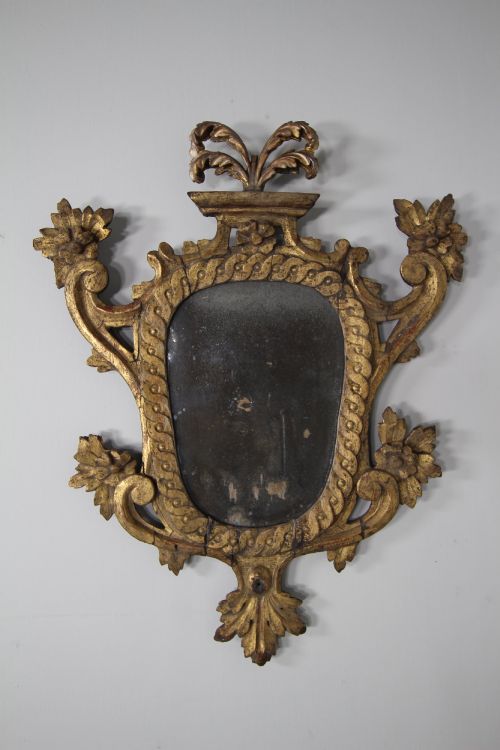


Carved Wood Cartouche
A carved wood cartouche brings scrollwork, asymmetry and classical relief directly into an interior as a wall mirror or architectural carving.
Carved Wood Cartouche
A carved wood cartouche takes the form of an ornamental tablet, heraldic shield or scroll-bordered frame, frequently executed in walnut, fruitwood, mahogany, oak or giltwood. These pieces often serve as wall mirrors, wall plaques or architectural carvings rather than standalone furniture.
Italian, French and Black Forest workshops generated these items across the seventeenth, eighteenth and nineteenth centuries, adopting styles that range from Italian Rococo to French Rococo Revival.
The buyer meets pieces spanning seventeenth-century walnut carvings to Victorian oak shield-back chairs, alongside wall mirrors of cartouche form dating from the eighteenth and nineteenth centuries.
Materials and construction methods
Makers shaped structural elements from walnut, oak, mahogany and fruitwood, applying relief carving to achieve organic scrolls and asymmetric curves.
Giltwood and gesso surfaces frequently appear on mirrors, where thin layers of plaster receive gold leaf over carved wooden bases.
Secondary materials such as glass, enamel and brass integrate into mirrors, clocks and emblems mounted upon the carved wooden supports.
Automobile enthusiasts can acquire an 1898 Swiss club emblem carved in wood alongside centuries of domestic mirrors and seating.
Assessing quality in carved woodwork
Depth and sharpness of the hand-carved relief distinguish finer work from simpler production, separating deep undercut scrolls from shallow mechanical profiling.
The preservation of original surfaces, whether unpainted timber or early gilding over gesso, dictates the historical integrity of the piece.
Proportion and harmony within the cartouche outline, particularly in Rococo Revival frames and heraldic shields, govern the visual success of the carving.
The Carved Wood Cartouche Glossary
- Cartouche
- An ornamental tablet or panel resembling a rolled-up scroll or shield, often used as a frame or focal decoration. It frequently houses a mirror plate or armorial design.
- Giltwood
- Wood that has been coated with gold leaf over a prepared gesso ground. This finish appears widely on eighteenth and nineteenth-century Italian and French frames.
- Gesso
- A plaster-like mixture applied to wood surfaces to provide a smooth base for gilding and fine decorative carving. It cracks with age, which helps confirm period authenticity.
- Rococo
- An exuberant decorative style characterised by asymmetry, C-scrolls, S-scrolls and naturalistic plant motifs. It dominates eighteenth-century Italian and French design.
- Sgabello
- A type of lightweight wooden chair with a high back and solid trestle supports, common in the Renaissance and revived in later centuries. Examples sometimes incorporate cartouche-shaped backs.
Carved Wood Cartouche: Frequently Asked Questions
How do I date an old wood carving?
Dating relies on identifying the underlying wood species, the tool marks left by the carver, and the composition of the gesso or finish beneath any gilding.
Stylistic markers such as seventeenth-century walnut scrollwork or Victorian golden oak relief provide a secure chronological baseline.
Where should I hang a wall plaque?
Architectural carvings and wall plaques suit prominent wall spaces where their relief work can catch directional light.
They work well above mantelpieces, in hallways, or paired symmetrically on either side of a larger architectural feature.
Are these pieces French or Italian?
Origin depends on the specific design vocabulary, with French pieces often displaying delicate Rococo Revival asymmetry and Italian examples showing bolder architectural relief.
Both traditions utilised native hardwoods like walnut and fruitwood before applying gesso and gold leaf.