



Carved Timber Book Supports
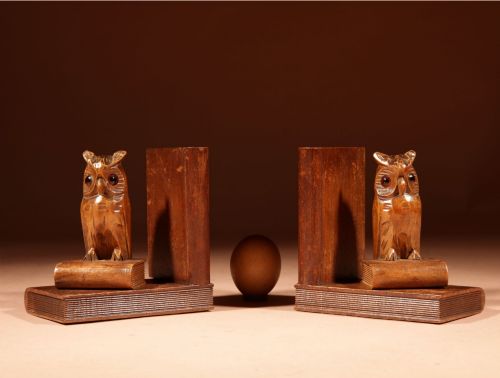
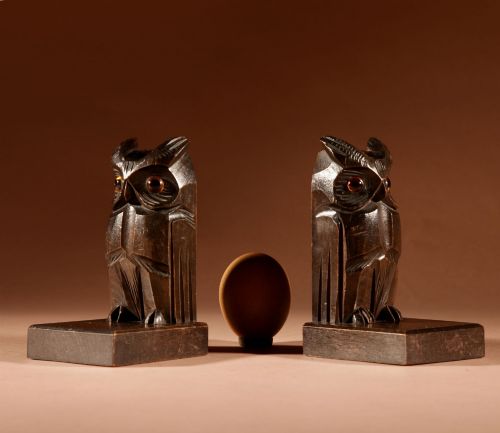
These carved timber book supports range from Black Forest owls and bears to Anglo-Indian beech rests, built to hold working libraries securely.
Carved Timber Book Supports
Carved timber book supports hold heavy volumes upright on desks and shelves using dense woods and shaped bases. The pieces seen here span the Victorian, Edwardian, and Art Deco eras, alongside Black Forest and Anglo-Indian regional schools.
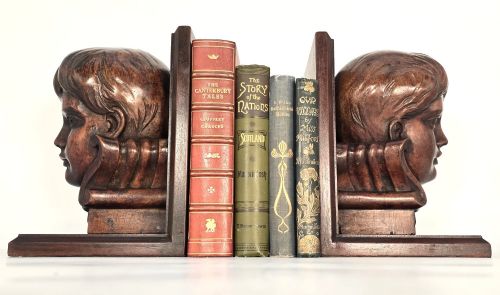
Owl figures, bears, lions, elephants, and canine subjects dominate the carved forms, paired with architectural mahogany Gothic Revival designs and sculptural hardwood figures. These functional objects served as library furnishings and decorative mantel items.
Animal carvings from the Black Forest workshops appear most frequently, alongside British pine and imported exotic hardwoods. Collectors encounter matching pairs designed to secure rows of books through solid weight and leverage.
How they were made
Carvers shaped these book supports from linden wood, mahogany, beech, pine, and coromandel using hand gouges and chisels to define feather, fur, and architectural detail. Hardwood blocks provide the substantial weight needed to resist the push of heavy texts.
Regional workshops utilised distinct timber species suited to their carving traditions, from European softwoods and linden to dense tropical hardwoods like coromandel. Joinery remains simple, relying on solid timber bases fixed directly to the carved uprights.
Carved Timber Book Supports Retail Price Guide 2026
Typical asking prices for carved timber book supports among the pieces listed under this phrase on Sellingantiques today, from the lower quarter to the upper quarter. They describe what is for sale here now, not the wider market.
Listings feature woods such as linden, mahogany, beech, pine, and coromandel across Victorian, Edwardian, and Art Deco periods.
What varies in quality
Anatomy, depth of relief, and expression separate ordinary turned or blocked supports from master carvers' animal figures. Sharp undercutting in Black Forest owls and bears shows deliberate hand labour rather than mechanical roughing.
Choice of timber dictates the finish and heft, with dense mahogany, coromandel, and seasoned hardwood outlasting softer pine or beech variants. The proportion between the display carving and the supporting base ensures the pair actually holds heavy volumes upright.
The Carved Timber Book Supports Glossary
- Black Forest
- A style of wood carving originating from Brienz in Switzerland, characterised by realistic animal figures such as bears and owls. These pieces often feature glass eyes and deep undercutting.
- Anglo-Indian
- Furniture and decorative objects made in India during the British colonial period, often employing dense indigenous timbers and intricate floral or animal carving. These pieces blend British forms with traditional Indian craftsmanship.
- Gothic Revival
- An architectural and decorative style drawing on medieval forms, featuring pointed arches, tracery, and heavy mouldings. In library fittings, this translates to ecclesiastical mahogany book supports.
- Coromandel
- A dense, heavy tropical hardwood from India and Southeast Asia featuring dark brown and black grain patterns. Cabinetmakers utilised this valuable timber for luxury decorative objects.
- Linden wood
- A pale, fine-grained European timber favored by carvers for its even texture and lack of prominent grain. This wood allows intricate detail without splitting.
Carved Timber Book Supports: Frequently Asked Questions
How do I date carved bookends?
Dating relies on timber choice, style markers, and mounting techniques that align with Victorian, Edwardian, or Art Deco periods. Workshops often employed specific subjects like owls or bears during distinct decades.
Examine the base construction and wear patterns on the underside to confirm age. Catalogues and regional archives help link specific carving styles to known production eras.
Can these book supports hold heavy books?
Most pairs use dense hardwoods like mahogany or coromandel to provide the necessary weight and friction against heavy volumes. The design of the base determines how well the support resists shifting under pressure.
Larger specimens handle folio volumes easily, while smaller animal carvings suit lighter octavo editions. Placement on a flat shelf ensures stable contact.
What is Black Forest carving?
Black Forest carving refers to nineteenth and early twentieth-century wooden sculptures produced primarily in Swiss and German Alpine regions. Bears, owls, and chamois are typical subjects rendered with glass eyes and textured fur.
These pieces were popular souvenirs for grand tourists and functional items for European libraries. The carving style emphasises naturalistic poses and detailed surface work.
How should I clean antique wood?
Dust carved surfaces gently with a soft, dry brush to reach into crevices without abrading the timber. Avoid modern liquid polishes that build up in the recessed carving.
Periodic application of microcrystalline wax preserves the finish and protects the dry antique wood. Keep pieces away from direct sunlight and radiators to prevent timber shrinkage.