



Carved Ebony Elephants
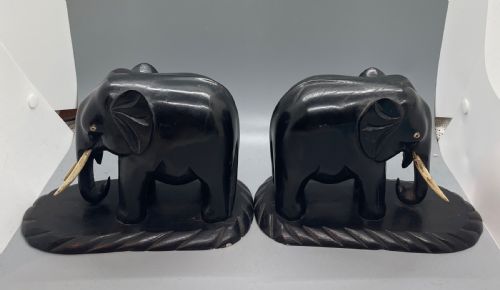
Carved ebony elephants are heavy tropical hardwood sculptures and functional bookends from the late nineteenth and early twentieth centuries that bring striking colonial craftsmanship into a room.
Carved Ebony Elephants
When you search for carved ebony elephants, you are looking at dark, dense wood figures that range from small decorative sculptures to pairs of sturdy bookends and occasional low tables. The pieces you are most likely to meet on this page hail from the Victorian, Indian Raj, and Art Deco eras, reflecting decades of British colonial trade and influence.
Makers shaped these animals from dense tropical hardwoods, often adding contrasting bone or ebony inlay to tusks, toenails, and eyes. Forms vary from naturalistic walking studies on fitted wooden bases to practical book rests designed for heavy libraries.
Geographic origins span British India and Ceylon, encompassing regional styles such as Anglo-Indian Colonial and intricate Hoshiarpur tripod tables. The materials extend beyond pure ebony to teak, coromandel wood, and walnut, showing the broad palette of colonial workshops.
Materials and construction
Artisans carved these figures from solid, heavy ebony and related hardwoods like coromandel and teak, selecting dense heartwood that took a fine natural polish without needing heavy varnish. This tight-grained material allowed carvers to execute deep relief and smooth curves on the skin, trunks, and ears of each animal.
Detailing often involved delicate bone inlay set flush into the dark wood for tusks and toenails, creating a stark tonal contrast. Tables and bookends utilised sturdy dowelled construction and fitted wooden bases to support the substantial weight of the dense timber.
Carved Ebony Elephants Retail Price Guide 2026
Typical asking prices for carved ebony elephants among the pieces listed under this phrase on Sellingantiques today, from the lower quarter to the upper quarter. They describe what is for sale here now, not the wider market.
Listings feature periods spanning the Victorian era through the Art Deco nineteen-thirties, utilising ebony, teak, coromandel, and bone inlay.
Assessing quality in carved ebony
Quality rests in the anatomical accuracy of the carving and the crispness of the detail in the ears, trunk, and wrinkles of the skin. Superior examples show careful observation of the animal rather than rigid, formulaic execution by the workshop.
The selection of the timber also dictates the tier of the piece, with deep, uniform black ebony or rich coromandel commanding greater respect than lighter specimen woods. Integrated bone inlay that remains complete and secure without shrinkage cracks elevates the standard of the work.
The Carved Ebony Elephants Glossary
- Ebony
- A dense, hard, dark black heartwood yielded by several species of trees, prized for its weight and fine polish. It is heavy enough to sink in water.
- Anglo-Indian
- A style of furniture and decorative objects made in India during the British Raj, combining traditional local craftsmanship with European forms.
- Coromandel wood
- A heavy, durable timber from India and Southeast Asia, showing rich brown colour with dark stripes. It resembles ebony and was frequently used for luxury decorative items.
- Hoshiarpur
- A North Indian town renowned for intricate woodwork involving precise geometric bone or shisham inlay on teak and other regional timbers.
- Specimen wood
- Furniture or decorative objects constructed from a mosaic of multiple contrasting native and exotic timbers to showcase variety in colour and grain.
Carved Ebony Elephants: Frequently Asked Questions
What periods do these pieces come from?
These sculptures and bookends predominantly date from the late nineteenth century through the Art Deco period of the nineteen-thirties. You will encounter Victorian and Indian Raj examples alongside later twentieth-century interpretations.
The materials and styles align closely with British colonial trade networks operating in India and Ceylon during those decades.
How were carved ebony elephants used?
Many examples served a practical domestic purpose as sturdy pairs of bookends holding heavy volumes on library shelves. Others functioned purely as decorative sculptures or formed the bases for small occasional tables.
Their substantial weight made them exceptionally stable for utility uses in Victorian and Edwardian homes.
How do I care for ebony furniture and sculpture?
Keep these dense hardwood pieces away from direct sunlight and rapid temperature fluctuations to prevent the wood or inlaid bone from splitting. Dust them gently with a dry, soft cloth and avoid chemical polishes.
A light application of neutral wax can help preserve the natural sheen of the dark timber over time.
How can I tell different woods apart?
Pure ebony appears uniform and near-black with a very fine, tight grain and considerable heft. Coromandel and teak display more prominent grain patterns, warmer brown tones, and distinctive striped figuring.
Inlay materials like bone provide a stark white contrast against the darker body timbers.