
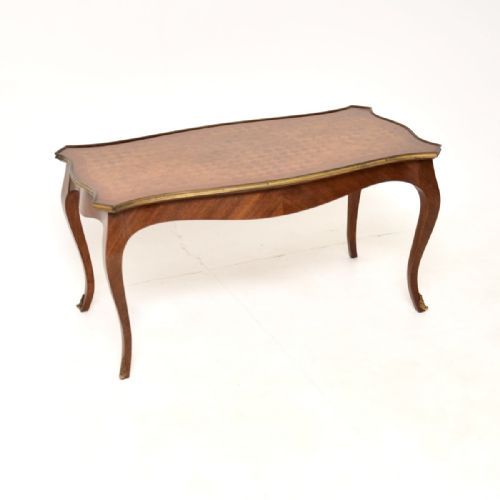
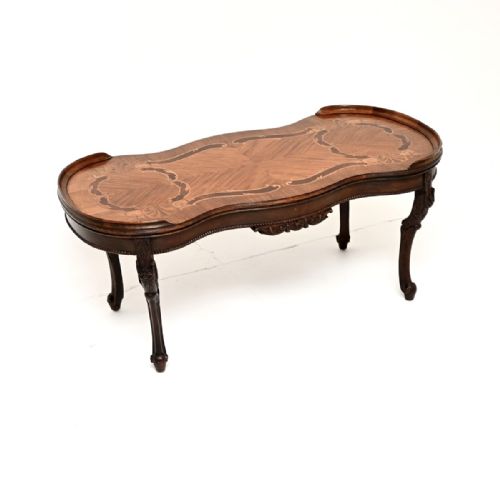
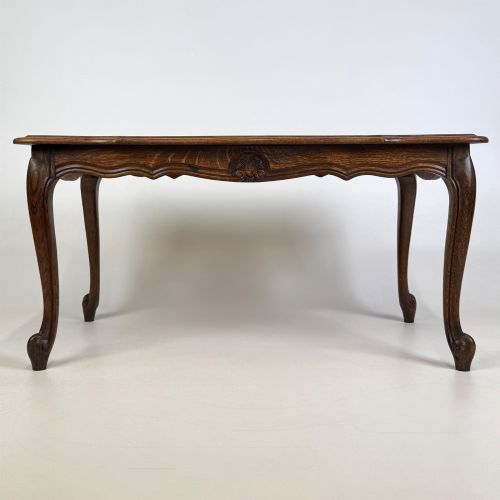
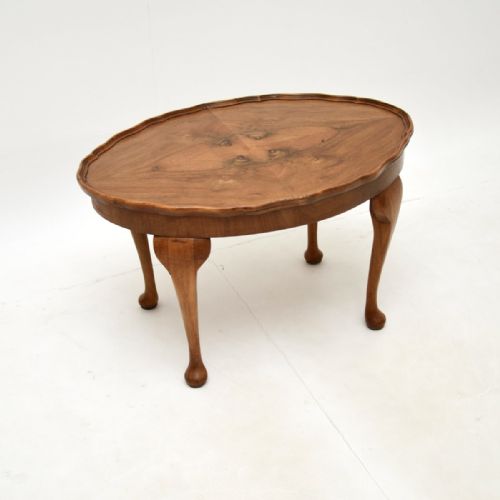
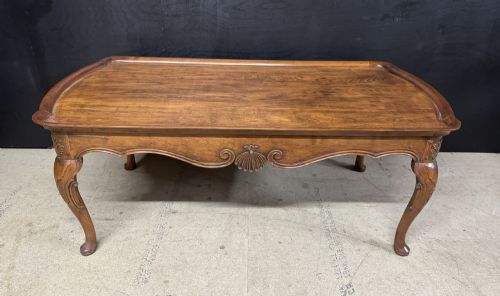


Cabriole Leg Cocktail Table
A cabriole leg cocktail table brings eighteenth-century grace into a modern room, offering low, curved support for evening drinks.
Cabriole Leg Cocktail Table
When searching for a cabriole leg cocktail table, buyers encounter low coffee and occasional tables primarily from the early twentieth century, including the 1920s and 1930s, alongside Victorian and Edwardian examples. These pieces adapt traditional furniture forms into low formats suited for entertaining.
The dominant aesthetic draws heavily on Queen Anne Revival, Louis XV Style, and Rococo Revival influences, often taking the shape of coffee tables with characteristic curved supports. Walnut, burr walnut, and various veneers define the bulk of the selection.
Makers and designers of the period also produced variations featuring black lacquer, chinoiserie decoration, and marquetry tops. Occasional tables and metamorphic drinks tables expand the category beyond standard rectangular or circular coffee tables.
Materials and construction methods
Makers utilised solid woods and applied veneers, with burr walnut and figured walnut appearing frequently across the surface of table tops. Walnut veneer provides intricate grain patterns, while oak and mahogany serve in supporting roles.
Decorative techniques include intricate marquetry and parquetry inlay, brass accents, and glass inserts. Black lacquer and gilt finishes appear on specific regional interpretations, such as chinoiserie pieces.
Among the standard coffee tables sits a metamorphic surprise drinks table, hiding its primary function until summoned.
Distinguishing quality in walnut and lacquer
The selection of timber grain defines the visual appeal at the upper end of the range, particularly with figured and burr walnut veneers. Consistency in grain matching across the table top indicates careful workshop execution.
Carving depth and precision on the knees and feet of the cabriole supports separate standard production from finer cabinet work. Surface finishes, whether French polish or gloss lacquer, reflect the original skill applied to the piece.
Whytock and Reid
The Cabriole Leg Cocktail Table Glossary
- Cabriole leg
- A furniture leg that bends outward in a convex curve at the top and inward in a concave curve at the bottom, terminating in a foot. This form derives from classical antiquity and became prominent in seventeenth and eighteenth-century furniture.
- Burr walnut
- A veneer sliced from walnut tree growths or burls, producing swirling, highly figured grain patterns. Cabinet makers prized this wood for decorative table tops.
- Marquetry
- The art of applying pieces of veneer to a structure to form decorative patterns or pictures. Craftsmen used various coloured woods to achieve pictorial designs on table surfaces.
- Chinoiserie
- European decorative art imitating Chinese and East Asian artistic traditions. Pieces often feature black lacquer and gilt decoration depicting figures or landscapes.
Cabriole Leg Cocktail Table: Frequently Asked Questions
What is a cabriole leg cocktail table?
A low table supported by curved cabriole legs, designed to hold drinks and accessories in a sitting room. Most examples date from the early twentieth century, drawing on earlier revival styles.
These pieces combine traditional woodworking techniques with the lower proportions required for modern entertaining.
How do I date a walnut coffee table?
Dating relies on timber selection, construction methods, and stylistic revival cues. Pieces from the 1920s and 1930s frequently employ burr walnut veneers on low frames.
Earlier Victorian and Edwardian examples often display heavier proportions or distinct interior framing methods compared to interwar production.
What styles are common in these tables?
Queen Anne Revival and Louis XV Style dominate the selection, featuring characteristic double-curved legs and shaped tops. French Rococo and chinoiserie finishes also appear.
These revival designs borrow heavily from eighteenth-century decorative vocabularies applied to low occasional formats.
How do I care for a veneered surface?
Polished walnut and lacquered surfaces require protection from moisture, heat, and direct sunlight. Regular dusting with a soft cloth maintains the finish without harsh chemical cleaners.
Avoiding abrasive materials preserves the delicate marquetry and grain patterns found on finer table tops.