

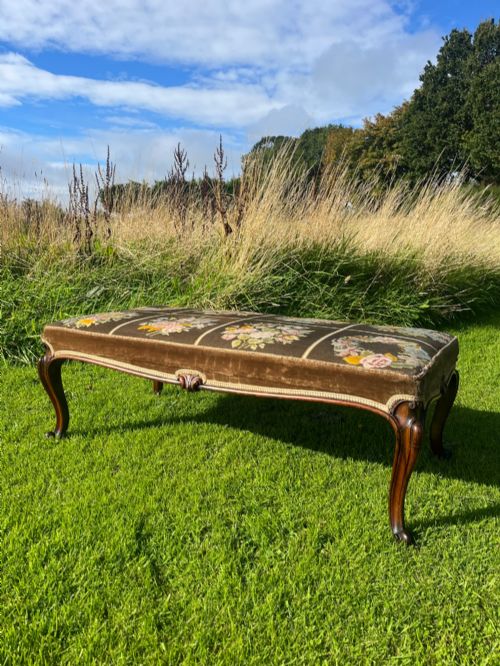



Brown Velvet Footstool
A brown velvet footstool brings rich texture and practical comfort to a room, offering a tactile piece of seating history.
Brown Velvet Footstool
When you search for a brown velvet footstool, you are looking at nineteenth-century and Victorian seating designed for resting feet or low sitting in parlours and drawing rooms. The pieces recorded here span various timber frames and upholstery types, reflecting the domestic habits of the 1850s to the turn of the twentieth century.
The version you are most likely to meet on this page is a Victorian walnut or mahogany framed stool, upholstered in soft fabric or velvet, sometimes featuring needlepoint or tapestry details. Forms range from large centre stools and salon seating to piano stools and dressing stools.
Originating largely from British workshops of the nineteenth century, these footstools combine robust hardwood structures with plush top surfaces. They serve equally as functional footrests and decorative interior accents in traditional or eclectic settings.
How they were made
The foundational frames of these stools utilise dense hardwoods such as mahogany, walnut, and rosewood, shaped into cabriole legs or Scottish Baronial forms. Cabinetmakers constructed these supports to bear weight firmly while displaying the natural grain and rich tone of the timber.
Upholstery techniques combined sturdy internal webbing and stuffing with tactile surface textiles like velvet, tapestry, and needlepoint. These materials were secured to the wooden frames with careful hand-tacking to create a resilient, cushioned top.
Brown Velvet Footstool Retail Price Guide 2026
Typical asking prices for brown velvet footstool among the pieces listed under this phrase on Sellingantiques today, from the lower quarter to the upper quarter. They describe what is for sale here now, not the wider market.
Listings feature nineteenth-century furniture incorporating velvet, tapestry, needlepoint, mahogany, walnut, and rosewood across various stool forms.
What varies in quality
The distinction between standard and superior pieces rests on the depth of timber carving and the sophistication of the frame silhouette. Refined cabriole legs and substantial rosewood or walnut structures show greater artisan investment than plain mahogany rails.
Upholstery choice and preservation also define the upper tier, where original or period-appropriate velvet, tapestry, and needlepoint retain their tactile richness and secure fitting. The harmony between the timber frame and the textile cover dictates the overall visual balance.
James Shoolbred
The Brown Velvet Footstool Glossary
- Cabriole leg
- A furniture leg that curves outward and then tapers inward, inspired by animal limbs. This form is common on eighteenth-century revivals and nineteenth-century seating.
- Scottish Baronial
- A nineteenth-century architectural and decorative style drawing on historic Scottish castles. Stools in this style often display heavier proportions and distinct regional detailing.
- Needlepoint
- A type of canvas work embroidery used for upholstery. It provides durable, patterned surface decoration on period footstools.
- Centre stool
- A large, freestanding piece designed to sit in the middle of a room rather than against a wall. These items often feature substantial rosewood or mahogany frames.
- Ottoman
- A low, upholstered seat or footstool without a back or arms. Nineteenth-century examples frequently doubled as dressing or salon seating.
Brown Velvet Footstool: Frequently Asked Questions
What is a Victorian salon stool?
A Victorian salon stool is a low, upholstered seat designed for formal entertaining rooms during the nineteenth century. These pieces typically feature polished walnut or mahogany frames and soft velvet or tapestry covers.
They were placed around reception spaces to provide flexible, comfortable seating for guests. Their compact size allowed them to be moved easily across carpeted floors.
How do I identify a piano stool?
A piano stool is a specialised seat created for musicians, often featuring a circular or adjustable top. Nineteenth-century versions commonly used mahogany or walnut structures with upholstered velvet surfaces.
They were built to withstand regular movement and adjustment during keyboard practice. Their distinct proportions set them apart from standard footstools.
Where were these stools used?
These pieces were placed in drawing rooms, dressing rooms, and parlours across British homes. They served as footrests before armchairs or as standalone low seats.
Their decorative timber frames and tactile velvet covers allowed them to complement formal interior schemes. They added both utility and comfort to domestic spaces.
How do I care for velvet upholstery?
Velvet upholstery requires gentle brushing and protection from direct sunlight to maintain its pile and rich colour. Regular light dusting prevents particulate matter from settling into the fabric fibres.
Harsh cleaners should be avoided to preserve the integrity of nineteenth-century textiles. Professional conservation methods are best for older or delicate coverings.