



Brown Patinated Bronze Vase
A brown patinated bronze vase brings weighty presence to a room, offering rich tactile depth through centuries of metalwork traditions.
Brown Patinated Bronze Vase
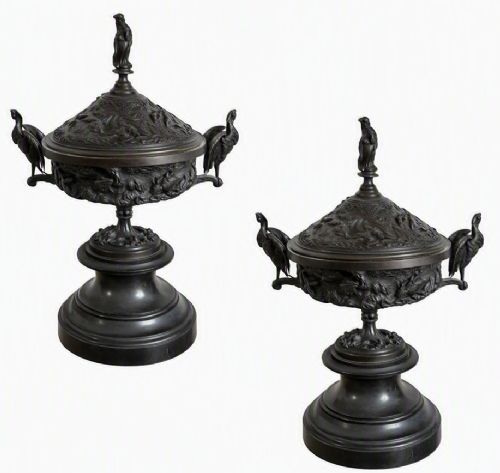
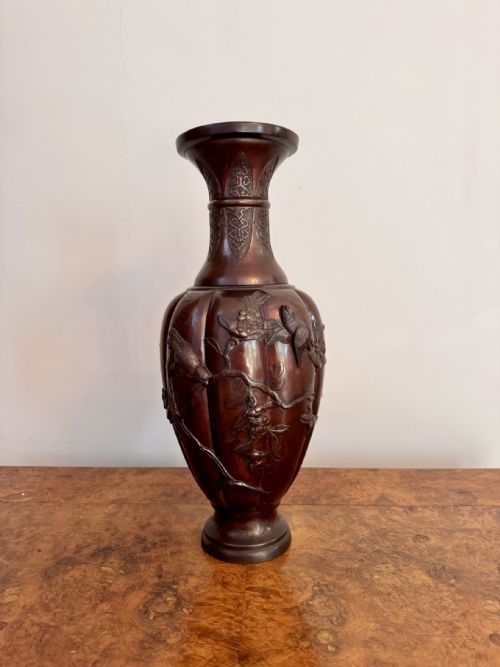
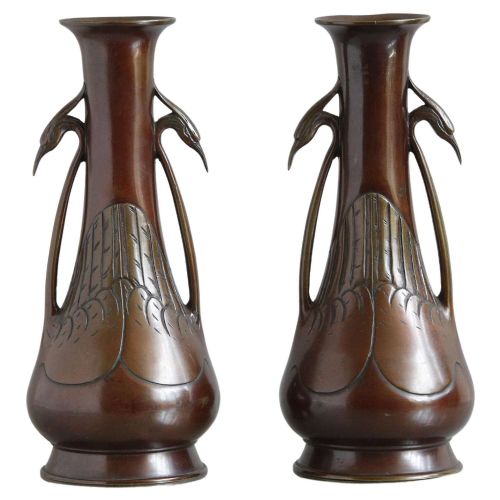
A brown patinated bronze vase encompasses a rich variety of forms, from Japanese Meiji period vessels and Chinese altar vases to French neoclassical campana urns. You will frequently encounter Japanese bronze vases featuring egret handles or botanical motifs, alongside pairs of nineteenth-century French decorative urns and cassolettes.
The selection ranges across several distinct eras, spanning Regency classicism, Victorian production, and Art Nouveau figural design. The most common manifestations on this page are nineteenth-century Japanese pieces and European campana-shaped urns finished with dark patination.
Materials and Techniques
These vessels rely fundamentally on cast bronze and metal alloys, occasionally accompanied by alternative cast metals such as spelter. Artisans utilised sophisticated casting methods to achieve hollow vessels with intricate handles, stepped plinth bases, and relief decoration.
The characteristic surface colour derives from chemical treatments applied to the metal. This patination creates deep brown tones that accentuate the underlying cast details and provide protection against oxidation.
Materials documented across the available pieces include cast bronze, gilded bronze, patinated bronze, and spelter.
Distinctions in Quality
Quality rests in the crispness of the casting and the sensitivity of the finishing work. Superior examples display sharply rendered motifs, balanced proportions, and substantial weight rather than hollow lightness.
The integrity of the surface patination significantly influences the character of the piece. Masterful patination reveals subtle tonal variations across the bronze, whereas inferior examples present a flat, uniform appearance.
Jules Moigniez·Charles Korschann
The Brown Patinated Bronze Vase Glossary
- Patination
- The process by which chemical treatments or natural ageing alter the surface colour of metal. In these pieces, controlled patination yields rich brown hues.
- Campana
- A classical bell shape associated with ancient pottery and adapted for metal urns and vases. These vessels typically feature a flared rim and a tapering body.
- Cassolette
- A decorative vessel shaped like an urn, often equipped with a reversible lid that functions as a burner or a shallow bowl. They appear frequently in Regency period metalwork.
- Gu
- An ancient Chinese ritual bronze vessel form featuring a slender central section widening towards a trumpet-shaped mouth and a flared base.
- Spelter
- A zinc alloy commonly utilised as a substitute for bronze in decorative figures and campana urns during the nineteenth century.
Brown Patinated Bronze Vase: Frequently Asked Questions
How do I care for bronze?
Dust the surface regularly with a soft, dry cloth to prevent accumulation. Avoid abrasive cleaners or liquids that might strip the historic brown patination.
Keep the metal away from direct moisture and fluctuating heat sources. Occasional application of specialist micro-crystalline wax helps protect the finish.
What is a campana vase?
A campana vase takes its inspiration from classical antiquity, featuring a distinct bell profile with an outward-curving rim. This form was especially popular during the Regency and Victorian eras for decorative garnitures.
The shape lends itself well to heavy bronze casting, often incorporating classical handles or mounted plinth bases.
How do I identify a Meiji period vase?
Meiji period Japanese bronze vases often display naturalistic motifs such as birds, egrets, or floral arrangements. Many pieces from this era exhibit skilled patination techniques and occasional artist signatures.
The production spans the late nineteenth and early twentieth centuries, reflecting Japan's flourishing metalwork export trade during that time.
Are spelter and bronze different?
Spelter is a softer, zinc-based alloy that was frequently used as an accessible alternative to bronze for decorative urns and figures. It tends to be lighter in weight than true bronze.
Bronze offers greater durability and a finer grain for intricate casting details. Close inspection of the base and weight usually reveals the distinction between the two metals.