



Brown Paper Marine Art
Brown paper marine art captures coastal life and harbour scenes with the direct, immediate touch of nineteenth and early twentieth century watercolourists.
Brown Paper Marine Art
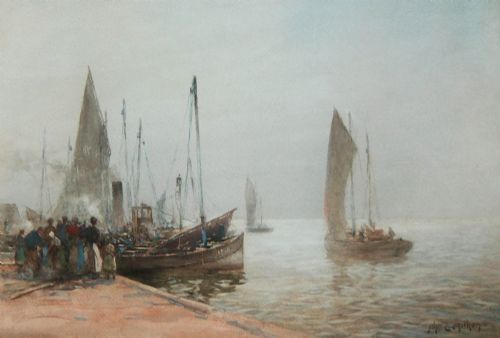
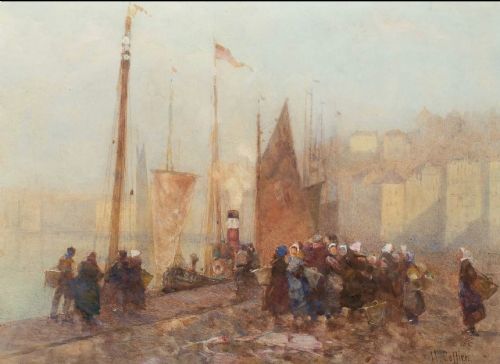
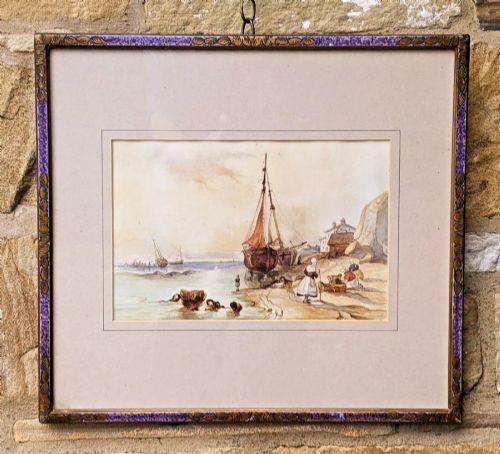
When you search for brown paper marine art, you encounter works on paper executed in watercolour pigment, depicting coastal views, fishing boats, and harbour life from the nineteenth century into the nineteen-thirties.
The selections here centre on British and European maritime subjects, ranging from quiet coastal landscapes to bustling scenes of fishermen at work in locations such as Whitby, Brighton, and continental ports.
These pieces arrive in various formats including framed waterpaintings and wall art, reflecting the styles of Victorian, Edwardian, and British Impressionist marine art.
How they were made
These works rely primarily on watercolour pigment applied to paper support, sometimes enhanced with wood framing and glass protection.
Artists utilised fluid washes and fine brushwork to capture atmospheric effects on the water, working directly on the sheet to record immediate coastal observations.
Listings feature works executed on paper using watercolour pigment, spanning the nineteenth century, Victorian, Edwardian, and nineteen-thirty periods.
What varies in quality
Quality rests in the handling of light and water, where skilled brushwork conveys the movement of the sea and the atmosphere of the harbour.
The strength of the composition and the definition of the architectural or maritime details distinguish the more accomplished works from simpler sketches.
James Orrock·James E. Aitken·Hector Caffieri·Alfred George Morgan·Thomas Bush Hardy·Tom Clough·Frederick William Booty·R.P. Noble·William Wyld·George Hamilton Constantine·Percy Brooke·Julian Drummond·Frank W. Scarborough·Lieutenant Harold E Frecker RNR·Walter Sweet·William Collins RA·Rowland Henry Hill·Henry Valter
The Brown Paper Marine Art Glossary
- Watercolour
- A painting method where water-soluble pigments are suspended in a water-based solution, traditionally applied to paper.
- Impressionism
- A style of painting emphasising a spontaneous capture of light and atmosphere rather than minute detail.
- Seascape
- A work of art depicting the sea, coastal views, shipping, or maritime activity.
- Provenance
- The documented history of ownership surrounding a work of art, establishing its authenticity and background.
Brown Paper Marine Art: Frequently Asked Questions
What subjects do these marine paintings show?
The works depict coastal scenes, fishing boats, harbours, and tidal estuaries. Many capture specific locations along the British coastline and European ports.
Common subjects include daily maritime labour such as hauling seaweed carts, landing the catch, and vessels moored in historic docks.
How should I frame and display these watercolours?
Watercolours require careful framing behind glass with acid-free mounts to protect the paper and pigments from environmental damage. Direct sunlight causes fading, so position them away from bright windows.
Display them in rooms with stable humidity levels to preserve the integrity of both the paper support and the wooden frame.
Which periods are represented in these marine artworks?
The selection spans the nineteenth century, the Victorian and Edwardian eras, up to the nineteen-thirties. This period covers shifts from traditional British marine painting towards impressionistic approaches.
Earlier nineteenth-century works often focus on topographical accuracy, while later nineteen-thirties pieces lean into atmospheric brushwork.
How do I identify a Victorian marine watercolour?
Victorian marine pieces typically combine traditional watercolour techniques with precise draughtsmanship, often focusing on shipping lanes, coastal fortifications, and working vessels. Signatures, framing materials, and paper stamps offer clues to the period.
Stylistic elements mirror the maritime expansion and coastal interest characteristic of nineteenth-century British art.