

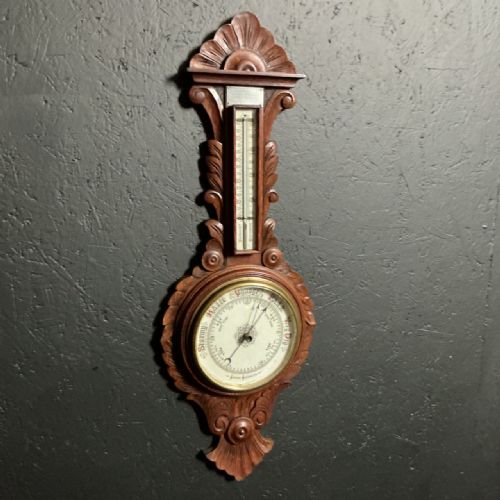
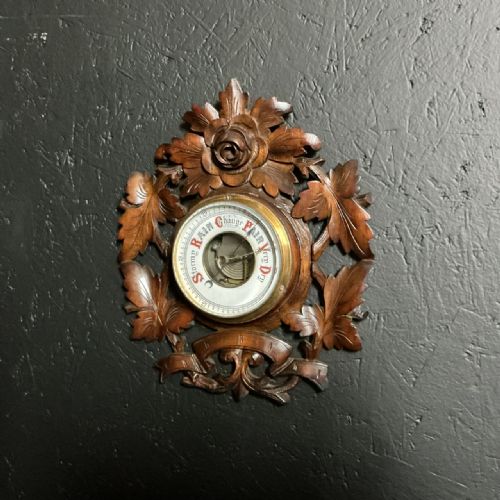


Brown Carved Barometer
These brown carved barometers measure atmospheric pressure while bringing rich timber texture and intricate woodwork into a room.
Brown Carved Barometer
A brown carved barometer combines domestic meteorology with decorative woodwork, serving as both a functional scientific instrument and a wall hanging. These pieces range from compact banjo shapes to large floor-standing marine variants, housing dials and mercury columns within timber frames.
The versions most commonly met on this page date from the Victorian and Edwardian eras, executed in dark hardwoods with relief carving. They frequently incorporate thermometers or combined clock and barometer faces alongside the main weather dial.
Origins span British workshops, Black Forest carvers, and Dutch makers, utilising regional timber varieties to achieve distinct domestic aesthetics.
Materials and construction methods
Cabinetmakers utilised dense timbers including oak, mahogany, walnut, beech and burr walnut, selecting them for stability and deep grain patterns. These woods were shaped using hand chisels and gouges to produce foliate, geometric, or figural relief carvings across the case.
Glass protects the delicate paper or bone dial faces and mercury tubes, while brass bezels and fittings secure the instrumentation within the timber housings.
Brown Carved Barometer Retail Price Guide 2026
Typical asking prices for brown carved barometer among the pieces listed under this phrase on Sellingantiques today, from the lower quarter to the upper quarter. They describe what is for sale here now, not the wider market.
Listings feature Victorian, Edwardian, and 19th-century periods, constructed from oak, walnut, mahogany, and beech.
Distinguishing quality in carving and movement
Quality rests in the crispness and depth of the timber carving, where undercut foliage and detailed figures separate superior workshop output from plain commercial production. The choice of figured veneers, such as burr walnut or richly grained oak, further elevates the piece.
The inclusion of signed scientific movements by notable instrument makers adds substance to the physical construction, distinguishing standard domestic items from precision engineering.
Negretti & Zambra·Maple & Co·J Hicks of London·S. P. Cohen
The Brown Carved Barometer Glossary
- Aneroid barometer
- An instrument that measures air pressure using a flexible metal box without liquid. It relies on internal vacuum chambers connected to a mechanical needle indicator.
- Stick barometer
- A tall, vertical instrument containing a mercury-filled glass tube. It displays atmospheric pressure directly through the height of the mercury column.
- Banjo barometer
- A domestic weather glass housed within a distinctive rounded and tapered wooden frame resembling a banjo. These typically feature a hygrometer, thermometer, and main dial.
- Admiral Fitzroy barometer
- A storm glass and barometer combination designed to interpret impending weather changes. These feature detailed printed instructions on paper scales mounted within glazed wooden cases.
- Black Forest style
- A carving tradition originating in central Europe characterised by naturalistic foliage, animals, and deep relief work. Pieces in this style utilise walnut and other local timbers.
Brown Carved Barometer: Frequently Asked Questions
How do I read an aneroid barometer?
Read the main dial by observing the position of the pointer relative to weather descriptions like rain, change, or fair. Tapping the glass gently helps settle the mechanism to show the true current reading.
Compare this primary needle with the secondary hand if present, which you set manually to track pressure movement over the course of a day.
Where should I hang a wall barometer?
Hang your barometer on an interior wall away from direct sunlight, radiators, and draughty doors. Stable temperatures ensure the internal metal components or mercury columns respond accurately to atmospheric shifts rather than room heat.
Ensure the wall fixing is secure enough to support the weight of dense hardwood cases, particularly larger Victorian and Edwardian examples.
How do I date a carved wooden barometer?
Examine the timber species, the style of the case carving, and the typography on the paper or metal dial face. Victorian and Edwardian models often feature deep oak or walnut relief work, while Georgian pieces favour simpler mahogany veneers.
Maker signatures and patent inscriptions on the dial or scale plates also provide reliable manufacturing periods.
What is the difference between stick and wheel barometers?
Stick barometers display the mercury column vertically within a long wooden trunk, offering a direct and traditional method of measuring air pressure. They prioritise scientific readability over decorative case work.
Wheel barometers translate the movement of mercury or aneroid chambers into a circular dial face using a pulley system, housed inside shaped banjo or geometric wooden frames.