




Brown Canvas Coastal Art
Brown canvas coastal art brings together maritime views and marine landscapes rendered in oil on canvas across the nineteenth and twentieth centuries.
Brown Canvas Coastal Art
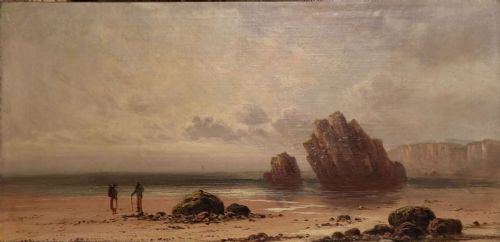
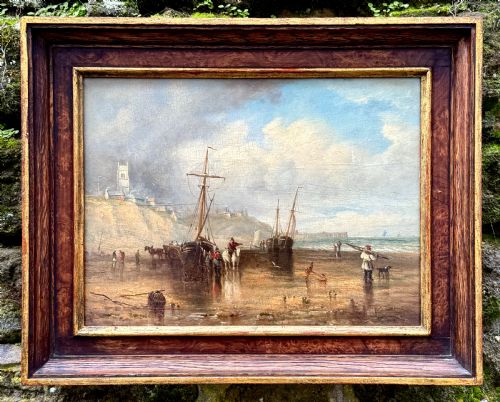
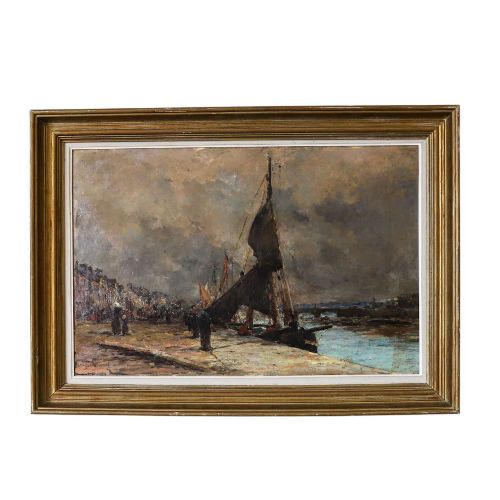
Brown canvas coastal art comprises oil paintings on canvas and board depicting harbours, rocky beaches, estuaries, and shipping scenes. These works capture maritime subjects ranging from Victorian marine art to British Impressionism and post-impressionist coastal views.
Buyers will encounter nineteenth-century canvases showing dramatic sea stacks and bustling harbours alongside twentieth-century depictions of fishing boats and coastal towns. The selection spans works from the Victorian era through to the mid-twentieth century.
The predominant forms are framed oil paintings executed on canvas or board, originating from British, French, Dutch, and Canadian schools. Subjects frequently focus on coastal figures, old barges, and tidal estuaries.
How they were made
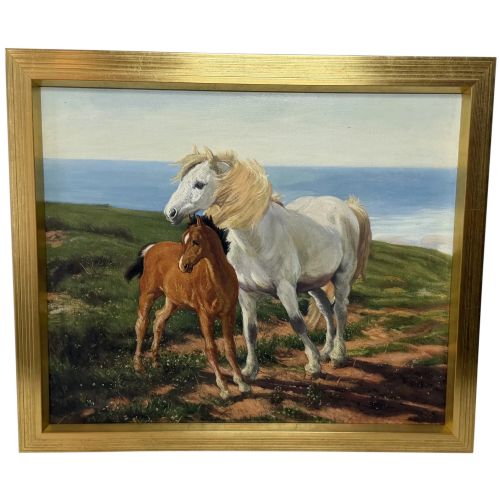
Artists painted primarily in oil paint upon prepared canvas and occasionally board, applying pigment to capture the light and movement of the sea. Many works are housed in period gilt frames that complement the maritime compositions.
Techniques range from nineteenth-century realism to impressionist brushwork and textured impasto applied to estuary scenes. The physical support relies on woven canvas stretched over wooden frames or laid onto panels.
The listings feature oil paintings on canvas and board spanning the 1800s to the 1960s, focusing on coastal and maritime subjects.
What varies in quality
Quality separates through the dexterity of brushwork and the artist's command of atmospheric light over water and sky. Finer canvases demonstrate a sure handling of marine architecture, shipping rigging, and coastal topography.
The sophistication of the palette and the preservation of the original pigment surface distinguish superior examples from standard decorative works. Period framing also contributes to the integrity of the piece.
Kenneth Cozens·B. Nash·Thomas Creswick·Gustave De Bréanski·Herbert Royle·T.S. Wallis·Owen Bowen·George Henry Knight·Sir David Murray·John Callow·William Shayer·Edward M. Elliott·Ernst Louizor·William Greaves·Ludwig Hermann·Johan Jens Neumann·Alec Caruthers Gould
The Brown Canvas Coastal Art Glossary
- Canvas
- A heavy woven fabric used as a surface for oil painting. It provides the foundational texture visible beneath many maritime works.
- Impasto
- Paint applied thickly to a canvas so that the brush or palette knife marks remain prominent. This technique creates a textured surface often seen in estuary and coastal scenes.
- Marine Art
- Artwork that depicts or draws its main inspiration from the sea. This category encompasses ships, coastal views, and harbour scenes.
- Gilt Frame
- A wooden frame finished with gold leaf or metallic paint. These frames surround many nineteenth-century oil paintings.
- Estuary
- The tidal mouth of a large river, where the tide meets the stream. These areas provided frequent subject matter for marine painters.
Brown Canvas Coastal Art: Frequently Asked Questions
What periods do these coastal paintings cover?
The works span from the early nineteenth century through the Victorian period and into the mid-twentieth century.
Most examples date from the Victorian era up to the 1950s and 1960s, reflecting various movements including impressionism and realism.
How should I care for an oil painting on canvas?
Keep the canvas away from direct sunlight and dramatic fluctuations in temperature or humidity.
Dust the surface gently with a soft, dry brush and avoid using liquids or chemical cleaners on the paint or gilt frame.
Are these paintings supplied with frames?
Many listings include period gilt frames that complement the nineteenth or twentieth-century oil paintings.
Certain works on canvas or board are sold unframed, so check individual descriptions for framing details.
Where did these marine artists paint?
The artists recorded coastal scenes across British shores, including Yorkshire, Scarborough, and Cornwall, as well as continental European ports.
Subjects also extend to Canadian coastal views and French fishing ports.