



Bronze Console Tables
These bronze console tables bring French refinement to a room, offering surface space and ornamental mounts.
Bronze Console Tables
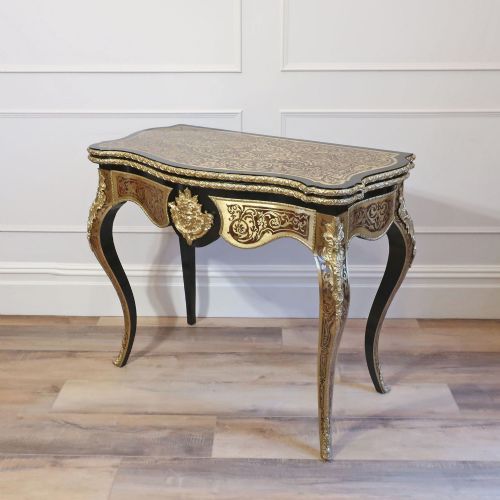
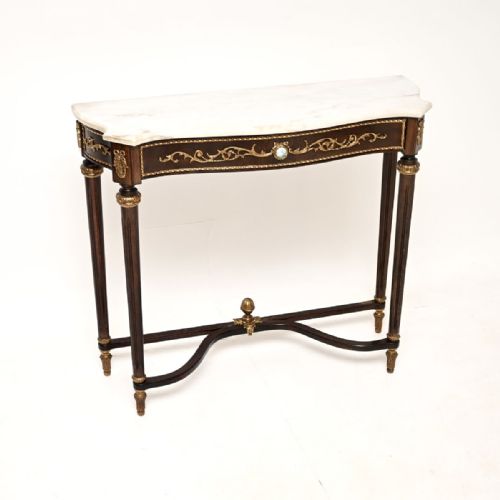
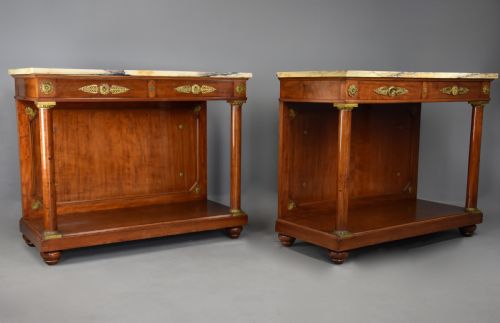
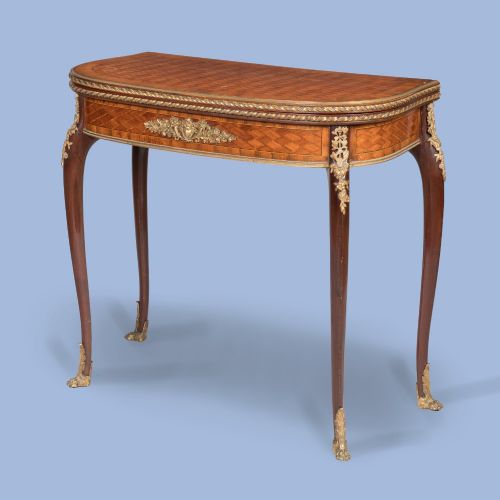
When you search for bronze console tables, you are looking at substantial pieces of furniture designed to stand against a wall, frequently paired with matching side or centre tables. The examples found here date principally from the nineteenth century, reflecting periods such as the Victorian era, the Restauration, and the early twentieth century.
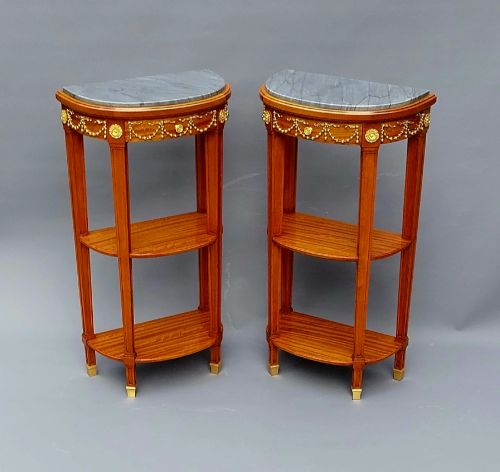
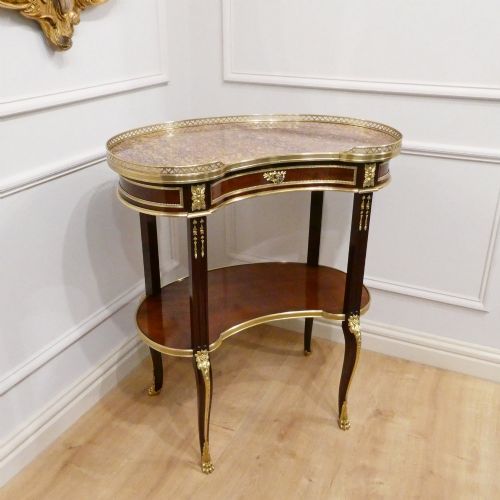
The form is overwhelmingly French in origin, appearing in demilune shapes or rectangular formats. Makers drew heavily on historical revivals, producing pieces in the Louis XV, Louis XVI, and French Empire styles.
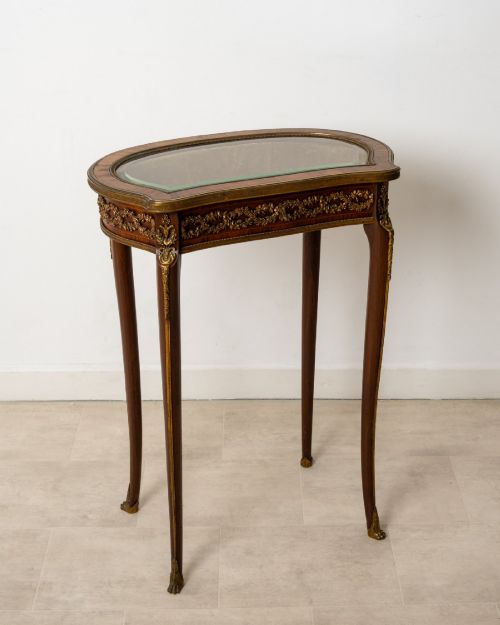
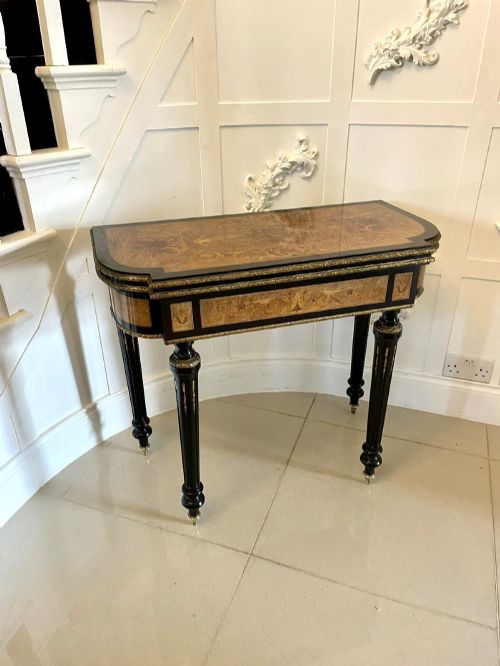
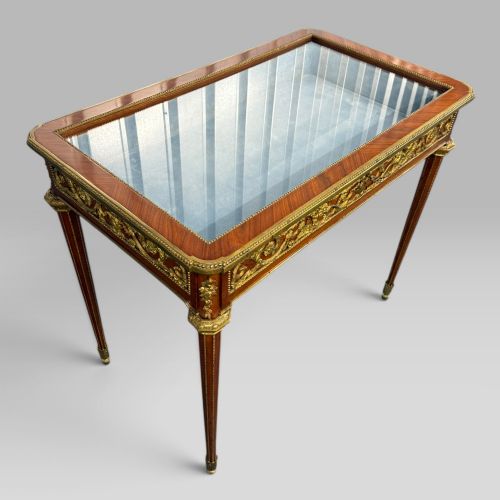
Alongside standard console tables, the selection includes related formats such as card tables, games tables, and vitrine display pieces. These share the characteristic use of decorative metal mounts and rich timber carcases.
How they were made
Makers constructed the carcases from dense timbers including mahogany, walnut, kingwood, and rosewood, often applying intricate parquetry, marquetry, or tulipwood veneers in geometric and floral patterns. Many surfaces feature elaborate brass and tortoiseshell Boulle inlay or black lacquer work.
Gilt bronze and ormolu mounts were cast and chased by hand, then fixed to corners, aprons, and legs to accentuate the architectural lines of the furniture. Marble tops, frequently in white or veined varieties, were shaped to fit the demilune or rectangular frames precisely.
Structural elements incorporated folding mechanisms for card and games tables, as well as glazed panels for display cabinets and vitrines. Cabinetmakers utilised stamps and signatures on mounts and timber to record their workshops.
Bronze Console Tables Retail Price Guide 2026
Typical asking prices for bronze console tables among the pieces listed under this phrase on Sellingantiques today, from the lower quarter to the upper quarter. They describe what is for sale here now, not the wider market.
Listings feature nineteen-century pieces spanning the Victorian era, French Empire, and Louis XVI revival styles.
What varies in quality
The standard of the gilt bronze or ormolu mounts dictates much of the visual success of a piece. Finer examples display crisp chasing and deep fire-gilding, whereas lesser work appears soft and uniform.
Timber selection and veneer execution separate master workshops from provincial production. Precision in cutting parquetry and marquetry determines whether geometric and floral motifs remain sharp over decades of use.
Maison Millet·François Linke·Krieger Paris·Maison Mottheau·Joseph-Emmanuel Zwiener
The Bronze Console Tables Glossary
- Ormolu
- Gilded bronze applied as a decorative mount to furniture. The technique involves coating metal in a mercury and gold amalgam before heating.
- Marquetry
- The art of applying pieces of veneer to a structure to form decorative patterns and pictures. Craftsmen used various coloured woods to achieve tonal depth.
- Boulle
- A style of marquetry using brass and tortoiseshell inlaid in counter-form. It is named after André-Charles Boulle, cabinetmaker to Louis XIV.
- Demilune
- A half-moon shape characteristic of console and side tables designed to sit flush against a wall. The format suits smaller reception rooms and hallways.
- Parquetry
- Geometric wood inlay forming patterns such as cubes or chequers. It creates a stable decorative surface on tabletops.
Bronze Console Tables: Frequently Asked Questions
Where should I place a bronze console table?
These tables are traditionally designed to stand against a flat wall in a hallway, drawing room, or reception space. Their shallow depth allows them to occupy narrow walkways without obstructing movement.
They often support decorative objects, lamps, or mirrors mounted directly above. Freestanding variations like centre tables and games tables occupy the middle of a room.
How do I care for marble tops?
Marble surfaces require simple dusting and prompt cleaning of liquid spills to prevent staining. Acidic substances can etch the polished stone finish.
Apply neutral stone soap sparingly when deeper cleaning is necessary. Avoid abrasive pads that scratch the gloss.
What is the difference between a console and a side table?
Console tables are specifically engineered to stand against a wall, frequently featuring flat backs and decorated fronts. Side tables are often finished on all sides for versatile placement.
Many console designs incorporate demilune shapes tailored to wall perimeters. Side tables tend to be fully rectangular or circular.
How do I identify a revival style?
Revival pieces appropriate nineteenth-century aesthetics from earlier French royal reigns like Louis XV and Louis XVI. They utilise period motifs such as scrolling foliage and classical swags. Nineteeth-century makers adopted these historical vocabularies while employing contemporary construction methods.