


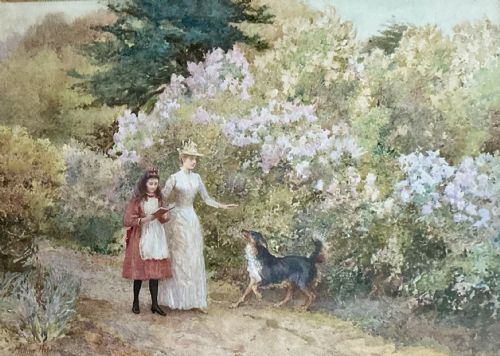


British Watercolour Floral
These british watercolour floral paintings capture garden scenes and still lifes on paper, offering delicate colour for domestic spaces.
British Watercolour Floral
When you search for british watercolour floral, you encounter works executed on paper spanning from the nineteenth century through the mid-twentieth century. The selection encompasses botanical studies, cottage gardens, and still lifes depicting cut flowers in jugs or baskets.
You are most likely to meet pieces from the Edwardian and Victorian periods, alongside early twentieth-century examples. Artists render subjects like wallflowers, anemones, and roses using pigmented washes on paper.
The format typically includes framed wall art, ranging from intimate flower studies to larger landscape views of country house gardens.
How they were made
These works utilise watercolour pigment and ink applied to paper surfaces, often framed behind glass within wooden surrounds. Artists build up translucent washes to achieve tonal depth in floral and garden subjects.
The support material consists primarily of paper, housed in traditional wooden frames that preserve the delicate pigments from atmospheric moisture.
Flowers immortalised on paper by artists a century ago continue to bloom permanently within their wooden frames.
What varies in quality
Quality rests upon the sensitivity of the brushwork and the vibrancy retained within the watercolour pigments over time. Superior examples demonstrate a confident handling of light and botanical detail rather than rigid botanical illustration.
The strength of the composition and the preservation of the paper support distinguish finer works from simpler decorative pieces.
James Tower·Arthur Hopkins·William Edward Fox·Theresa Stannard·Lester Sutcliffe·Lilian Stannard·Edith Barrow·Rowland Henry Hill·Phyllis I Hibbert·Jabez Bligh·Owen Bowen·David Woodlock·Alice Macallan Swan·Marion Broom·Edith Alice Andrews·Jane Utley·Beatrice Parsons·George Frederick Nicholls·Alfred Parsons·Amy Reeve-Fowkes·Helen Cordelia Angell·William Stephen Coleman·Minnie Smythe
The British Watercolour Floral Glossary
- Watercolour pigment
- The finely ground colour matter mixed with a binder, applied with water to paper surfaces. It produces translucent layers characteristic of these works.
- Still life
- An artwork depicting inanimate subject matter, frequently featuring cut flowers in jugs, bowls, or vases.
- Edwardian
- A stylistic period spanning the early twentieth century, noted here in garden and floral watercolours.
- Framed artwork
- A piece enclosed in a wooden structure with glass to protect the fragile paper surface from damage.
British Watercolour Floral: Frequently Asked Questions
What periods do these watercolours cover?
The listings span from the nineteenth century through the 1950s, with a strong representation of Edwardian and early twentieth-century pieces.
Artists active during these decades produced both garden views and indoor still life studies.
How should I care for these paintings?
Keep works behind glass away from direct sunlight to prevent the watercolour pigments from fading over time.
Maintain stable indoor humidity levels to protect both the paper support and the wooden frames.
What subjects appear in these works?
Common subjects include walled gardens, cottage flower beds, and tabletop arrangements of seasonal blooms in jugs or vases.
Artists also depict specific flowers such as roses, anemones, wallflowers, and chrysanthemums.
Are these works original paintings?
The listings consist of original hand-painted watercolours executed directly on paper by individual artists.
Each piece represents a unique application of pigment rather than a mechanical reproduction.