




British Rural Genre Painting
British rural genre painting captures the quiet rhythms of the countryside through oil and watercolour, bringing Victorian domestic and agricultural life straight to your walls.
British Rural Genre Painting
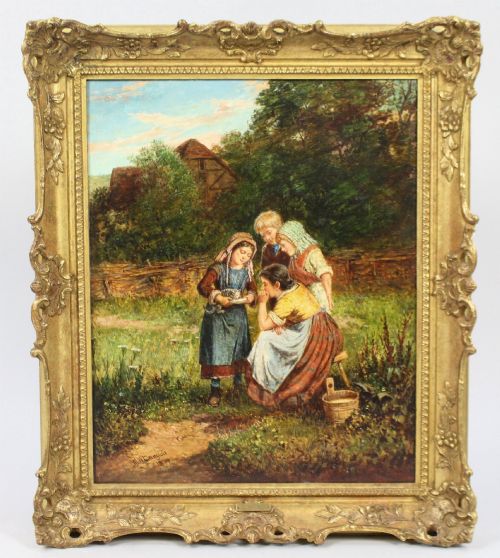
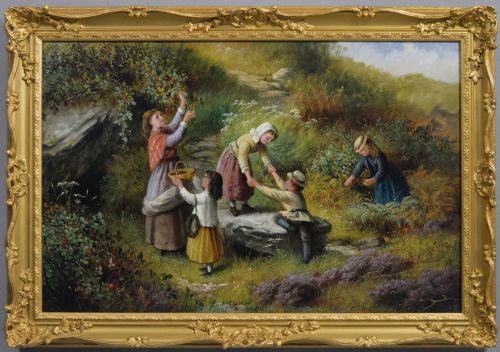
When you search for british rural genre painting, you encounter framed works depicting everyday country scenes, farmworkers, and cottage life from the nineteenth and early twentieth centuries. The pieces on this page span the Victorian and Edwardian eras, capturing children at play, women beside streams, and heavy horses in the field.
Most examples take the form of an oil painting on canvas or a detailed watercolour on paper, often housed in traditional gilt wood or gesso frames. The subjects focus closely on pastoral existence, rural labour, and domestic moments set against traditional British landscapes.
Materials and technique
Artists worked primarily with oil paint on canvas or watercolours on paper, building compositions that balance human figures with natural light and rural surroundings. Pigments were applied to capture the textures of farm clothing, cottage doorways, and open fields.
Finished works were typically mounted behind glass for watercolours or left unglazed for oils, then secured within wooden frames finished in gilt wood or gesso to complement the domestic interiors of the period.
Materials documented across the works include oil on canvas, watercolour on paper, gesso, and gilt wood.
Assessing quality and execution
Quality rests in the handling of light, the naturalism of human and animal figures, and the precision of the setting. Stronger works render the expressions and postures of children, farmworkers, and animals with convincing depth rather than stiff formula.
The choice of medium and the preservation of the canvas or paper surface also shape the work. Well-kept paint layers and untouched watercolours retain their original tonal balance and atmospheric detail.
Mark William Langlois·Henry John Yeend King·Ralph Hedley·Jane Maria Bowkett·George Kilburne·Vernon Stokes·Daniel Pasmore·Ernest Walbourn·Alfred Banner·Edward Killingworth Johnson·Arthur Claude Strachan·George Cole·William Stephen Coleman·James Ward·Frank Moss Bennett·Charles Edward Wilson·Thomas Mackay·Charles Hunt Jnr·John F. Pasmore
The British Rural Genre Painting Glossary
- Genre painting
- A branch of fine art depicting scenes from everyday life, ordinary people, and domestic or agricultural activities. It contrasts with historical or portrait painting by focusing on common experiences.
- Gesso
- A plaster-like mixture applied to wooden frames and moulded into decorative patterns before gilding. It provides a smooth base for gold leaf and ornamentation.
- Watercolour
- A paint consisting of pigment suspended in a water-based solution, typically applied to paper. It allows for transparent washes and delicate handling of light.
- Oil on canvas
- A traditional painting medium using pigments bound with drying oils, applied to stretched woven fabric. This method permits rich colour blending and textured brushwork.
British Rural Genre Painting: Frequently Asked Questions
What subjects appear in these paintings?
These works typically show country people engaged in daily tasks, children playing near cottages or ponds, and farmworkers with horses. Scenes range from quiet domestic moments on a doorstep to agricultural labour in open fields.
Animals also feature prominently, including heavy horses, geese, donkeys, and dogs accompanying figures through rural landscapes.
How do I hang a watercolour safely?
Watercolours require protection from direct sunlight to prevent the paper and pigments from fading over time. They should be hung on interior walls away from damp areas.
Ensure the frame is properly sealed and that the paper does not touch the glass directly to avoid moisture damage.
How do I date a Victorian painting?
Dating relies on the artist's active working years, stylistic markers, and occasionally signatures or inscriptions on the reverse of the canvas. Victorian and Edwardian works often reflect the clothing styles and agricultural practices of their decade.
Frame construction and framing materials can also provide supporting evidence for the period of the piece.