
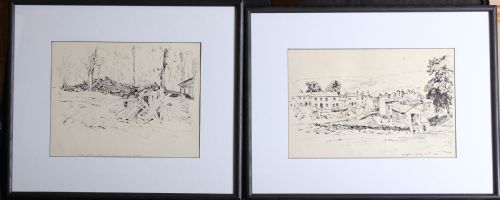


British Landscape Ink Drawing
These British landscape ink drawing works capture pastoral scenes and historic towns through delicate lines and washes.
British Landscape Ink Drawing
A British landscape ink drawing offers a direct encounter with historical countryside and town views rendered on paper through ink and wash techniques. These works range from early nineteenth-century pastoral studies to mid twentieth-century depictions of northern castles and villages.
Buyers frequently encounter works by artists such as Fred Lawson, whose depictions of Yorkshire locations dominate the available selection. Other notable pieces span the Georgian period, Norwich School, and early twentieth-century British art traditions.
The primary forms on this page include original watercolour drawings, framed sketches, and sepia ink landscapes. Each piece records topography and atmosphere with distinct graphic clarity.
How they were made
Artists created these works utilising ink, sepia ink, and watercolour on paper supports. Pencil underdrawings often established the composition before fluid ink lines and transparent washes defined the light and shadow.
Framed presentation typically involves traditional wood mouldings and protective glass covering the paper surface. These durable materials protect delicate pigments and ink lines from environmental exposure.
Fred Lawson walked extensively through Yorkshire with his sketchbooks, capturing everyday rural life before the advent of modern transport.
What varies in quality
Quality rests upon the sureness of the pen line and the balance achieved between ink definition and watercolour wash. Masterful works demonstrate confident mark-making that structures the landscape without relying entirely on heavy pigment.
Condition of the paper and the preservation of ink tones also differentiate examples. Works that retain crisp contrast and stable paper integrity present the artist's intended composition with greater visual impact.
Fred Lawson·Stanley Orchart·John Thirttle·Dr Thomas Monro
The British Landscape Ink Drawing Glossary
- Sepia ink
- A rich brown drawing ink traditionally prepared from the ink gland of the cuttlefish. It produces warm monochromatic tones favored in historical landscape studies.
- Wash
- A semi-transparent layer of diluted ink or watercolour applied across paper. This technique establishes atmospheric depth and tonal gradients within a drawing.
- Norwich School
- A regional movement of artists associated with Norfolk who painted local landscapes and architecture. John Thistle is a notable figure connected to this tradition.
- Georgian
- The historical period spanning the reigns of the four British monarchs named George from seventeen fourteen to eighteen thirty. Works from this era often reflect neoclassical or early romantic sensibilities.
- Watercolour drawing
- An artwork combining linear ink or pencil work with water-soluble pigments. The medium allows for rapid notation of natural light and topographical detail.
British Landscape Ink Drawing: Frequently Asked Questions
What is a British landscape ink drawing?
These works are original paper-based artworks utilising ink lines and washes to depict countryside and architectural scenes across various British periods.
They serve as direct visual records of historical topography created by artists working from the Georgian era through the twentieth century.
How should I display my drawing?
Protect the paper by keeping framed pieces away from direct sunlight and excessive humidity. UV-filtering glass helps preserve delicate ink and watercolour pigments over time.
Ensure the framing materials are acid-free to prevent degradation of the paper support in domestic environments.
How do I identify the period?
Examine the paper characteristics, framing style, and stylistic conventions associated with movements like the Norwich School or twentieth-century British art.
Signatures, dates inscribed on the paper, and documented artist biographies further clarify the historical context of each piece.
Where were these scenes typically set?
Many compositions focus on specific regional locations such as Yorkshire castles, Sussex market crosses, and Norfolk churches. Artists often drew local rural environments and familiar village landmarks.
These topographical choices reflect the historical practice of artists sketching directly from nature during their travels.