
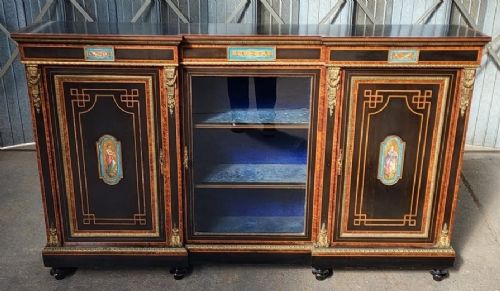
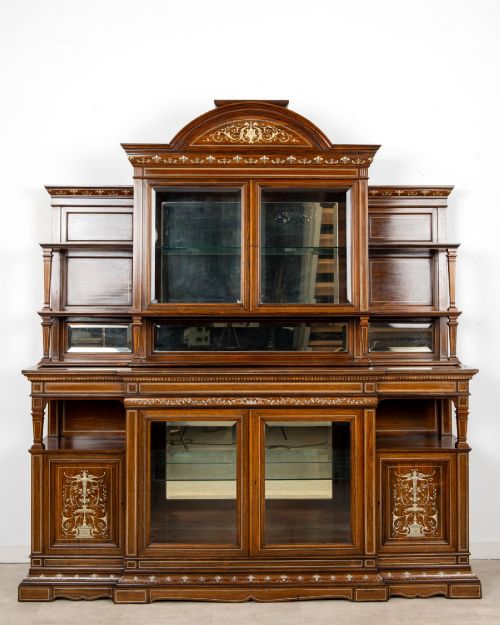
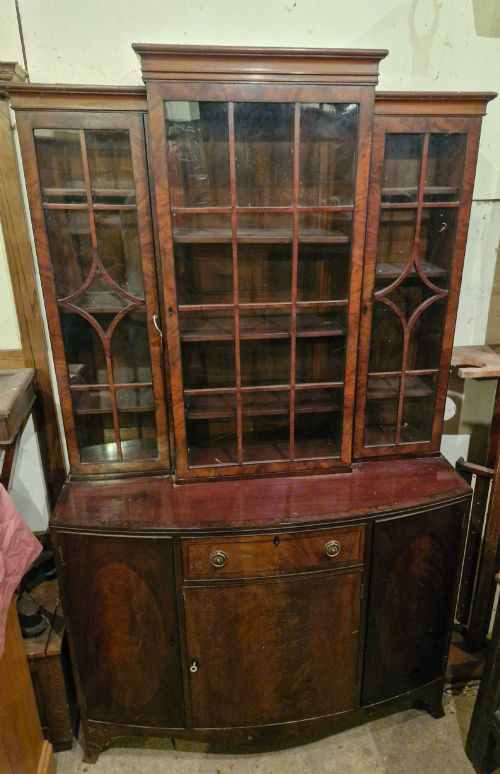
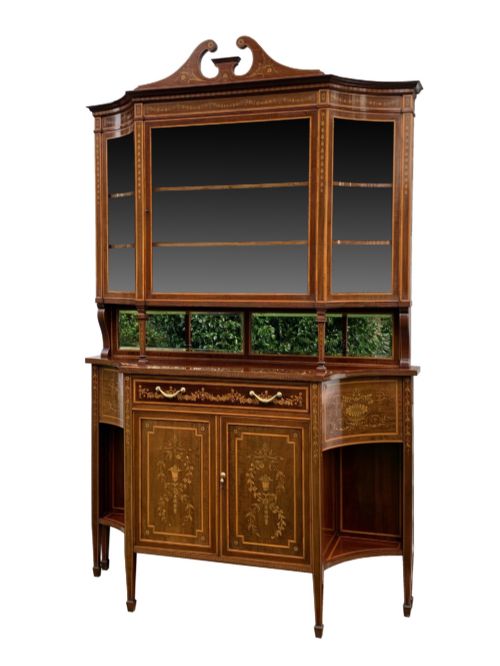
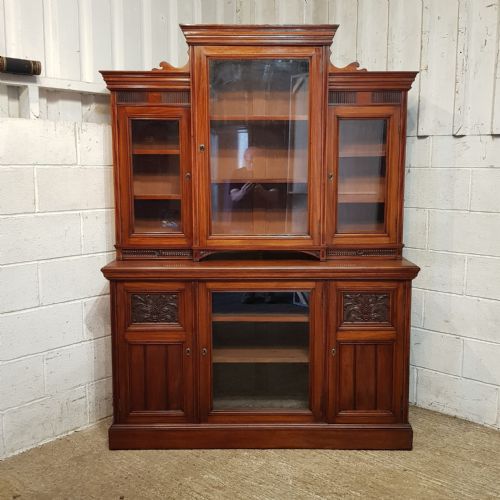
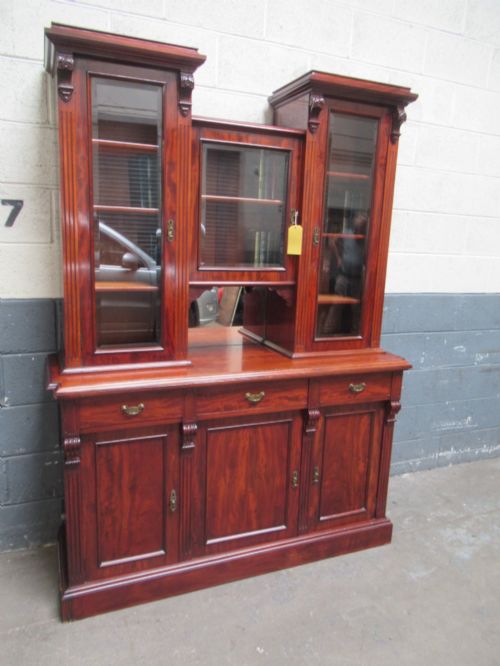
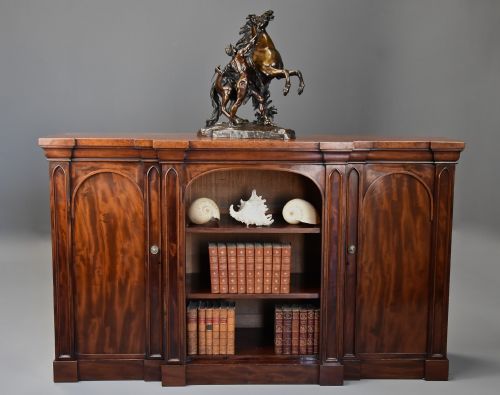


Breakfront Sideboard Bookcase
A breakfront sideboard bookcase marries the display capacity of a library piece with the architectural presence of a grand cabinet.

Breakfront Sideboard Bookcase
A breakfront sideboard bookcase is a substantial hybrid piece featuring a central section that projects forward from flanking wings, combining lower storage with upper display or shelving. You will most frequently meet these pieces in nineteenth-century manifestations, spanning Regency, Victorian, and Edwardian periods.
The form encompasses various functional combinations including glazed bookcases, display cabinets, and credenzas with varied door configurations. Makers utilised the breakfront profile to break up flat walls and introduce architectural depth into formal rooms.
Distinctions in Quality
Quality rests upon the selection of timber veneers and the crispness of applied ormolu mounts and hand-carved details. Superior examples display continuous grain matching across the projecting central section and recessed wings.
Maker attribution separates standard workshop output from exceptional commissions, where internal secondary timbers, lock mechanisms, and brasswork exhibit superior precision.
Listings feature mahogany, rosewood, and burr walnut as primary timbers, spanning the Regency to Edwardian eras.
Collinson & Lock·Edwards & Roberts·Gillows·Maple & Co.·Lamb of Manchester
The Breakfront Sideboard Bookcase Glossary
- Breakfront
- An architectural furniture facade where the central section projects forward beyond the flanking sections.
- Ormolu
- Gilded bronze mounts applied to furniture for decorative accent during the Regency and Victorian periods.
- Marquetry
- Decorative patterns formed by the insertion of various woods and other materials into a veneer surface.
- Chiffonier
- A low cabinet or sideboard, frequently fitted with doors enclosing shelves, popular in Regency and Victorian interiors.
- Cross-banding
- A border strip of veneer laid perpendicular to the grain of the main surface panel.
Breakfront Sideboard Bookcase: Frequently Asked Questions
Where does a breakfront sideboard bookcase work best?
These pieces suit principal reception rooms, libraries, or large dining spaces where substantial wall space accommodates their architectural scale and depth.
Their combined display and storage capacity allows them to anchor a room while housing substantial book collections or display objects.
How do I distinguish Regency from Victorian examples?
Regency pieces often display restrained rosewood surfaces with fine brass inlay and architectural symmetry. Victorian variations lean towards heavier burr walnut veneers, elaborate marquetry, and ormolu mounts.
Examining the internal secondary timbers and construction methods helps confirm the manufacturing period.
Are the shelves adjustable?
Many library bookcases and cabinets feature adjustable shelving systems supported on wooden racks or metal pins. This adaptability permitted owners to store folios and octavos of differing heights.
Original interior fittings remain an indicator of untouched condition.
How should I care for polished wood surfaces?
Maintain polished mahogany and walnut surfaces by keeping them away from direct sunlight and steady heat sources that dry out timber. Gentle dusting with a dry lint-free cloth preserves the sheen of the polish.
Periodic application of appropriate wax feeds the grain without building up heavy residues.