



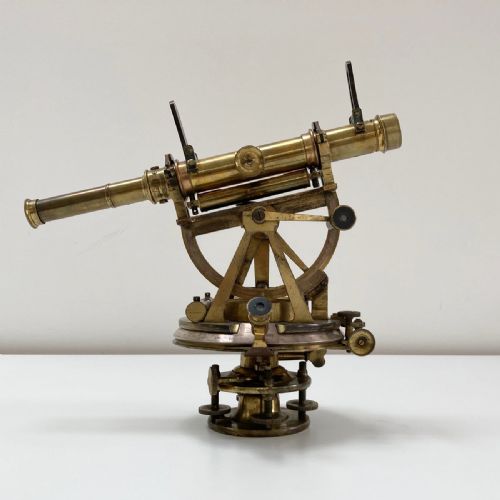

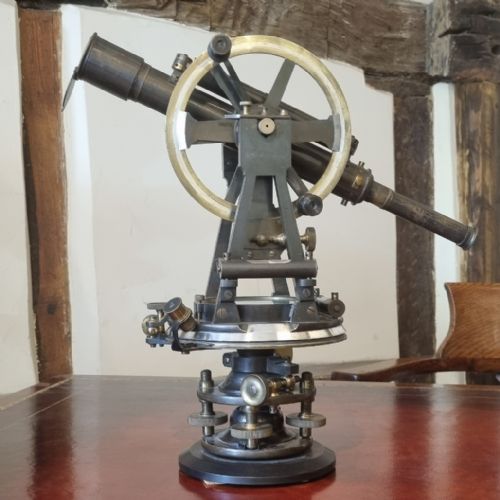
Brass Transit Instrument
These brass transit instrument examples are precision optical tools for surveying and navigation, prized for their complex engineering and polished metal finishes.
Brass Transit Instrument
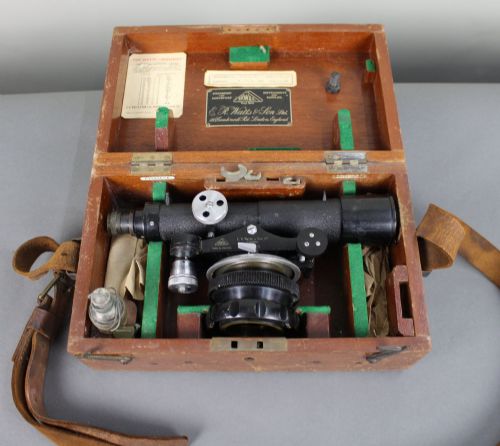
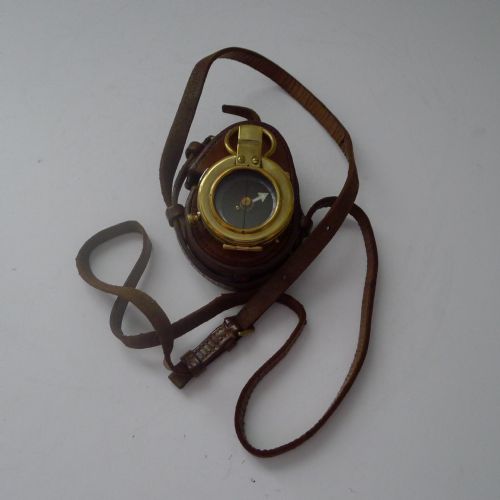
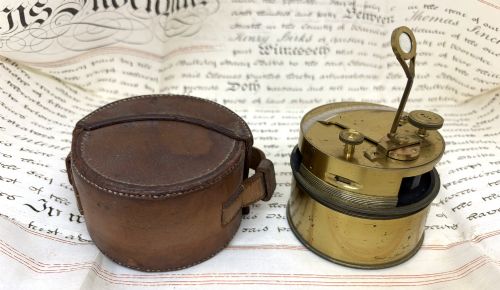
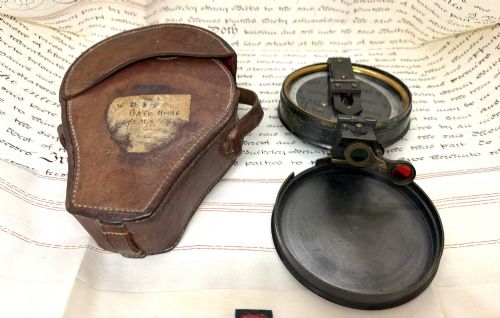
When you search for a brass transit instrument, you encounter historic surveying and measuring tools dating from the Georgian period through to the mid-twentieth century. These items include altazimuth theodolites, general utility levels, and prismatic compasses housed in fitted wooden boxes.
The pieces on this page originate from makers in London, Edinburgh, Devonport, and Madras, reflecting widespread British imperial and domestic engineering. Most examples span the nineteenth and early twentieth centuries, featuring complex leveling screws, graduated circles, and telescopic sights.
Materials and construction
Makers constructed these instruments primarily from cast and turned brass, paired with glass for optical lenses and silvered metal for graduated arcs. Structural components often utilise steel for strength, whilst protective fitted cases employ mahogany and other hardwoods lined with leather.
Workshops applied fine silvering to metal dials to ensure sharp legibility of navigational and surveying graduations beneath glass covers. Assembly relied on threaded joints, delicate adjustment screws, and precision engraving for maker signatures and scale markings.
Brass Transit Instrument Retail Price Guide 2026
Typical asking prices for brass transit instrument among the pieces listed under this phrase on Sellingantiques today, from the lower quarter to the upper quarter. They describe what is for sale here now, not the wider market.
Scientific instrument styles represented here range from Georgian and William IV through Victorian, Edwardian, and First World War military patterns.
Assessing quality
Quality rests in the precision of the mechanical movement, the crispness of the engraved scales on silvered metal, and the clarity of the internal glass optics. Instruments bearing signatures from established scientific makers demonstrate superior finishing on brass components and tighter tolerances in the leveling assemblies.
The survival of original fitted mahogany or leather cases alongside accessory plumb bobs and lenses elevates an instrument's completeness. Simpler utility levels differ from complex altazimuth theodolites and radial instruments, which required more intricate manufacturing processes to execute.
E.R. Watts & Son Ltd·French Ltd·P. Orr, Madras·Baker, London·W&S Jones·Negretti & Zambra·Elliott Bros. of London·Alexander Adie of Edinburgh·Cox of Devonport·WF Stanley
The Brass Transit Instrument Glossary
- Theodolite
- A precision instrument for measuring horizontal and vertical angles, mounted on a base with leveling screws. It is commonly found in nineteenth-century scientific collections.
- Transit instrument
- A telescope that rotates on an axis perpendicular to its line of sight, used for measuring celestial or terrestrial time and coordinates. This form underpins much of historic surveying work.
- Silvered metal
- A base metal treated with a silver finish to provide a high-contrast background for engraved measurement scales. It allows surveyors to read fine graduations under field conditions.
- Altazimuth
- A mounting that allows a telescope or instrument to move in both altitude and azimuth axes. This setup appears on specialised surveying pieces from the Georgian and Victorian eras.
- Prismatic compass
- A pocket or field compass fitted with a prism to view the magnetic bearing and distant targets simultaneously. These served military officers and engineers in the field.
Brass Transit Instrument: Frequently Asked Questions
What is a brass transit instrument used for?
These instruments were utilised by surveyors, engineers, and military officers to measure angles, establish property boundaries, and map terrain.
They allowed operators to sight distant targets with telescopic lenses while reading precise horizontal and vertical coordinates from graduated metal circles.
How do I identify the period of a theodolite?
Dating relies on the style of the brass casting, the complexity of the leveling mechanism, and any maker signatures engraved on the silvered metal plates.
Georgian and William IV pieces often display simpler, robust forms, whilst Victorian and Edwardian examples incorporate more enclosed gears and refined finishes.
Are these instruments still functional?
Many of these pieces retain their mechanical adjustments, focusing lenses, and spirit levels, though they are primarily collected as historical scientific artefacts.
Careful handling is required to maintain the delicate brass threads and silvered metal scales without causing wear.
Why do some instruments come with wooden boxes?
Fitted mahogany boxes were built to protect delicate optical glass and precise brass pivots during transport across rough terrain.
These cases often include specialised compartments for auxiliary lenses, plumb bobs, and adjustment pins.