

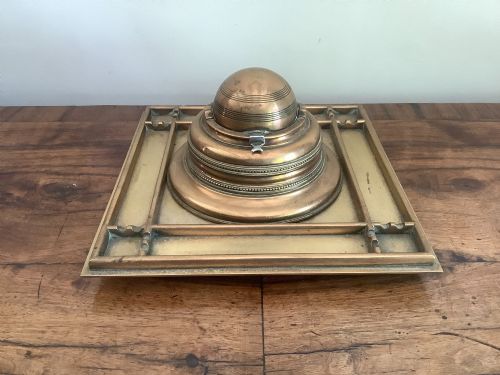
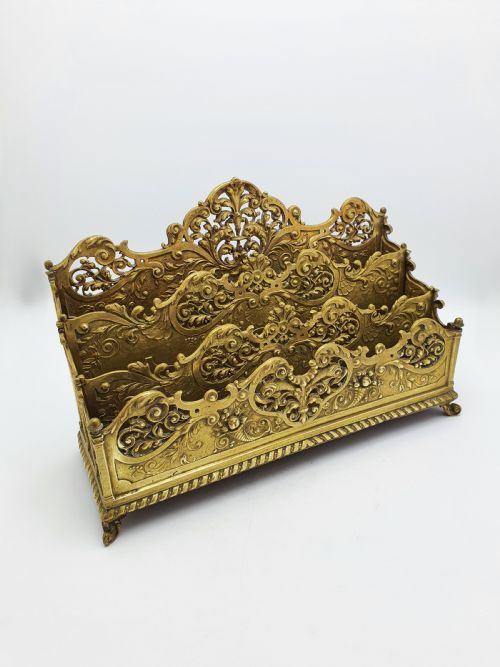


Brass Stationery Holder
These pieces of a brass stationery holder bring order to a desk while showing the robust utility and metalworking skill of the nineteenth and early twentieth centuries.
Brass Stationery Holder
A brass stationery holder is a desk accessory designed to organise correspondence, letters, and envelopes in a domestic or professional study. When you search for this phrase, you find items spanning the Victorian era through to the early twentieth century, taking the form of letter racks, stationery boxes, wall pockets, and desk sets.
The objects on this page range from simple cast brass clips and wall-hanging pockets to substantial tabletop stationery boxes mounted with wood or glass. Many examples combine brass with oak, mahogany, walnut, or copper, reflecting the varied desk furniture produced during the nineteenth century.
How they were made
These items rely heavily on cast brass, sheet brass, and copper, often shaped through casting, stamping, and piercing techniques. Makers mounted the metalwork onto timber backings and bodies made of oak, mahogany, walnut, amboyna, or oak, joining them with screws and pins.
Details include applied decorative motifs such as cherubs, dolphins, parrots, and equestrian figures, alongside moulded or fretted metal fretwork. Glass and leather elements occasionally appear within desk sets and inkstands to complete the fittings.
Brass Stationery Holder Retail Price Guide 2026
Typical asking prices for brass stationery holder among the pieces listed under this phrase on Sellingantiques today, from the lower quarter to the upper quarter. They describe what is for sale here now, not the wider market.
Listings feature items spanning the Victorian, Edwardian, and Arts and Crafts periods, utilising brass, copper, oak, mahogany, and walnut.
What varies in quality
The standard of a brass stationery holder depends largely on the crispness of the cast metal details and the quality of the timber carcase. Finely chased or modelled ornamentation, such as cherubs or naturalistic foliage, demonstrates superior craftsmanship compared to simpler mass-produced stampings.
Construction methods also distinguish finer pieces, particularly where timber and brass are integrated cleanly without loose mounts or warped panels. The inclusion of matching inkwells, tape dispensers, or complete desk sets elevates an individual piece above a basic standalone letter rack.
William Tonk and Sons·Whitehouse and Son
The Brass Stationery Holder Glossary
- Stationery box
- A tabletop case with partitioned compartments designed to hold writing paper and envelopes securely. These boxes frequently feature hinged lids and sloping brass fronts.
- Letter rack
- An open-framed desk accessory featuring vertical dividers to keep correspondence sorted and upright. They appear in freestanding tabletop formats or fitted with rings for wall hanging.
- Standish
- A traditional desk stand or inkstand incorporating inkwells, pen trays, and sometimes a stationery holder or bell. They served as the central writing apparatus on a nineteenth-century desk.
- Wall pocket
- A hanging receptacle designed to be mounted on a wall or side of a desk to hold incoming post. These often utilise lightweight sheet brass or copper with pierced backplates for suspension.
Brass Stationery Holder: Frequently Asked Questions
How do I date a brass letter rack?
Dating relies on observing the prevailing styles, materials, and construction methods used in the piece. Victorian examples often display ornate Rococo Revival casting or specific commemorative themes, while Arts and Crafts pieces favour hammered copper and simpler geometric lines.
Reference points include associated timber types, such as mahogany or oak bodies, and maker details stamped into the brass or hardware. Comparing the complexity of the cast motifs against known period designs helps narrow the decade of manufacture.
Were these holders made for offices or homes?
These items served both professional offices and domestic studies during the nineteenth and early twentieth centuries. Sturdier brass and oak boxes were built to withstand daily commercial use.
More decorative items featuring mahogany, walnut, or motifs like cherubs and dolphins were intended for private writing desks in parlours and libraries. Their dual purpose as functional items and decorative ornaments made them popular across various settings.
How do I care for antique brass?
Maintaining antique brass requires gentle dusting with a soft cloth to prevent the accumulation of dirt in recessed details. Avoid harsh chemical cleaners that strip the aged patina accumulated over decades.
If polishing is necessary, use a mild, non-abrasive metal polish applied sparingly with a cotton swab, taking care to keep polish off adjacent wood or leather surfaces.