

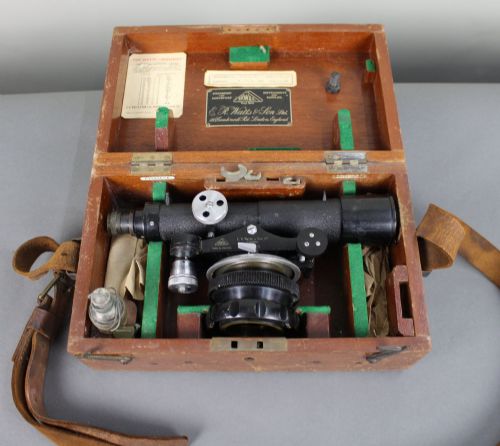


Brass Leveling Instrument
These brass leveling instrument examples are precision tools of metal and glass built to measure space, which collectors prize for their engineering and polished surfaces.
Brass Leveling Instrument
When you search for a brass leveling instrument, you are looking at nineteenth and early twentieth century scientific equipment designed for surveying, architecture, and engineering. The forms include drainage levels, theodolites, transit instruments, and clinometers housed in fitted wooden cases of mahogany.
You are most likely to meet Victorian and Edwardian examples on this page, spanning periods from the early nineteenth century through to nineteen forty. These objects range from portable transit instruments to heavy utility levels bearing the marks of notable London makers.
How they were made
These instruments combine polished brass frames with delicate glass optics, silvered metal dials, and steel components. The metalwork is turned, cast, and engraved with precise calibration scales for measuring angles and elevations.
Many of these tools come with fitted mahogany storage cases lined with materials such as leather to protect the sensitive optical tubes and leveling vials during transport.
Brass Leveling Instrument Retail Price Guide 2026
Typical asking prices for brass leveling instrument among the pieces listed under this phrase on Sellingantiques today, from the lower quarter to the upper quarter. They describe what is for sale here now, not the wider market.
Several instruments retain their original leather carrying straps, suggesting they spent more time bouncing on packhorses than sitting quietly in a study.
What varies in quality
The distinction between standard utility items and finer pieces lies in the crispness of the engraved markings upon the silvered metal dials and the smoothness of the focusing mechanism. Superior examples retain their original lacquered brass finish and unblemished glass lenses.
Completeness dictates standing at the upper end of the scale, particularly when an instrument retains its original fitted mahogany case, signed optics, and matching accessories such as clinometers or sighting telescopes.
E R Watts and Son Ltd·W and S Jones·L Casella and Co·Cooke Troughton and Simms·Negretti and Zambra·Elliott Bros of London·Alexander Adie of Edinburgh·W H Harling·W F Stanley
The Brass Leveling Instrument Glossary
- Theodolite
- A precision instrument for measuring horizontal and vertical angles, mounted on a base and often featuring telescopic sights.
- Clinometer
- A tool used for measuring angles of slope or tilt relative to gravity, frequently incorporated into surveying equipment.
- Transit instrument
- A telescope mounted on an axis that rotates in a vertical plane, used for timing celestial passages and accurate land measurement.
- Vernier
- A secondary sliding scale that allows readings to a fraction of the main division on a graduated scale, ensuring high measurement precision.
Brass Leveling Instrument: Frequently Asked Questions
What is a brass leveling instrument used for?
These devices were employed by surveyors, architects, and engineers to establish horizontal planes and measure elevations across land. They formed the backbone of nineteenth century infrastructure and cartography.
Today, they function primarily as decorative objects or study pieces for collectors of scientific history, reflecting an era when precision measurement relied entirely on mechanical ingenuity.
How do I date a brass leveling instrument?
Dating relies on stylistic shifts in the brass casting, the complexity of the optical mounts, and the specific names or addresses engraved on the metal plates. Maker signatures often correspond to known periods of partnership or active trading years.
Additional clues come from the fitted wooden cases, where the construction techniques and interior linings reflect Victorian or Edwardian cabinetmaking standards.
Are these instruments still accurate?
While many retain their mechanical movement, internal optical alignment can drift over decades of storage or transport. They are typically valued for their historic craftsmanship and aesthetic appeal rather than modern surveying utility.
Collectors treat them as desktop displays or cabinet pieces rather than functional tools for construction work.
Why do they come in wooden boxes?
The fitted mahogany cases were essential for protecting delicate glass lenses, spirit levels, and precise metal calibration scales from field damage. Transporting a sensitive theodolite across rough terrain required robust housing.
These boxes often contain original accessories, spare parts, and maker labels that add significantly to the historical context of the instrument.