







Brass Inlay Coffer
A brass inlay coffer brings together warm hardwoods and bright metalwork to anchor a room with centuries of utilitarian craft.
Brass Inlay Coffer
A brass inlay coffer is a storage piece defined by the integration of metal accents into timber surfaces, taking forms such as blanket boxes, chests, and campaign furniture. These items originate across diverse regional traditions including Anglo-Indian and Dutch colonial workshops, alongside domestic British cabinet making.
The pieces encountered on this page span several centuries, reaching from the early eighteenth century through the Georgian and Victorian eras into the early twentieth century. Common formats include storage chests, blanket boxes, wine coolers, and writing slopes, often utilising dense tropical hardwoods or native timbers.
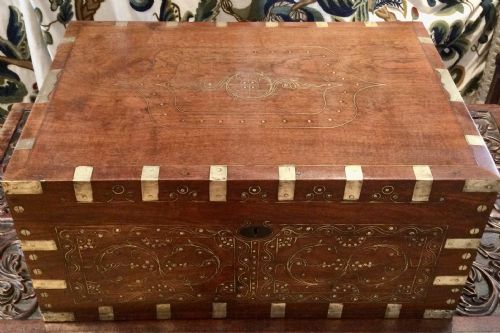
Domestic iterations sit alongside colonial and campaign variants, reflecting both stationary household storage and transportable trunks designed for travel. The inclusion of brass work ranges from simple corner straps to intricate geometric inlay across the entire lid and front panel.
Materials and construction
Makers utilised a variety of dense timbers including mahogany, walnut, padouk, teak, and oak, often selecting these woods for their ability to withstand structural stress and take a fine polish. Wood veneer frequently appears on refined domestic examples, whilst colonial pieces rely on solid tropical hardwoods.
Brass is integrated either as flush binding, corner mounts, or inlaid stringing and cartouches set directly into the timber surface. Metal components were traditionally secured with small pins or screws, anchoring the brass firmly into the wood grain to protect edges and corners during use.
Brass Inlay Coffer Retail Price Guide 2026
Typical asking prices for brass inlay coffer among the pieces listed under this phrase on Sellingantiques today, from the lower quarter to the upper quarter. They describe what is for sale here now, not the wider market.
Some nineteenth-century writing slopes hide secret drawers behind false partitions, rewarding curious owners with miniature compartments for clandestine correspondence.
Assessing quality and execution
Quality rests in the precision of the metalwork integration and the selection of timber, where tightly fitted brass inlay and figured wood veneers denote higher workshop standards. Simpler studded utility boxes contrast with exhibition grade pieces that feature meticulous joinery and complex brass decoration.
The structural integrity of the carcass and the retention of original hardware dictate the standing of a piece. Finer examples maintain their original internal fittings, secret drawers, or stands, whereas utilitarian storage trunks prioritise robust construction over decorative refinement.
Whytock & Reid
The Brass Inlay Coffer Glossary
- Campaign chest
- A modular chest designed to dismantle into sections for easy transport by military officers. These pieces are characteristically fitted with recessed brass handles and corner brackets.
- Padouk
- A dense tropical hardwood known for its deep reddish-brown colour and durability. It was frequently utilised in colonial cabinet making.
- Stringing
- A narrow strip of contrasting wood or metal inlaid into the surface of furniture. It creates fine linear borders around drawer fronts or panels.
- Cellarette
- A lockable container used for storing wine bottles near the dining table. They often feature lead lining or fitted internal dividers.
Brass Inlay Coffer: Frequently Asked Questions
What is a brass inlay coffer used for?
These pieces serve primarily as practical storage furniture for blankets, textiles, or household items while functioning as decorative focal points within a room. Their sturdy construction allows them to double as surface tables or benches depending on the specific form.
Historically, variations such as writing slopes or cellarettes were built to house specific luxury goods like stationery or wine bottles. Today, they integrate easily into living spaces to conceal clutter while displaying traditional cabinet craftsmanship.
Where were colonial chests made?
Colonial chests originate from regions influenced by European trade and settlement, such as Dutch colonial territories and British India. Local craftsmen utilised native timbers like teak and ebony, combining European furniture forms with indigenous decorative techniques.
These pieces often display distinct construction methods suited to tropical climates, alongside characteristic brass decoration or ivory details. They reflect the exchange of design ideas between European markets and local artisan workshops.
How do I care for brass inlay wood?
Maintenance involves keeping the timber nourished with appropriate wax and cleaning the brass gently with a soft cloth to prevent tarnishing. Avoiding direct sunlight and excessive temperature fluctuations protects both the wood veneer and the metal inlay from splitting or loosening.
Regular dusting prevents particulate buildup in the recessed channels where the brass meets the wood. Gentle handling of the hinges and locks preserves the original operational mechanics of the piece.