
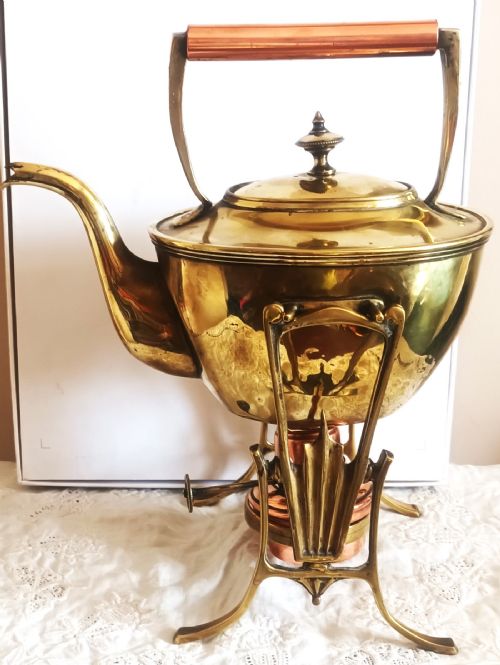


Brass Hot Water Kettle
A brass hot water kettle brings warmth and traditional hospitality to a room, offering the gleaming presence of Victorian metalwork.

Brass Hot Water Kettle
When you search for brass hot water kettle, you encounter substantial vessels designed to heat and dispense water for tea, often taking the form of spirit kettles on stands or large samovars and tea urns. These examples span the Victorian era, alongside pieces dating from eighteen fifty, eighteen sixty, eighteen eighty, and nineteen twenty.
The objects frequently combine bright brass with warm copper, occasionally incorporating practical stands or burners beneath the main body. You will most commonly meet Victorian spirit kettles and copper samovars that reflect the domestic hospitality of nineteenth century English households.
Some variations present distinct stylistic influences, such as Arts and Crafts design or dresser style presentation, showing how utilitarian kitchenware evolved into decorative interior items. The selection ranges from portable spirit kettles on fitted stands to monumental tea urns intended for larger gatherings.
How they were made
The construction of these vessels relies on the combination of beaten copper and polished brass, shaped by Victorian metalworkers to create durable liquid containers. Makers utilised these two contrasting metals to give the bodies a warm reddish tone while highlighting handles, taps, and stands in bright yellow brass.
Fittings and insulators frequently incorporate complementary materials like wood, ebonised wood, or bone to ensure handles remained cool to the touch during use. Metal spinning, riveting, and careful polishing defined the workshop techniques used to produce these robust heating vessels.
What varies in quality
Distinctions in quality often rest upon the visual harmony of mixed metals and the substantial weight of the copper and brass plates used in the body. Superior examples display crisp definition in cast mounts and well-balanced proportions between the kettle, its stand, and the burner below.
The presence of original matching components, such as the burner assembly and the supporting stand, elevates the integrity of a spirit kettle. Finer pieces demonstrate meticulous finishing around the seams, taps, and handles, reflecting the pride of established Victorian manufacturing firms.
William Soutter And Sons
The Brass Hot Water Kettle Glossary
- Spirit kettle
- A water kettle mounted on a metal stand with an integrated spirit burner underneath to keep the water hot at the table.
- Samovar
- A large heated metal container traditionally used to boil and heat water for tea, often featuring a central internal pipe and a dispensing spigot.
- Tea urn
- A large vessel equipped with a tap for serving hot water or tea, commonly associated with formal hospitality in Victorian settings.
- Ebonised wood
- Timber treated with a dark stain or finish to resemble expensive ebony, frequently utilised for cool-touch kettle handles and knobs.
- Arts and Crafts
- A design movement valuing handcraftsmanship and simple utility over excessive factory ornamentation, influencing later nineteenth and early twentieth century metalwork.
Brass Hot Water Kettle: Frequently Asked Questions
What is a spirit kettle?
A spirit kettle is a portable water heating vessel mounted on a dedicated metal frame that houses a small burning spirit lamp beneath. This allowed hosts to maintain boiling water for tea directly at the dining or drawing room table.
These pieces typically date from the Victorian period and combine functional metal engineering with decorative brass and copper presentation.
How do samovars and kettles differ?
While both heat water for tea, a kettle usually rests on a tipping stand above a burner for easy pouring into individual teapots. A samovar is a larger, upright urn featuring a spigot near the base and often an internal heating tube.
Samovars generally served larger gatherings, whereas spirit kettles formed part of an intimate afternoon tea service.
What materials are used?
These items are constructed primarily from sheet copper and brass, celebrated for their thermal conductivity and warm metallic sheen. Handles and lifting grips often incorporate wood, ebonised wood, or bone to protect hands from heat.
This deliberate combination of metals and tactile natural materials defines nineteenth century British metalware.
How do I date these pieces?
Dating relies on stylistic markers, manufacturing techniques, and historical periods such as the Victorian era or specific decades like eighteen eighty. Evidence of hand-shaping, specific maker attributions, and design influences like Arts and Crafts provide further chronological clues.
Most surviving examples originate from the mid to late nineteenth century up through the early twentieth century.