



Brass Handled Fire Tools
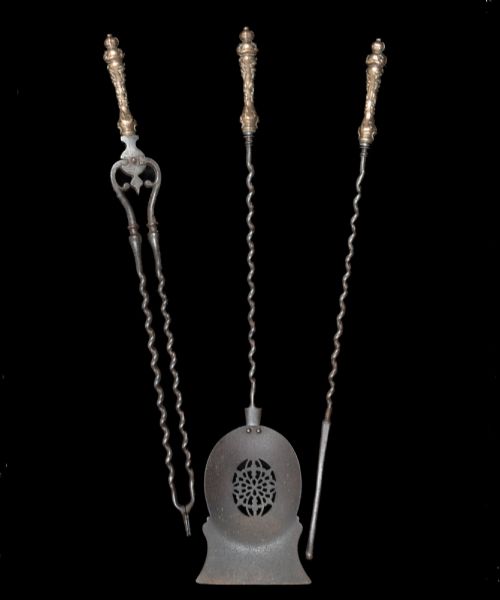
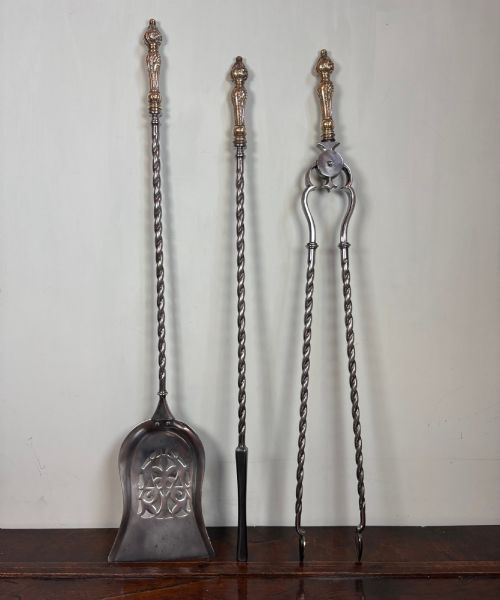
These brass handled fire tools are hearth furniture designed to tend an open coal or wood fire while bringing bright metalwork to the fireplace.
Brass Handled Fire Tools
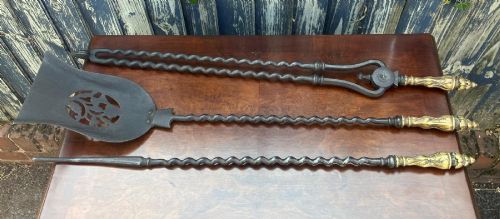
When you search for brass handled fire tools, you encounter functional companion sets and individual implements intended for daily use beside the chimney. These pieces include pokers, tongs, and shovels that combine iron or steel shafts with decorative metal grips.
The examples gathered here span several key eras, predominantly featuring Victorian and Georgian designs alongside Regency pieces. Originating from English hearths, these accessories serve both practical duties and ornamental roles in period rooms.
How they were made
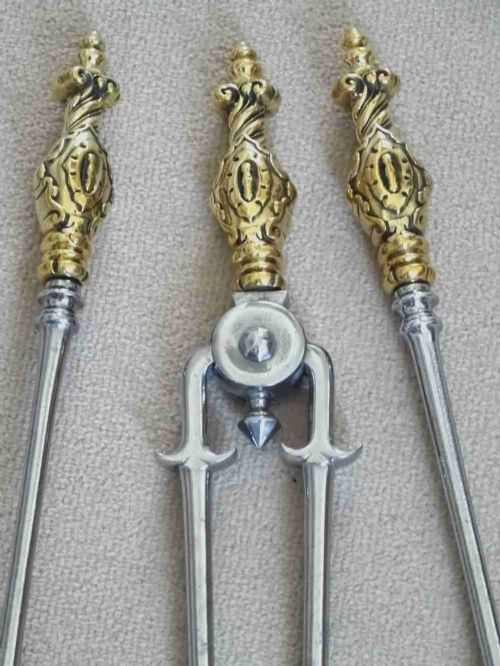
Makers paired sturdy steel and iron shafts with cast or turned brass handles to withstand the heat and weight of daily fire tending. Gilt brass, gunmetal, and copper also appear as primary materials for both handles and companion accessories.
Craftsmen shaped the metal through forging and casting, often adding decorative elements such as rope twist handles or ring grips. The joints between the handle and the shaft relied on secure mechanical fitting to endure regular lifting.
This selection spans the eighteenth and nineteenth centuries, featuring Georgian, Regency, and Victorian periods across steel, brass, and copper.
What varies in quality
Quality rests in the crispness of the handle casting and the substantial weight of the steel shaft. Superior examples display balanced proportions and carefully finished brass details rather than mass-produced uniformity.
The distinction between standard utility items and finer parlour pieces lies in the decorative enrichment, such as gilt finishes and rope twist patterns. Original matched sets carry greater cohesion than assembled groups of mixed implements.
The Brass Handled Fire Tools Glossary
- Companion set
- A matched group of hearth implements, usually including a poker, tongs, and shovel, designed to stand together in a holder.
- Fire irons
- The collective term for the metal implements used to tend a domestic fire, comprising pokers, tongs, and shovels.
- Gilt brass
- Brass that has been treated with a thin layer of gold to enhance its lustre and appearance in the hearth.
- Rope twist
- A decorative spiral pattern carved or cast into handles to mimic the appearance of braided cordage.
Brass Handled Fire Tools: Frequently Asked Questions
How do I date these fire tools?
Dating relies on stylistic clues in the handle design and the manufacturing marks of the steel shafts. Georgian and Regency pieces tend to show finer hand-forged details, whereas Victorian examples often incorporate heavier cast elements.
Comparing the specific forms of the shovel blades and tongs to known period pieces helps narrow down the decade of manufacture. Material combinations, such as the use of gunmetal or gilt brass, also point toward specific nineteenth-century decades.
Can I use these tools on a real fire?
Most of these historic pieces were built for active service and remain robust enough to tend a domestic fire today. The steel and iron shafts handle heat well, provided the metal shows no deep structural corrosion.
For valuable or gilt-finished sets, many owners prefer to keep them purely for display to preserve their surface finish. Regular use will require careful cleaning to remove soot and ash without damaging the brass handles.
What tools belong in a complete set?
A standard nineteenth-century companion set typically contains a poker for breaking up coal, a pair of tongs for moving logs, and a shovel for clearing ash. Some collections also include a chestnut roaster or related hearth accessories.
Matching sets feature handles cast from the same mould and shafts of uniform length and metal type. Assembled sets often mix pieces from different makers that share a general stylistic period.
How do I clean brass handles safely?
Cleaning requires a soft cloth and a mild brass cleaner designed for antiques to avoid stripping away the aged patina. Harsh abrasives will scratch the metal and ruin the fine definition of cast details like rope twist grips.
Steel shafts benefit from a light application of oil or wax to prevent surface rust while resting near the dampness of an unlit hearth. Keeping the metal dry ensures the tools maintain their finish over years of display.