



Brass Arm Girandoles
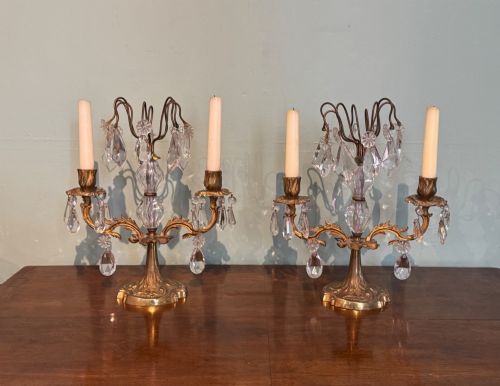
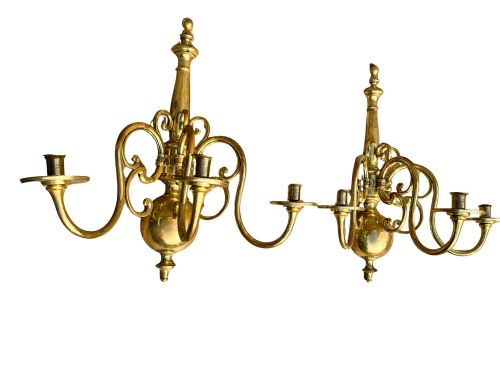
These brass arm girandoles bring instant candlelit reflection to a room, catching the light in glass drops and polished metal.
Brass Arm Girandoles
When you search for brass arm girandoles, you encounter reflective wall sconces, mirrored candle brackets, and table candelabras designed to bounce light across a room. These pieces combine metal frames with glass or crystal components to maximise illumination from candles.
The versions most commonly met on this page span the Victorian era through the early twentieth century, drawing on French Rococo Revival, Dutch Baroque, and Neoclassical styles. They appear as wall-mounted mirrors with candle arms, paired branch candelabras, and ornate wall brackets.
Makers utilised various configurations, from twin-arm gilded mirrors to large multi-branch table lustres hung with cut glass drops. Each form serves the dual purpose of art object and functional light source, relying on polished brass, gilt bronze, and ormolu.
Materials and construction
Craftsmen built these items using cast and sheet brass, gilt bronze, and ormolu, often combining metalwork with carved wood frames for mirrored wall pieces. The structural arms and backplates required sturdy casting to support the weight of branching candle sockets.
Cut glass and crystal drops hang from many examples, drilled and wired to dangle from bezels and drip pans to refract the flame light. Ceramic elements, such as Delft components, integrate into the brass framework alongside bronze cast figures like cherubs.
Brass Arm Girandoles Retail Price Guide 2026
Typical asking prices for brass arm girandoles among the pieces listed under this phrase on Sellingantiques today, from the lower quarter to the upper quarter. They describe what is for sale here now, not the wider market.
Listings on this page span the Victorian period through 1930, utilising brass, gilt bronze, cut crystal, and ceramic components.
Distinguishing quality
The finest examples display crisp chasing on the bronze and brass surfaces, where floral motifs, scrollwork, and figural details retain sharp relief. Lower quality pieces show softer casting lines and simpler stamped metal components without hand-finishing.
Quality also rests in the glass elements, where heavy cut crystal drops with polished facets contrast against thin, machine-pressed glass. Integrated mercury glass or bevelled mirror plates in the backplates indicate higher workshop standards.
The Brass Arm Girandoles Glossary
- Girandole
- A branched candleholder, often featuring a mirrored backplate to multiply the flickering light of the candles. These fixtures hang on walls or stand on tables.
- Ormolu
- Finely ground high-carat gold mercury-gilded onto a bronze or brass object. This technique gives the metal a rich, warm lustre that resists tarnishing.
- Lustre
- A table candelabra or hanging fixture decorated with cut glass pendants and drops. The glass elements amplify the visual brightness of the piece.
- Rococo Revival
- A nineteenth-century design movement inspired by eighteenth-century French style, characterised by asymmetrical scrolls, C-curves, and naturalistic plant motifs.
- Wall Sconce
- A light fixture fixed to a wall rather than resting on a floor or table, typically featuring arms to hold candles or electric bulbs.
Brass Arm Girandoles: Frequently Asked Questions
What is the difference between a sconce and a girandole?
A standard wall sconce holds candles without necessarily featuring a reflective backplate. A girandole specifically incorporates a mirror or polished metal reflector behind the candle arms.
This reflective surface distinguishes girandoles, designed originally to double the apparent light in a dark room.
How should I clean cut glass drops?
Remove the glass drops gently from the brass arm if the wire fastenings permit, washing them in warm soapy water. Dry them thoroughly with a soft cloth before rehanging them to restore their sparkle.
Avoid harsh chemical dips that can strip the gilt finish from the surrounding brass frame.
Can these pieces be converted to electricity?
Many buyers choose to wire these fixtures for electric bulbs, though purists prefer retaining them for wax candles. Professional rewiring can route cords discreetly through the brass arms without altering the antique structure.
Consult a qualified restorer to ensure any electrical conversion respects the integrity of the metalwork.