

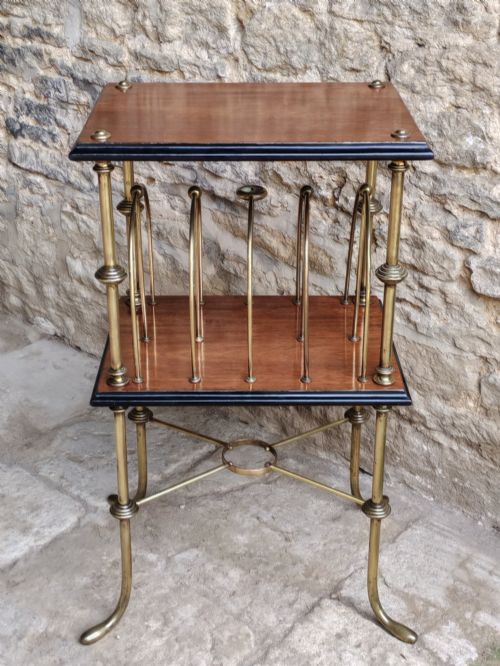
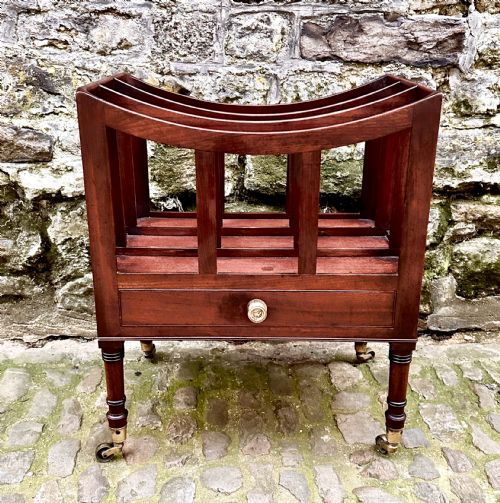

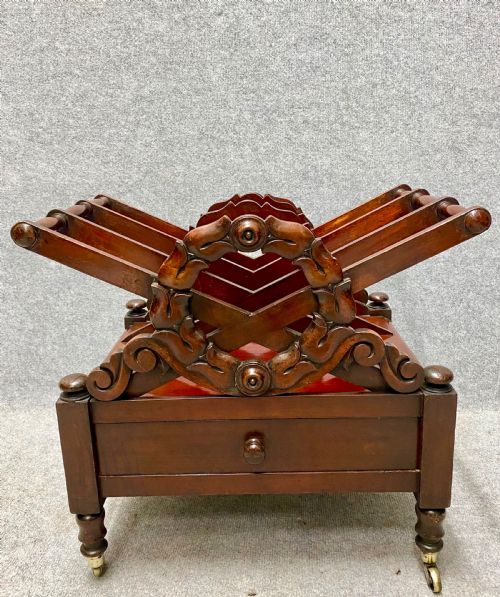


Brass and Wood Canterbury
A brass and wood canterbury is a practical multi-division stand for papers, periodicals, or folios, combining fine timber frames with metal castors, bars, or inlay.
Brass and Wood Canterbury
A brass and wood canterbury serves as a compartmentalised rack traditionally used for newspapers, sheet music, or folios, resting on castors for easy movement across a room. Most examples found here date from the Georgian and Regency periods through to the Victorian, Edwardian, and early twentieth century eras.
Makers shaped these stands in forms such as boat-shaped frames, magazine tables, and multi-division stands alongside larger country house folio stands and what-nots. They appear in timbers like mahogany and rosewood, frequently accented with brass rods, carrying handles, or inlay details.
Buyers encountering this search phrase find pieces ranging from compact four-division newspaper holders to oversized library stands and occasional table hybrids. The selection spans straightforward domestic furnishings to grander country house iterations.
How they were made
Cabinetmakers constructed the frames primarily from dense, durable timbers such as mahogany and rosewood, occasionally employing ebonised finishes for a dramatic dark surface. These woods provided the structural integrity required to support multiple vertical compartments and heavy folios.
Metalwork played a defining functional and decorative role, with brass utilised for division rods, carrying handles, castors, and structural supports. Joinery techniques varied from traditional pegged framing to precise cabinet construction suited to daily domestic handling.
Brass and Wood Canterbury Retail Price Guide 2026
Typical asking prices for brass and wood canterbury among the pieces listed under this phrase on Sellingantiques today, from the lower quarter to the upper quarter. They describe what is for sale here now, not the wider market.
Current listings span from the late Georgian period through Regency, Victorian, and Edwardian eras, predominantly fashioned in mahogany and rosewood.
What varies in quality
Quality rests in the choice of timber and the crispness of the cabinetwork, where finely figured mahogany or rich rosewood elevates the visual weight of the stand. Superior examples demonstrate thoughtful proportions and meticulous joinery that withstands the structural stress placed on vertical partitions.
The sophistication of the brass mounts and hardware distinguishes finer workshop production from standard utility pieces. Heavier gauge metal rods, well-cast handles, and original castors contribute to the overall integrity and period character of the object.
The Brass and Wood Canterbury Glossary
- Folio stand
- A large standing rack used for holding loose prints, maps, or drawings. These often feature adjustable sides or oversized proportions suitable for institutional or country house libraries.
- Ebonised
- Timber treated to resemble ebony through staining or painting. This finish gained popularity during the Victorian period to create a formal contrast with gilt or brass fittings.
- Boat-shaped
- A curved hull-like contour seen on certain Regency frames. This silhouette softens the linear geometry typical of standard compartmentalised racks.
- What-not
- An open set of multi-tiered shelves used for displaying or storing small items. Examples sometimes combine a lower canterbury base with upper display surfaces.
Brass and Wood Canterbury: Frequently Asked Questions
What was a canterbury originally used for?
These stands were designed to hold sheet music, books, and newspapers near seating areas in polite rooms. The partitions kept periodicals upright and accessible for evening reading.
Over time, households adapted them for general paper storage, folios, and correspondence. Their compartmentalised structure made sorting daily reading material straightforward.
How do I distinguish a Regency canterbury?
Regency pieces often display classical restraint, featuring turned brass uprights, slender mahogany or rosewood frames, and distinct boat-shaped outlines. Cabinetmakers of this era favoured clean lines and architectural proportions.
They frequently incorporate ring-turned legs and high-quality brass castors for mobility. The joinery reflects early nineteenth-century construction methods.
Are these stands sturdy enough for daily use?
Most examples were built to handle the weight of heavy folios and newspapers in active domestic settings. Their solid timber frames and fastened partitions provide inherent structural strength.
Care should be taken when moving them loaded, relying on the original castors where fitted. Placing them away from direct heat sources protects the timber and glue joints.
What timber varieties appear most often?
Mahogany forms the structural basis for the majority of Georgian and Regency pieces, valued for its stability and rich grain. Rosewood frequently appears in later Regency and Victorian versions.
Some Victorian examples utilise ebonised mahogany to achieve a contrasting dark surface finish. Brass components accompany these timbers across all periods.