


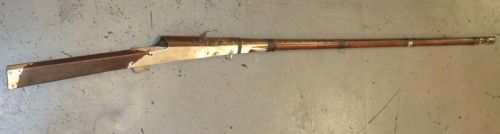


Brass and Steel Gun
Brass and steel gun pieces span military service arms and decorative ordnance, offering collectors tangible fragments of centuries of tactical innovation.
Brass and Steel Gun
A brass and steel gun brings together historical arms and ordnance, ranging from flintlock pistols to percussion revolvers, muskets, and signal cannons.
The most common examples on this page are 18th century flintlock and 19th century military service arms, alongside regional variants from the Balkan Ottoman sphere and American Civil War period.
These items originate from diverse contexts, including Georgian British military contracts, Napoleonic French arsenals, and mid-19th century American production.
Materials and construction methods
Construction relies heavily on forged steel barrels and actions paired with brass furniture, mounts, or frames, frequently bedded into stocks of walnut, oak, or general hardwoods.
Makers integrated functional metals like gunmetal and iron alongside decorative elements such as bone inlays and intricate engraving on mounts and locks.
Brass and Steel Gun Retail Price Guide 2026
Typical asking prices for brass and steel gun among the pieces listed under this phrase on Sellingantiques today, from the lower quarter to the upper quarter. They describe what is for sale here now, not the wider market.
Materials across these listings include steel, brass, walnut, iron, wood, gunmetal, bone, and oak.
Assessing quality in historical arms
Quality separates standard military issue pieces from specialised or heavily ornamented variations through the crispness of lock markings, depth of brass engraving, and overall integrity of the metalwork.
The refinement of the timber stock, the precision of matching serial numbers where applicable, and the retention of original action components distinguish superior examples.
Harrison of London·Henry Nock·Tower·Colt
The Brass and Steel Gun Glossary
- Flintlock
- An ignition mechanism utilising a flint struck against a steel frizzen to create sparks that ignite the gunpowder charge. This system dominated military and civilian firearms for centuries.
- Percussion cap
- A small metal cup containing priming compound placed on a nipple, struck by the hammer to fire the piece. It succeeded the flintlock system in the 19th century.
- Smoothbore
- A barrel without rifling inside the bore, standard for muskets and early pistols before rifled barrels became universal for military arms.
- Muzzleloader
- A firearm loaded with powder and projectile through the muzzle end of the barrel rather than the breech. Most historical pieces on this page utilise this method.
- Brass furniture
- Decorative and structural brass components on a firearm, including trigger guards, butt plates, side plates, and ramrod pipes.
Brass and Steel Gun: Frequently Asked Questions
What periods do these guns represent?
The pieces span from the early 18th century through the Victorian era and up to early 20th century signal cannons.
Major representation falls within the Georgian, Napoleonic, and American Civil War periods.
How do I identify a military issue pistol?
Military examples typically bear government acceptance marks, crown stamps, or arsenal designations such as Tower or regimental stamps.
Standard regulation patterns often feature brass furniture and robust walnut stocks built for active service.
What is the difference between flintlock and percussion?
Flintlock arms use a piece of flint striking steel to generate sparks for ignition, identifiable by an external frizzen and cock.
Percussion arms use a hammer striking a primed cap placed on a nipple, representing the mid-19th century technological transition.
Where did regional variants originate?
Regional pieces on display include Balkan Ottoman snaphaunce and miquelet locks from the Adriatic region.
Early Indian matchlock muskets also appear alongside European and American martial arms.