

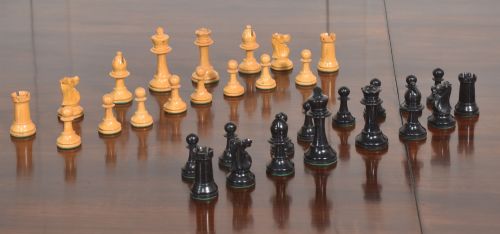


Boxwood Chessmen
Boxwood chessmen are tactile table companions, offering tactile warmth and classic form for serious play and display alike.
Boxwood Chessmen
When you search for boxwood chessmen, you encounter complete sets and folding boards dating primarily from the Victorian and Edwardian eras. These pieces span the nineteenth century up to nineteen ten, capturing the golden age of British chess design.
The sets you meet most often on this page follow the Staunton pattern, paired with contrasting dark pieces in ebony or ebonised wood. Alongside standard Staunton designs, you occasionally find St George patterns, Calvert patterns, and signed sets by notable makers.
These items were built for the parlour and the club, combining practical weight for stable play with distinct sculptural forms. They arrive in various sizes, often housed in fitted wooden boxes alongside folding boards or draughts.
How they were made
Makers relied on dense, pale boxwood for the light pieces, turning each king, queen, and pawn on a lathe to achieve sharp, uniform details. This dense timber accepted fine cuts for coronets and mitres without splintering.
Dark counterparts were carved from ebony or produced by ebonising cheaper timber to mimic the deep black finish. Many sets incorporated internal lead weighting within the bases, secured beneath green felt layers to improve balance during rapid play.
Boxwood Chessmen Retail Price Guide 2026
Typical asking prices for boxwood chessmen among the pieces listed under this phrase on Sellingantiques today, from the lower quarter to the upper quarter. They describe what is for sale here now, not the wider market.
Some antique boxwood knights retain faint chalk numbers on their bases, revealing how Victorian players kept their armies organised.
What varies in quality
Quality rests in the crispness of the turning and the proportional balance of each piece, especially the intricate carving of knight heads and rooks. Superior sets display hand-carved individuality in the horses, whereas mass-produced alternatives appear rigid and uniform.
Material selection and maker attribution elevate certain sets above standard parlour variants. Signed pieces by established makers carry distinct marks that distinguish ordinary turned timber from collector-grade works of art.
Jaques·Whitty·British Chess Company·F. H. Ayres·Calvert
The Boxwood Chessmen Glossary
- Staunton pattern
- The standard design of chess pieces introduced in the mid-nineteenth century, featuring realistic carved motifs and clear hierarchical forms. This style became the official tournament standard worldwide.
- Ebonised wood
- Cheaper timber treated with a black chemical stain or lacquer to imitate solid ebony. It provided a cost-effective alternative for the dark side of a chess set.
- St George pattern
- An earlier British chess design popular before the dominance of the Staunton pattern, characterised by simpler turned profiles without carved bases.
- Calvert pattern
- A distinct nineteenth-century style of chess pieces associated with the London maker Calvert, known for specific rook turret designs and slender profiles.
- Weighted set
- Chessmen containing lead or metal shot inserted into the base during manufacture. This addition provided extra heft to prevent the pieces from tipping during play.
Boxwood Chessmen: Frequently Asked Questions
Why are some pieces ebonised instead of solid ebony?
Ebonising allowed makers to use dense domestic hardwoods stained black, offering the heavy contrast of ebony without the prohibitive import costs. This technique made fine-turned sets accessible to a broader Victorian market.
These pieces still offer the durability and weight required for regular play while maintaining the traditional two-tone monochrome aesthetic.
How do I care for antique boxwood chessmen?
Store your pieces in a dry, stable environment away from direct sunlight to prevent the boxwood from drying out or splitting. Handle them gently on a soft surface to preserve the original felt bases and the delicate turned details.
Avoid using modern harsh chemical polishes, as these can strip the historic patina accumulated over more than a century of use.
How can I tell a Victorian set from an Edwardian set?
Victorian sets often display deeper hand-carving in the knight heads and distinct crown markers on the rooks and kings. Edwardian sets, produced around nineteen hundred and ten, sometimes show more standardised machine turning as manufacturing methods evolved.
Examining the turning marks and the style of the wooden storage box often provides further clues to the precise decade of manufacture.