



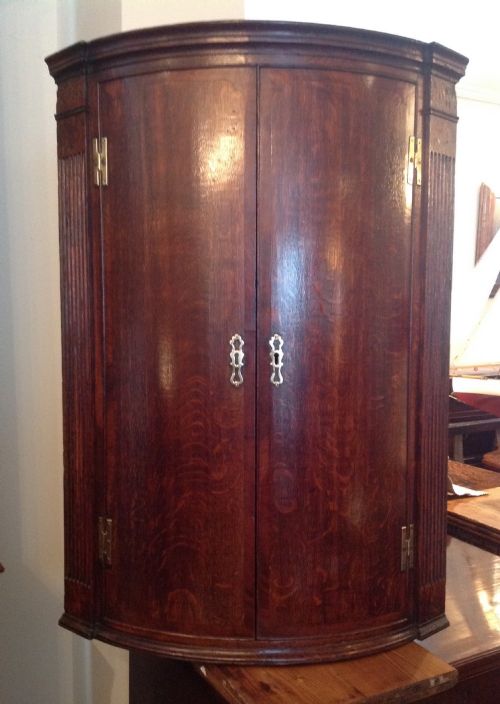


Bowfront Storage Unit
A bowfront storage unit brings a curved Georgian silhouette to awkward corners and tight walls without losing internal depth.
Bowfront Storage Unit
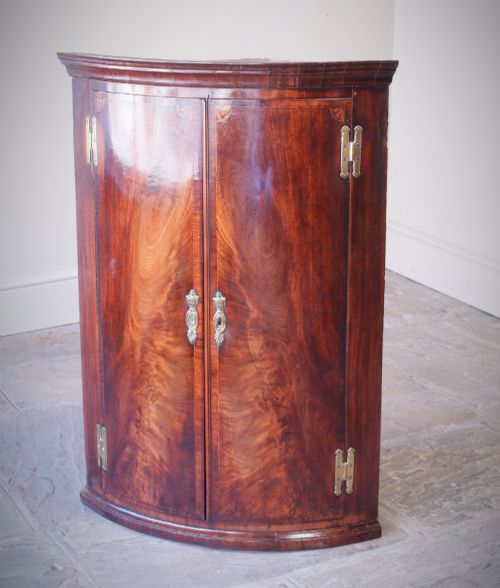
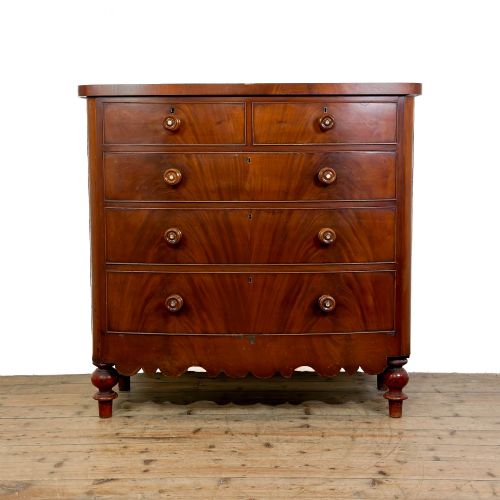
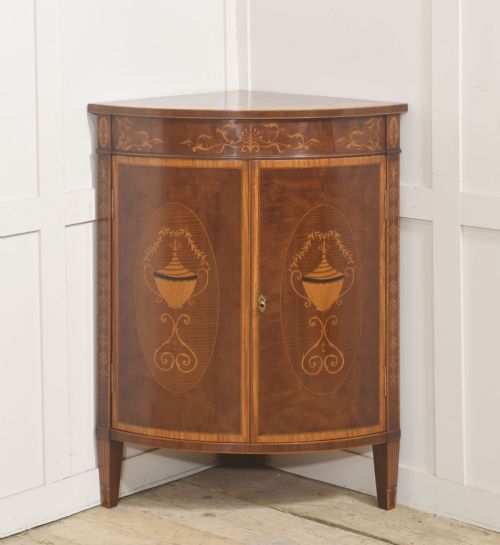
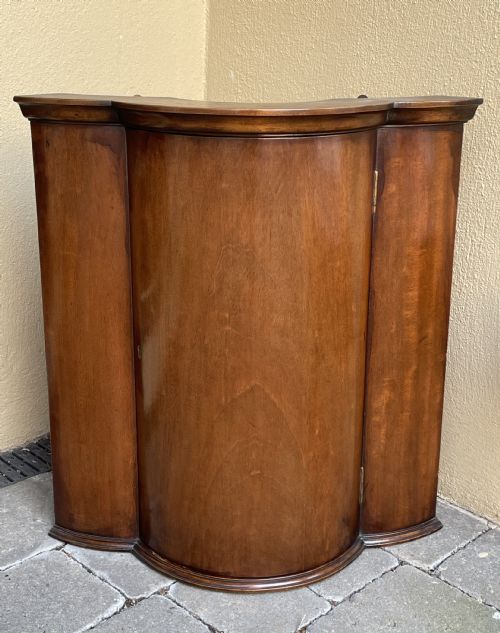
A bowfront storage unit brings a curved Georgian silhouette to awkward corners and tight walls without losing internal depth. These pieces take the form of corner cupboards and chests of drawers, shaped with a rounded front that projects into the room.
Most examples found here date from the Georgian period through the Victorian era, executed in solid timber or rich veneers. Buyers encounter wall-hanging corner cupboards, standing cabinets, and multi-drawer chests in equal measure.
Makers from the eighteenth century onwards utilised this curved design to soften rectilinear rooms and make functional use of empty angles. The form remains a practical solution for modern interiors requiring traditional character.
How they were made
Cabinet makers built these pieces using dense hardwoods such as mahogany and oak, often framing the structure with solid timber while applying fine veneers to the curved exterior doors and drawer fronts. Satinwood and boxwood inlay provided delicate contrast along the borders of panels.
Brass fittings, including H-hinges, escutcheons and drawer pulls, secured the doors and functioned as structural reinforcement. Secondary timbers lined the interiors of drawers and backboards, constructed with traditional joinery methods suited to curved forms.
Bowfront Storage Unit Retail Price Guide 2026
Typical asking prices for bowfront storage unit among the pieces listed under this phrase on Sellingantiques today, from the lower quarter to the upper quarter. They describe what is for sale here now, not the wider market.
Form variations include both wall-mounted corner cupboards and freestanding chests of drawers with curved fronts.
What varies in quality
The sophistication of the timber grain and the precision of the inlay separate finer examples from standard workshop production. Flame mahogany veneer carefully matched across a curved front indicates superior craftsmanship.
The integrity of the structural joints where the curved front meets the straight sides dictates the longevity of the piece. Crisp lines in the boxwood stringing and well-preserved brass hardware reflect the original maker's investment in materials.
The Bowfront Storage Unit Glossary
- Bowfront
- A convex, curved cabinet front that projects outward from the centre. This shape softens the corners of a room and increases internal capacity.
- Stringing
- A narrow line of contrasting wood inlay used to outline panels and drawers. It requires high skill to execute on a curved surface.
- Flame mahogany
- A veneer cut from the fork of a mahogany tree where the branch joins the trunk. It creates a distinctive, fiery pattern across large surfaces.
- Escutcheon
- A protective plate surrounding a keyhole, often cast in brass. It prevents the timber from wearing around the lock.
- H-hinge
- A decorative hinge shaped like the capital letter H, commonly found on eighteenth-century cabinet doors. These allow doors to open flat against the wall.
Bowfront Storage Unit: Frequently Asked Questions
How do I hang a wall cabinet safely?
Wall-hanging corner cupboards require secure fixing directly into masonry or solid timber studs using heavy-duty brackets. The weight of the mahogany or oak construction demands proper load-bearing support.
Position the unit at eye level to allow easy access to internal shelves while ensuring the fixing screws engage with the primary wall structure rather than surface plaster.
What is the difference between hanging and standing models?
Hanging corner cupboards are designed to mount on walls, utilising empty vertical space above furniture and keeping floor areas clear. Standing cabinets rest on the floor, offering greater height and internal capacity.
Both forms utilise the bowfront shape to project outward, but standing versions often include a base section or plinth for stability.
How do I care for mahogany veneer?
Keep wooden storage units away from direct sunlight and heat sources to prevent the timber veneer from drying out and lifting. Regular dusting with a dry lint-free cloth maintains the polish.
Apply a traditional beeswax sparingly to nourish the grain, avoiding modern silicone sprays that build up a hazy residue over time.
How do I date an older wooden cupboard?
Examine the construction methods of the interior drawers and backboards, looking for hand-cut dovetails and circular saw marks versus modern machine milling. Secondary woods like oak or deal provide clues to the region of origin.
Hardware styles, such as brass H-hinges and original locks, also help narrow the period of manufacture between the eighteenth and nineteenth centuries.