



Bowfront Entry Table
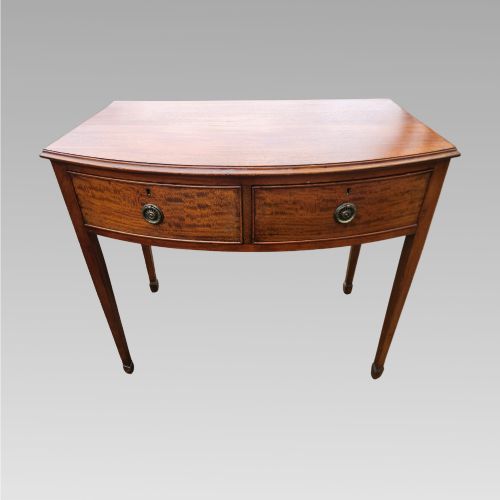
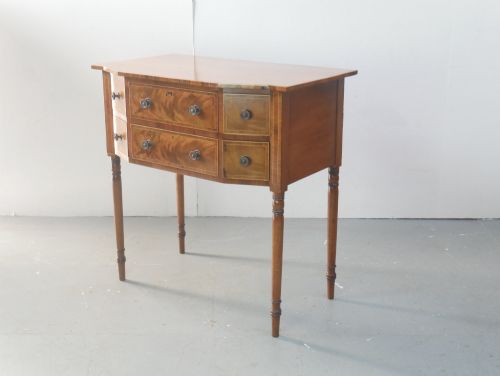
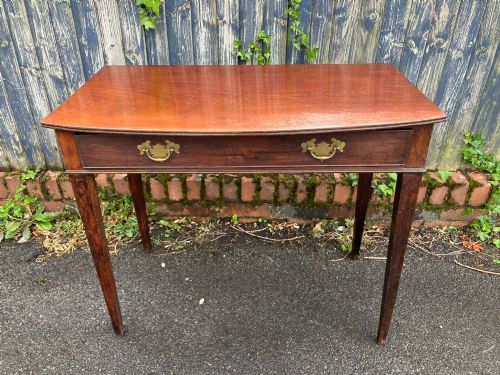
These bowfront entry table pieces offer curved mahogany and pine forms designed for narrow spaces, bringing period craftsmanship straight to the hallway.
Bowfront Entry Table
When you search for a bowfront entry table, you look at narrow furniture forms designed to sit against a wall in a hall or reception space without blocking passage. These pieces appear across several eras, including the Georgian period, Victorian times, and later twentieth-century revivals.
The most common version you meet on this page is the Georgian mahogany side table, often constructed with a gentle outward curve to the front drawer or frame. Side tables, console tables, hall tables, and small servers make up the primary object types available.
Origins stretch from genuine eighteenth-century pieces to later nineteenth-century interpretations in pitch pine or painted finishes, alongside twentieth-century Georgian style reproductions. Buyers often select them for their shallow depth, which suits compact entrance areas.
How they were made
Makers utilised solid mahogany and pitch pine as the primary structural timbers, often shaping the front rails into a sweeping curve. Boxwood inlay frequently appears as a contrasting decorative border along the edges and drawer fronts.
Some examples incorporate painted surfaces combined with gold leaf details, particularly on baroque or revival pieces. Brass fittings and hardware secure the joints and drawer pulls, while skilled carpentry forms the demi-lune and rectangular outlines.
Bowfront Entry Table Retail Price Guide 2026
Typical asking prices for bowfront entry table among the pieces listed under this phrase on Sellingantiques today, from the lower quarter to the upper quarter. They describe what is for sale here now, not the wider market.
Listings feature pieces spanning the Georgian, Victorian, and twentieth-century eras, constructed primarily from mahogany and pitch pine.
What varies in quality
The refinement of the timber grain and the precision of the boxwood inlay define the upper tier of these pieces. Subtle proportioning and the crispness of carved or shaped edges separate superior examples from simpler utilitarian furniture.
Original brass hardware and untouched surface patination indicate careful preservation over centuries. Less sophisticated work relies on heavier construction and simpler painted finishes without the detailed stringing found in finer sheraton period items.
The Bowfront Entry Table Glossary
- Bowfront
- A convex, outward-curving front profile characteristic of certain chests, sideboards, and tables. This shape softens the room's angles and maximises central storage depth while keeping the ends shallow.
- Demi-lune
- A half-moon shape used for table tops and hall stands designed to fit flat against a wall. This format saves floor space in tight hallways.
- Inlay
- A decorative technique where contrasting materials such as boxwood are set into recesses flush with the wood surface. It defines borders and panel outlines on tabletops.
- Sheraton
- A late eighteenth-century furniture style known for restrained classical proportions, straight tapered legs, and delicate inlay work. Pieces from this tradition favour elegance and functional geometry.
Bowfront Entry Table: Frequently Asked Questions
Where should a bowfront entry table go?
These tables fit best in narrow hallways, landings, or reception rooms where floor space is limited. Their shallow depth allows people to walk past easily while providing a surface for keys or decorative objects.
Matching the period style of the table to your existing interior helps it blend naturally into the entranceway. Placing a mirror or small lamp above the table completes the traditional hall arrangement.
How do I identify a Georgian piece?
Georgian tables typically feature rich mahogany timbers, hand-cut dovetails on drawer construction, and restrained decorative elements like boxwood stringing. Examining the underside and drawer linings reveals older woodworking marks and timber ageing.
Later revival pieces from the twentieth century often replicate these forms but display more uniform machine sawing and newer internal secondary woods.
What is the difference between a console and a side table?
Console tables historically relied on wall brackets or specific leg placement for support, whereas standard side tables stand independently on four legs. Both forms function similarly in an entrance setting for display and surface storage.
On this page, makers and dealers sometimes use these terms interchangeably depending on the exact leg configuration and tabletop shape.
How do I care for antique mahogany wood?
Keep mahogany furniture away from direct sunlight and sudden temperature shifts to prevent the timber from splitting or warping. Dusting regularly with a soft, dry cloth preserves the polished surface without building up residue.
Applying a traditional beeswax polish occasionally nourishes the wood and maintains its natural sheen without sealing the pores permanently.