

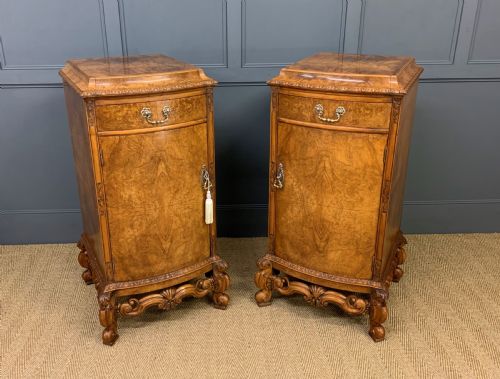


Bow Front Bedside Cupboards
Bow front bedside cupboards bring compact enclosed storage to the bedroom through curved mahogany and walnut forms.

Bow Front Bedside Cupboards
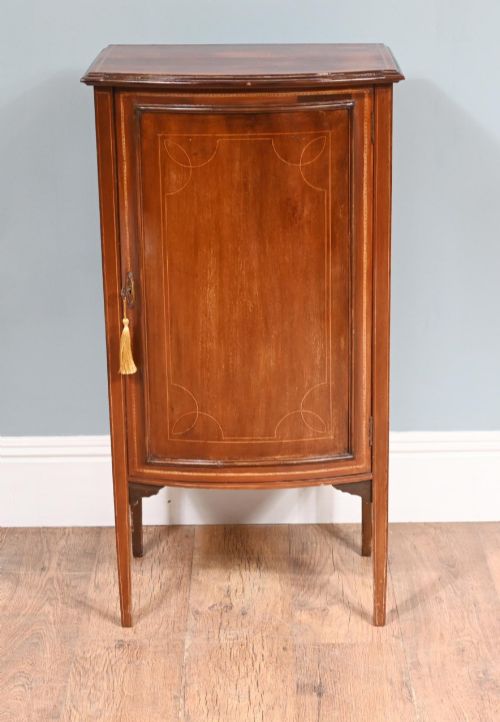
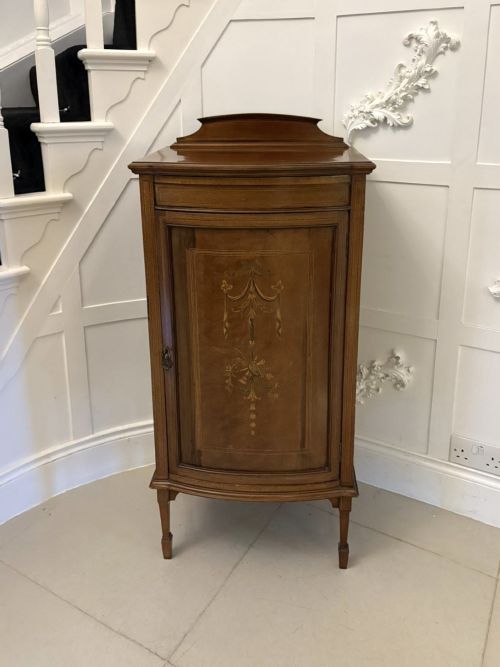
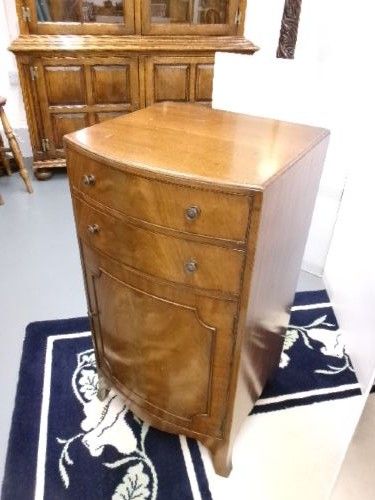
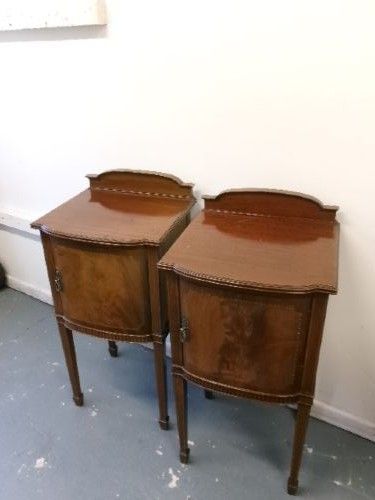
Bow front bedside cupboards provide practical bedside storage through a closed cabinet door and a curved projecting front. Buyers seeking bow front bedside cupboards find pieces primarily in mahogany, walnut, and satinwood, spanning the Georgian, Victorian, and Edwardian eras.
The common forms include pedestal cupboards, pot cupboards, and bedside cabinets alongside occasional commodes and lockers. These pieces range from George III originals to later Edwardian and 1920s interpretations in various revival styles.
Pairs appear frequently alongside single cabinets, often featuring inlaid details, boxwood stringing, or marquetry. Proportions vary from narrow bedside companions to taller pedestal cupboards designed for domestic use.
How they were made
Cabinetmakers constructed these pieces using solid timbers and veneers over secondary woods like pine or oak, shaping the characteristic curved front to achieve the bow profile. Mahogany and burr walnut serve as primary face timbers, frequently enhanced with contrasting satinwood or boxwood stringing and inlay.
Hardware such as brass handles and hinges complement the timber, while internal construction often incorporates single shelves or enclosed pot spaces. Joinery techniques from the Georgian period onward rely on precise dovetailing and frame construction to support the curved doors.
Bow Front Bedside Cupboards Retail Price Guide 2026
Typical asking prices for bow front bedside cupboards among the pieces listed under this phrase on Sellingantiques today, from the lower quarter to the upper quarter. They describe what is for sale here now, not the wider market.
Object forms span bedside cabinets, pot cupboards, commodes, and tall pedestal lockers.
What varies in quality
Quality rests in the choice of timber figure, such as highly grained burr walnut or flame mahogany, and the crispness of any inlaid marquetry or stringing. The smoothness of the curved door fitting and the integrity of the structural joinery distinguish finer examples.
Subtleties in proportion, original brass hardware, and the restraint or ambition of the decorative carving or inlay separate standard utility pieces from exceptional workshop outputs.
The Bow Front Bedside Cupboards Glossary
- Bow front
- A convex curving front profile that projects outward from the centre of the piece. This shape softens the corners of bedroom furniture and maximises internal capacity.
- Pot cupboard
- A small bedside cabinet originally constructed to house a chamber pot behind a single door. Many now serve standard bedside storage functions.
- Marquetry
- Decorative patterns formed by fitting contrasting pieces of veneer into a wood background. It appears on Edwardian and later revival pieces.
- Stringing
- Thin inlaid lines of contrasting wood used to outline drawers, doors, or top edges. Boxwood is frequently used for this linear detail on mahogany carcasses.
- Commode
- A historic term for a decorative cabinet with enclosed storage, sometimes incorporating a commode seat or drawer configuration in Georgian examples.
Bow Front Bedside Cupboards: Frequently Asked Questions
What is a bow front bedside cupboard?
A bow front bedside cupboard is a small enclosed cabinet featuring a convex curving front designed to stand beside a bed.
These pieces provide concealed shelving while taking up minimal floor space in domestic interiors.
How do I date a bedside cupboard?
Dating relies on observing timber choices, construction methods, and stylistic cues such as Georgian bracket feet or Edwardian inlay.
Secondary woods and hardware styles also offer clear indicators of the manufacturing era.
Are these cupboards found in pairs?
Pairs appear regularly alongside single cabinets, particularly from the Victorian and Edwardian periods.
Matching pairs command distinct interest for balanced bedroom placement.
What woods were used for these cabinets?
Mahogany, burr walnut, and satinwood dominate the external surfaces, often supported by oak or pine internally.
Inlays incorporate boxwood and various exotic veneers to create decorative contrast.
How were pot cupboards used historically?
Pot cupboards functioned as bedside receptacles for chamber pots before modern indoor plumbing became standard.
Their enclosed compartments now adapt easily to general bedside storage.