
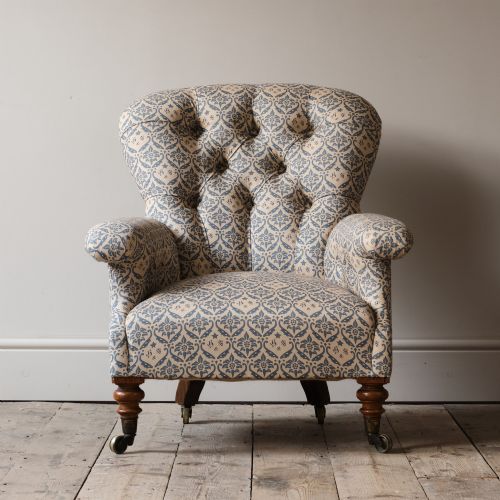
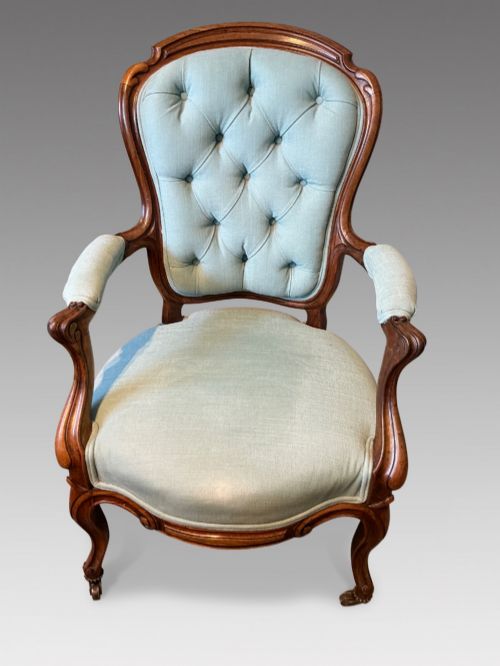
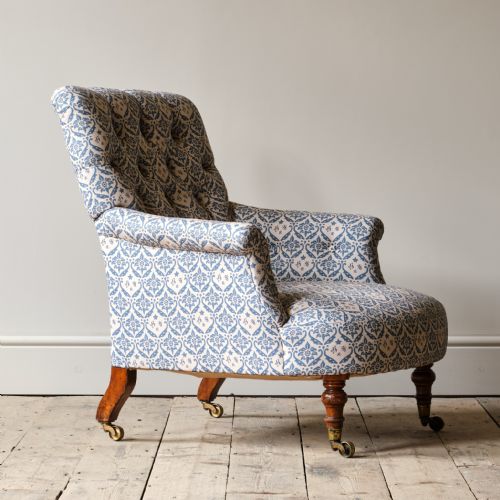
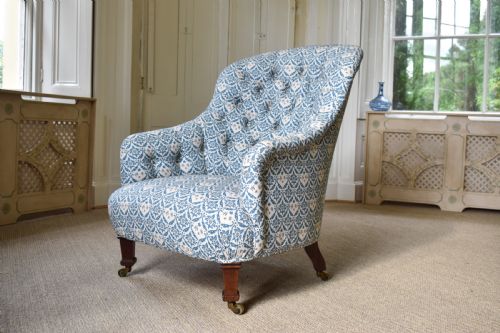
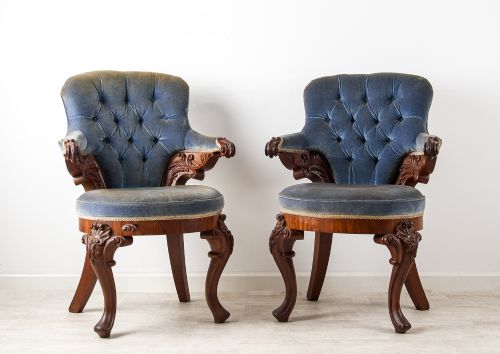


Blue Tufted Chair
A blue tufted chair brings Victorian buttoned upholstery and deep seating into a room, offering period comfort and traditional craft.
How they were made
Construction relies on timber frames of mahogany, walnut, rosewood, beech, and iron. Wood is carved and turned to form the structural support for upholstered seats and backs.
Upholstery techniques involve deep buttoning, known as tufting, applied to fabrics including velvet, damask, ribbing, and ticking. Frames incorporate bentwood and iron supports to achieve specific reclining and rocking forms.
What varies in quality
Quality separates standard production from pieces bearing maker attributions such as Howard and Sons or Miles & Edwards. The refinement of the timber carving and the integrity of the frame construction define the standard of an armchair.
The execution of the buttoning and the choice of covering fabric, from simple ticking to damask and velvet, influence the overall character. The proportion of the frame and the depth of the seating shape the enduring utility of the piece.
Listings feature timber frames in mahogany, walnut, rosewood, beech, and iron, upholstered in velvet, damask, ribbing, and ticking.
Howard and Sons·Miles & Edwards
The Blue Tufted Chair Glossary
- Button back
- Upholstery pulled deep with buttons arranged in a geometric grid. This technique creates the tufted texture characteristic of Victorian seating.
- Slipper chair
- A low-seated bedroom chair without arms designed for ease of dressing. These pieces typically feature upholstered frames from the nineteenth century.
- Chaise longue
- An elongated chair or daybed designed for reclining. These forms combine wooden frames with upholstered seating surfaces.
- Bentwood
- Wood steamed and bent into curved structural shapes. This technique appears in nineteenth century rocking chairs.
- Tub armchair
- A rounded chair where the back and arms form a continuous curved enclosure. These pieces offer deep, enclosed seating.
Blue Tufted Chair: Frequently Asked Questions
How do I identify a Victorian armchair?
Victorian armchairs are identified by timber frames made from mahogany, walnut, or rosewood, combined with traditional upholstery methods. Stylistic markers include carved woodwork, buttoned fabric, and deep-seated proportions.
Many examples reflect revival styles such as Rococo Revival, while others follow simpler country house aesthetics from the nineteenth century.
What is a slipper chair used for?
A slipper chair was historically used in bedrooms for dressing, positioned low to the ground for convenience. Its compact, armless design allowed ample space for heavy nineteenth century garments.
Today, these chairs function well in living rooms, bedrooms, and dressing areas where space is limited.
How do I care for antique velvet upholstery?
Antique velvet requires gentle brushing with the grain to maintain the pile and prevent flattening. Professional cleaning is recommended to preserve the integrity of older textiles.
Keep upholstered pieces away from direct sunlight to prevent fading and protect the original fabric fibres.