
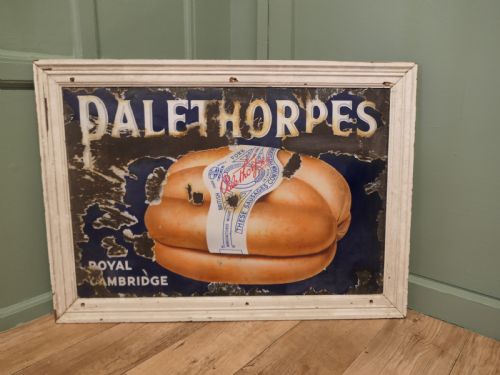
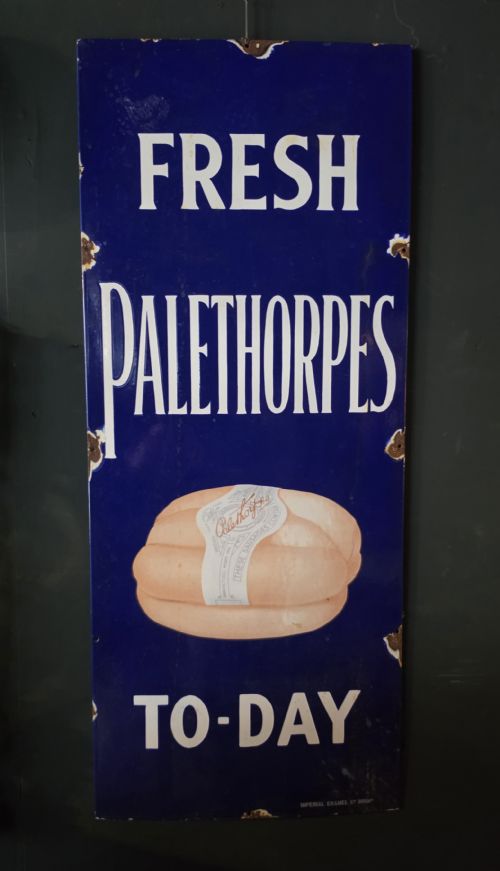


Blue Advertising Sign
A blue advertising sign is a robust piece of commercial history in iron and enamel, offering rich colour and graphic appeal for domestic display.
Blue Advertising Sign
When you search for a blue advertising sign, you encounter durable vitreous enamel panels, painted sheet iron, and framed cardboard displays that originally promoted household goods, newspapers, and tobacco from the Victorian era through the Art Deco period. These objects served utilitarian commercial purposes on shop fronts, carts, and public walls before transitioning into decorative items for modern interiors.
The versions most commonly met on this page include heavy enamel wall signs in striking cobalt shades, alongside specific early twentieth-century trade signage and shop display pieces. They range from small public telephone notices to large pictorial sausage and soap advertisements.
How they were made
Makers fused powdered glass onto sheet iron or heavy iron plates at high temperatures to produce the vitreous enamel surfaces that survive today with glossy, resilient finishes. This technique allowed manufacturers to apply bold blue backgrounds and contrasting lettering that resisted weathering on outdoor walls and carts.
Wood, oak, and glass appear in related frames and structural supports, while cardboard provides the substrate for delicate paper-based wall art housed behind glass. Artisans combined these materials to create sturdy commercial objects designed for daily interaction in public and retail spaces.
Several signs spent decades bolted to cart sides and shop walls, enduring street weather just to end up on living room walls.
What varies in quality
The distinction between standard commercial pieces and superior examples rests in the crispness of the original typography, the depth of the cobalt or blue enamel colour, and the preservation of pictorial details. Signs retaining their original mounting holes, deep gloss, and unaltered graphic surfaces represent the higher end of the range.
Simpler utility notices display straightforward lettering with minimal decorative flair, whereas pictorial advertising boards show intricate multi-coloured graphics fused directly into the metal plate. The integrity of the substrate, whether heavy iron or fragile framed cardboard, dictates the overall physical stability of the piece.
Palethorpes·Watsons Matchless Soap·Will's Capstan·Coca Cola·Eley Cartridges
The Blue Advertising Sign Glossary
- Vitreous Enamel
- A material created by fusing powdered glass to a metallic substrate at high heat. This process results in a glossy, hard-wearing surface impervious to most weathering.
- Sheet Iron
- A malleable iron rolled into thin plates that served as the primary foundation for many outdoor wall signs and trade boards.
- Trade Signage
- Commercial displays commissioned by businesses to identify their premises or promote specific goods directly to the public.
- Art Deco
- A design style prevalent in the nineteen-thirties characterised by sleek geometric lines and stylised motifs seen in contemporary mirrors and adverts.
Blue Advertising Sign: Frequently Asked Questions
How do I hang a heavy enamel sign?
Support the weight using the original mounting holes where possible, fixing directly into solid wall studs or using appropriate masonry anchors.
Avoid tightening screws to the point where stress fractures develop in the surrounding enamel surface.
Can these signs stay outdoors?
While originally designed for exterior trade use, surviving examples often benefit from indoor display to protect exposed iron edges from moisture.
Humidity can cause corrosion around mounting points and flaking where the iron substrate meets the air.
What period do most enamel signs date from?
The majority of surviving commercial enamel pieces originate from the late Victorian era through the nineteen-thirties.
Industrial expansion during these decades drove widespread demand for durable outdoor advertising.