


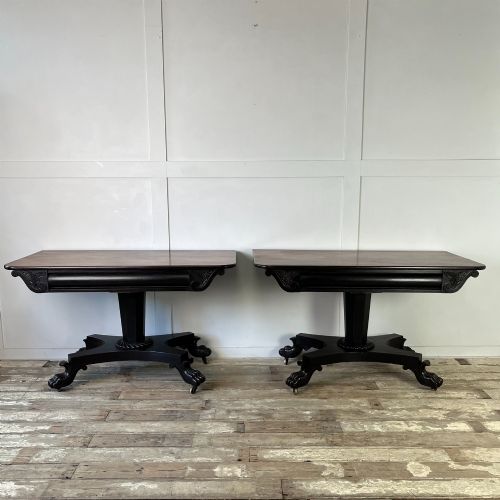


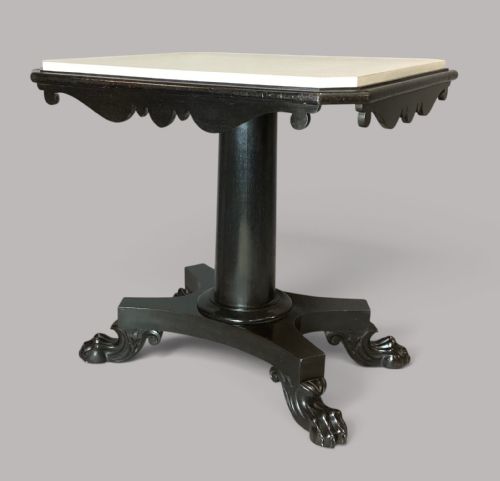


Black Foyer Table
A black foyer table sets a strong architectural tone in an entrance hall, offering a dark silhouette that grounds light spaces.
Black Foyer Table
A black foyer table encompasses forms such as console tables, centre tables, and guéridons designed for a hallway or reception space. When searching for a black foyer table, a buyer most frequently meets nineteenth-century examples in ebonised mahogany, ebonised hardwood, or painted finishes.
The styles span Regency, William IV, Victorian, and French Empire periods, reflecting formal nineteenth-century taste. These surfaces often feature round or oval tops, sometimes paired with marble or burr elm accents.
Materials and construction
Construction relies on timber substrates finished with ebonisation, paint, or blackening to imitate costly exotic hardwoods. Cabinetmakers utilised mahogany, hardwood, and burr elm, shaping them into centre and console tables.
Surface details include brass inlay, parcel silvering, and inset marble tops that provide durability and contrast. Carved wooden elements demonstrate period joinery and finishing techniques typical of nineteenth-century workshops.
Black Foyer Table Retail Price Guide 2026
Typical asking prices for black foyer table among the pieces listed under this phrase on Sellingantiques today, from the lower quarter to the upper quarter. They describe what is for sale here now, not the wider market.
Several tables disguise themselves as architectural monuments on slender legs, ready to host your visiting cards.
Judging quality
Quality rests in the crispness of carved wooden details and the precision of brass inlay work. Finer examples balance heavier materials like marble tops with refined proportions in the base.
The depth and integrity of the ebonised or painted finish distinguish superior pieces from simpler later alterations. Original surface patination holds more appeal than heavily restored or stripped timber.
The Black Foyer Table Glossary
- Ebonised wood
- Timber treated to resemble ebony through staining, painting, or chemical processes. This finish gained popularity during the nineteenth century for formal furniture.
- Guéridon
- A small round table supported by a central pillar or columns. Originating in France, these pieces often functioned as centre tables in reception spaces.
- Console table
- A table designed to stand flat against a wall, frequently secured with brackets. In entrance halls, these provide a narrow surface for display.
- Centre table
- A freestanding table designed to be viewed from all sides in the middle of a room. Nineteenth-century versions frequently occupied the centre of large halls.
Black Foyer Table: Frequently Asked Questions
Where should a black foyer table go?
These tables suit entrance halls and reception spaces where a striking focal point is required. Console versions sit flat against walls to save floor space.
Freestanding centre tables require more surrounding room to appreciate their design from all angles.
How do I identify a nineteenth-century piece?
Look at the timber selection, such as mahogany or burr elm, alongside period construction methods. Joinery marks and the style of carving help date the piece.
Ebonised finishes on nineteenth-century tables often show a distinct natural patina developed over decades.
What is the difference between a console and a centre table?
Console tables are meant to stand against a wall, sometimes with flat backs or wall fixings. They offer a shallow profile suitable for narrow corridors.
Centre tables are built to stand independently in the middle of a space with decoration on all sides.
How do I care for ebonised wood?
Dust the surface regularly with a soft, dry cloth to prevent accumulation. Avoid abrasive cleaners that might damage the dark finish.
Keep the timber away from direct heat sources and strong sunlight to prevent warping and fading.