



Barrel Flintlock Pistols
Barrel flintlock pistols are historical handheld firearms driven by flint ignition, sought by collectors for their intricate mechanical ingenuity and martial heritage.
Barrel Flintlock Pistols
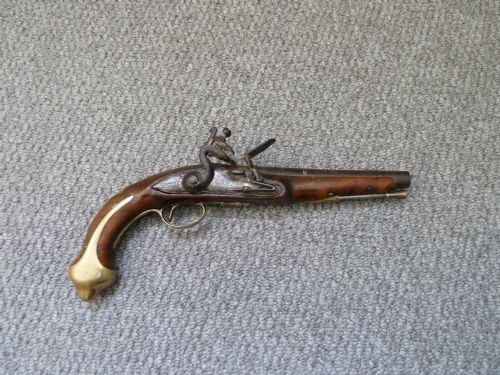
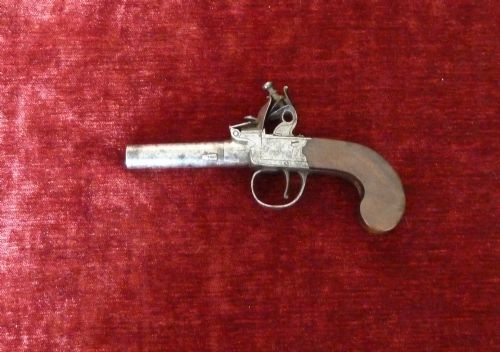
When you search for barrel flintlock pistols, you encounter historic personal firearms spanning the eighteenth and nineteenth centuries. These arms encompass military service pieces, naval weapons, and civilian pocket designs produced across Britain, Europe, and the Ottoman Empire.
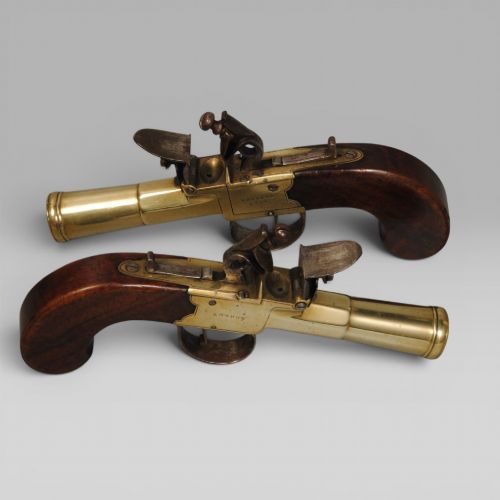
The specimens available on this page most commonly take the form of Georgian military regulation arms, pocket pistols with cannon barrels, and travelling pieces. Styles range from utilitarian Queen Anne designs to ornate French Rococo and Napoleonic period examples.
How they were made
Makers constructed these arms using forged steel and iron for the barrels and lock mechanisms, paired with stocks carved from dense hardwoods such as walnut. Brass and silver frequently appear as furniture components, side plates, and grotesque butt caps.
High-end civilian pieces incorporate decorative enhancements including silver wire inlay and gilt decoration on cast metal surfaces. Military and sea service variants rely on robust brass barrels and sturdy iron furniture built to withstand active service.
Travellers trusted pocket-sized cannon barrel pistols so much that some makers hid the trigger until the cock was pulled.
What varies in quality
Quality in these firearms rests upon the crispness of the maker's engraving on the lock plate and the precision of the metal-to-wood fit in the stock. Finer examples display signed locks by respected gunsmiths alongside intricate cast decoration rather than plain military issue marking.
The structural integrity of the walnut stock and the survival of original surface finishes significantly influence the standing of a piece. Specialist additions like silver wire inlay and hallmarked mounts elevate an item above standard service weapons.
T. Potts, London·Henry Nock·La Motte·James Barber, London·Thomas Henshaw, London·R. Willoughby, Birmingham·I Parr, London·John Rimes, London·J. Robinson, Liverpool·Wilson
The Barrel Flintlock Pistols Glossary
- Flintlock
- A firearm ignition mechanism that uses a flint held in a cock to strike a steel frizzen, creating sparks to ignite the priming powder. This system dominated personal firearms throughout the eighteenth and early nineteenth centuries.
- Cannon barrel
- A barrel shaped with a flared muzzle resembling a small cannon, commonly found on eighteenth-century pocket and turn-off pistols. This design allowed the barrel to be unscrewed for loading from the breech.
- Turn-off pistol
- A firearm featuring a barrel that unscrews from the breech for ball loading, eliminating the need for a ramrod. These pieces were popular for civilian self-defence due to their compact size.
- Holster pistol
- A large firearm designed to be carried in a saddle holster on horseback by military officers or travellers. They typically possess substantial calibre and robust construction for mounted use.
- Proof marks
- Official stamps struck onto the metal components of a firearm to certify that the barrel has been tested against controlled powder charges. British examples frequently bear London or Birmingham proof marks.
Barrel Flintlock Pistols: Frequently Asked Questions
How do you load a flintlock pistol?
Loading requires measuring black powder down the muzzle followed by a lead ball and wadding, secured with a ramrod. A small amount of priming powder is then placed in the pan before the frizzen is closed.
When the trigger is pulled, the flint strikes the steel frizzen to ignite the prime, sending fire through the touchhole to set off the main charge.
Were these pistols used in combat?
Many examples on this page served active roles with cavalry regiments, naval forces, and military officers during the Georgian and Napoleonic conflicts. Service arms were issued to standard troops for close-range combat.
Civilian pocket versions were carried by travellers and citizens for personal protection against highwaymen and urban crime.
How should I clean a flintlock pistol?
Maintenance involves keeping the steel components lightly oiled to prevent active corrosion and storing the piece in a dry environment. The bore and lock mechanism require gentle cleaning after any handling to remove residue.
Avoid aggressive polishing of brass and silver mounts to preserve the historic surface patina accumulated over centuries.
How do I identify the date of a flintlock?
Dating relies on stylistic evolution, barrel proof marks, and maker signatures recorded in historical gunsmith directories. Changes in stock shape and lock geometry help narrow the period.
Government service arms often feature crowned inspection stamps or contractor names that indicate the specific decade of manufacture.