

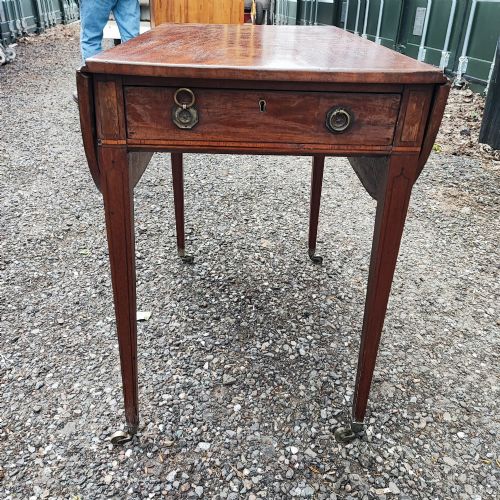
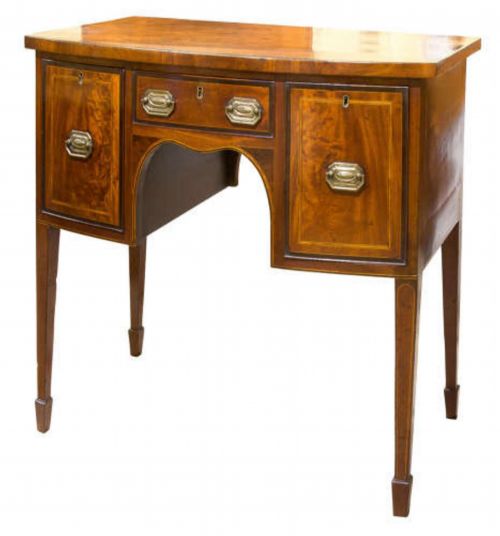
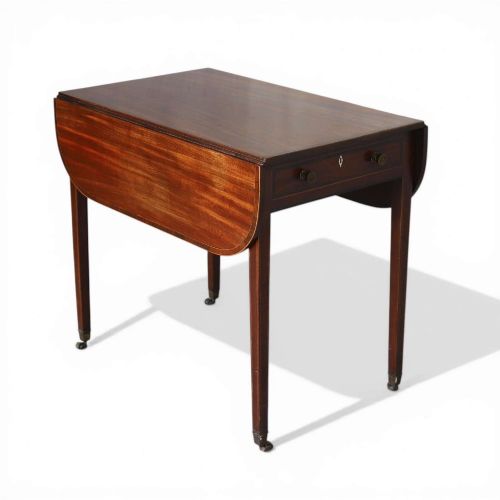
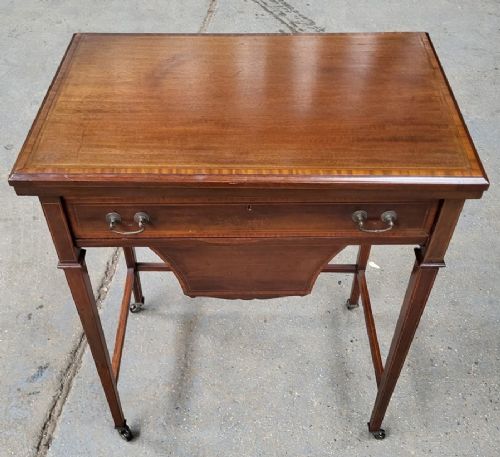


Banded Mahogany Table
These banded mahogany table examples combine rich timber with contrasting wood borders to anchor a room.
Banded Mahogany Table
A banded mahogany table centres on rich timber surfaces defined by contrasting perimeter borders. When you search for a banded mahogany table, you encounter diverse forms spanning dining, Pembroke, sofa, and occasional designs.
The pieces on this page originate from the Georgian, Regency, and Edwardian periods, alongside Sheraton revival interpretations. Pembroke and dining formats appear most frequently among the current selection.
Craftsmen utilised mahogany as the primary structural and surface wood, complemented by distinct framing borders. These tables served various domestic functions, from formal dining to intimate writing and sewing.
How they were made
Cabinetmakers constructed these tables using solid mahogany and mahogany veneers laid over secondary timbers. The defining characteristic involves contrasting perimeter bands set into the top surface.
Workshops applied satinwood, purpleheart, partridge wood, boxwood, ebony, and lacewood for the decorative cross-banding and inlay work. Brass hardware, including castors and pulls, frequently complemented the timber construction.
Banded Mahogany Table Retail Price Guide 2026
Typical asking prices for banded mahogany table among the pieces listed under this phrase on Sellingantiques today, from the lower quarter to the upper quarter. They describe what is for sale here now, not the wider market.
Listings span Georgian, Regency, and Edwardian periods, utilising mahogany alongside satinwood, purpleheart, and partridge wood in diverse dining and occasional forms.
What varies in quality
Quality rests in the selection of timber figures and the precision of the contrasting inlay work. Finer examples display harmonious grain patterns and meticulous timber matching along the borders.
The integrity of the construction, from stable drop-leaf mechanisms to original brass details, separates standard pieces from exceptional ones. Attribution to noted makers or documented design traditions elevates certain works.
Gillows·William Trotter of Edinburgh
The Banded Mahogany Table Glossary
- Cross-banding
- A border veneer applied perpendicularly to the grain of the main surface. This technique frames the top of the table with a contrasting wood.
- Pembroke table
- A small drop-leaf table with hinged flaps on two opposing sides. These versatile pieces often feature a drawer and slender legs.
- Sofa table
- A rectangular library or Pembroke table traditionally placed in front of a sofa. They typically include two small drawers and trestle supports.
- Satinwood
- A durable, yellow-brown exotic timber used extensively for contrasting inlay and banding. Its luminous quality creates a striking visual border.
- Sheraton style
- A neoclassical furniture style characterised by straight lines, tapered legs, and delicate inlay. Named after cabinetmaker Thomas Sheraton.
Banded Mahogany Table: Frequently Asked Questions
What periods do these tables represent?
The pieces span the eighteenth century, Georgian era, Regency period, and Edwardian times. Sheraton revival designs from the early twentieth century also feature.
Each period brings distinct proportions and inlay treatments, reflecting evolving domestic fashions.
Which woods appear in the banding?
Satinwood, purpleheart, partridge wood, boxwood, ebony, and lacewood provide the contrasting borders. These timbers create visual distinction against the dark mahogany base.
Craftsmen selected these contrasting species to highlight the geometric outlines of table tops.
How were Pembroke tables used?
Pembroke tables served as versatile occasional tables for breakfast, writing, or needlework. Their drop leaves allowed them to expand or contract depending on the space available.
Owners moved them easily around the room to suit daily domestic activities.
What distinguishes a sofa table?
Sofa tables feature a long, narrow rectangular top supported by trestle ends or pillar columns. They were designed to sit immediately behind a sofa in the drawing room.
Drawers at the front provided convenient storage for writing materials or sewing items.