





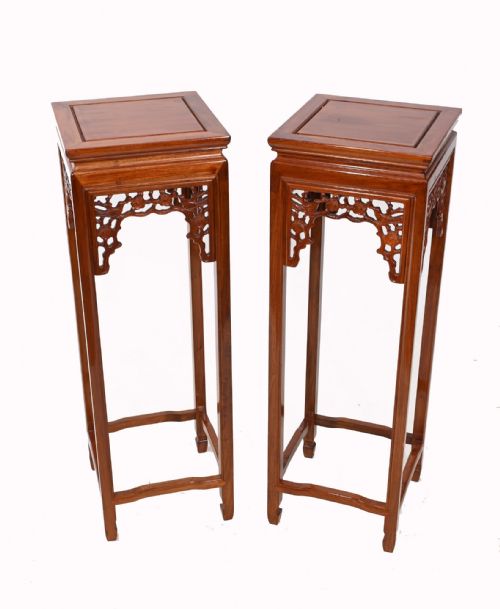




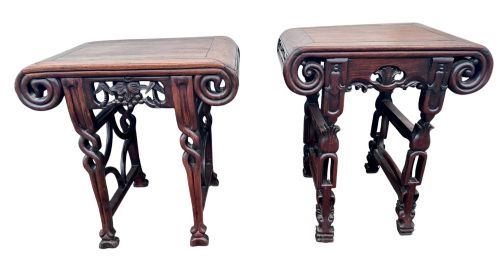


Asian Pedestal Table
An asian pedestal table brings architectural form and dense timber to a corner, serving as a raised platform for plants, vases and lamps.
Asian Pedestal Table
When searching for an asian pedestal table, buyers encounter compact stands and occasional tables originating from Chinese and Japanese workshops. These pieces appear primarily as plant stands, jardiniere supports, and small tables designed to elevate decorative objects.
The material record spans the nineteenth and early twentieth centuries, drawing heavily on traditional forms like Qing Dynasty and Meiji period designs. Makers produced these stands in varied heights to hold porcelain, bronze lamps, and floral arrangements within domestic interiors.
Most examples function as single display pedestals or matched pairs of side tables. Their profiles range from square and octagonal tops to rustic rootwood shapes and multi-tiered urn supports.
Materials and Technique
Joinery relies on dense Asian hardwoods such as hongmu, huali, padouk, and rosewood, chosen for their weight and structural stability. Craftsmen carved these heavy timbers with deep relief panels, pierced aprons, and curved cabriole legs.
Many tops integrate inset panels of white or grey marble, smooth stone, or occasionally deep quartz to provide a cool, stable surface for heavy ceramic vessels. Other variants utilise lacquered paintwork, mother of pearl inlay, or ebonised elm to create decorative contrast.
Asian Pedestal Table Retail Price Guide 2026
Typical asking prices for asian pedestal table among the pieces listed under this phrase on Sellingantiques today, from the lower quarter to the upper quarter. They describe what is for sale here now, not the wider market.
Some nineteenth century artisans carved entire table bases to resemble natural tree roots, transforming humble seating into tangled wooden sculptures.
Assessment of Quality
The standard of carving distinguishes standard production from finer workshop output, evident in the crispness of floral motifs and the depth of undercut foliage. Sharp, deliberate chisel work on hardwood frames indicates skilled hand execution.
Timber selection and stone fitting also govern the standard of a piece. Tightly grained hongmu or well-matched marble inserts that sit flush within the wooden rebate separate robust, high-status furniture from simpler utility stands.
The Asian Pedestal Table Glossary
- Hardwood
- Dense timber such as rosewood, hongmu or huali used for structural durability and intricate carving. These slow-growing woods take a high natural polish.
- Jardiniere stand
- A tall pedestal specifically built to support a heavy ceramic plant pot or flower bowl. These tables often feature circular tops and braced legs.
- Marble top
- A polished stone slab inset into the wooden frame of a table or stand. This surface resists moisture from plant pots and adds considerable weight.
- Meiji period
- The era of Japanese history spanning from 1868 to 1912. Pieces from this time often incorporate bronze elements and ebonised finishes.
- Qing Dynasty
- The final imperial dynasty of China, lasting from 1644 to 1912. Furniture from this period is noted for deep relief carving and dense tropical woods.
Asian Pedestal Table: Frequently Asked Questions
What is an asian pedestal table used for?
These tables provide a sturdy raised platform for displaying heavy items like ceramic vases, bronze sculptures, and potted plants. Their compact footprint allows them to occupy narrow corners or act as low side tables beside seating.
Historically, scholars and collectors used them to elevate prized objects of art off the floor to a level suitable for closer inspection. Today they serve identical display functions in domestic interiors.
How do I identify the wood on these tables?
Asian pedestal tables frequently employ dense, heavy tropical timbers such as hongmu, padouk, and rosewood. These woods display tight grain patterns and deep natural colouration ranging from dark red to near-black.
By contrast, lighter structural elements may use elm or generic Asian hardwoods. The substantial weight of the piece usually indicates the presence of these dense timbers rather than softer European woods.
Are marble top tables waterproof?
The marble insert provides a cool, moisture-resistant surface designed to hold damp plant pots or heavy flower vases without damaging the surrounding wood. Stone naturally tolerates incidental water spills better than polished timber.
However, standing water should still be wiped dry promptly to prevent mineral staining or dulling of the polished stone surface over extended periods of use.
How do I tell Chinese and Japanese pieces apart?
Chinese pieces from this category often rely on deep relief-carved tropical hardwoods like hongmu and huali, frequently featuring marble or quartz inserts. The decorative motifs draw heavily on traditional Qing Dynasty iconography and floral themes.
Japanese items from the Meiji period more commonly utilise ebonised elm, lacquer, or incorporated bronze elements, such as sculptural elephant figures supporting the table structure.