
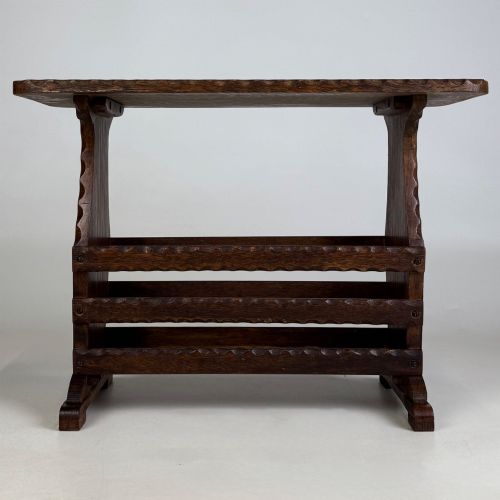
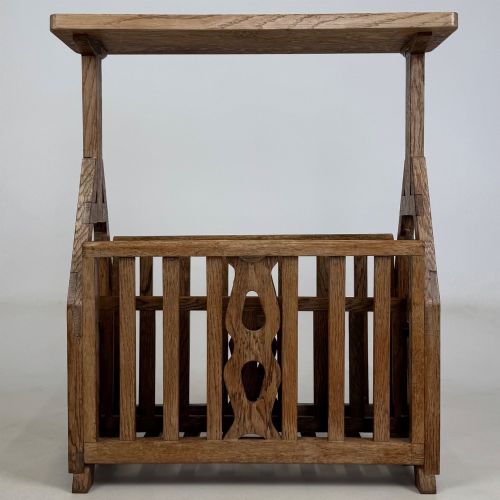
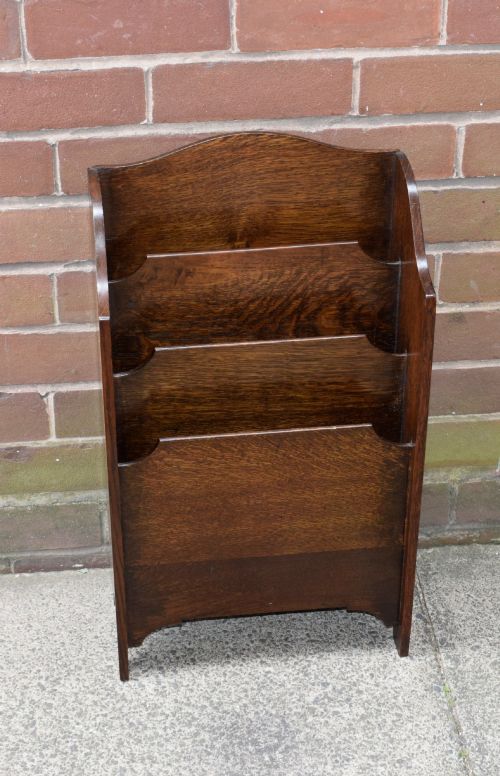


Arts and Crafts Magazine Stand
An arts and crafts magazine stand brings honest timber and utility into a room, offering a sturdy home for periodicals.
Arts and Crafts Magazine Stand
When you search for an arts and crafts magazine stand, you encounter utilitarian furniture designed to hold periodicals, books and papers. The examples on this page span from the late nineteenth century through to the interwar period, capturing a shift in domestic design.
The most common version met here is constructed from oak, often taking the form of a freestanding rack or a combined side table. Alongside standard magazine racks, the evidence shows slope-shelf book troughs, open bookcases, and occasional pieces featuring integrated pipe racks.
Origins stretch across the Victorian era, the Edwardian period, and the 1920s and 1930s. Makers drew upon the broader Arts and Crafts ethos, whilst occasional items incorporate Anglo-Indian influences or mother of pearl inlay.
How they were made
Construction relies primarily on solid oak, selected for its strength and prominent grain. Woodworkers built these stands to withstand daily use, frequently combining storage compartments with functional surfaces like folding reading tables.
Metalwork plays a key role, with copper and brass applied as structural mounts or decorative highlights. These metal elements bring a contrasting texture to the timber frames, characteristic of the period's workshop output.
What varies in quality
Quality reveals itself in the selection of timber and the integrity of the joinery. Superior pieces display thoughtful construction in the divisions and shelves, handling weight without sagging.
The integration of secondary materials dictates distinction. Where brass, copper, or mother of pearl inlay is utilised, the precision of the fitting separates standard utility items from more ambitious workshop pieces.
The Arts and Crafts Magazine Stand Glossary
- Magazine Rack
- A dedicated piece of furniture designed to hold periodicals upright or in troughs. These items often double as side tables or incorporate book storage.
- Book Trough
- An open-topped trough designed to hold books or magazines for easy access. They frequently feature slope shelves for display.
- Mother of Pearl
- An iridescent inner shell layer used for decorative inlay work. It appears on select nineteenth-century pieces to create contrasting geometric or floral patterns.
Arts and Crafts Magazine Stand: Frequently Asked Questions
What periods do these stands cover?
The pieces span from the late nineteenth century through the Edwardian era and into the 1930s. This covers the height of the movement as well as later interwar interpretations.
Most items cluster around the 1890 to 1920 window, reflecting the peak years of domestic craft production.
What materials were commonly used?
Oak is the predominant timber found across these listings, valued for its durability and strong grain pattern. Mahogany also appears in select pieces.
Metal components in brass and copper frequently accent the wooden structures, alongside decorative mother of pearl inlay.
Are these stands purely for magazines?
While primarily built for periodicals, many designs serve multiple functions. Some combine magazine storage with side tables, folding reading surfaces, or pipe racks.
Open-front troughs and small bookcases also feature in the selection, serving general reading needs in a fireside setting.
How do I identify an older piece?
Dating relies on construction methods, timber selection, and stylistic markers associated with specific decades. Victorian and Edwardian examples often show distinct joinery compared to 1920s or 1930s equivalents.
Details like brass fittings and inlay work help anchor pieces to the late nineteenth or early twentieth century.