



Arts and Crafts Gold Pendant
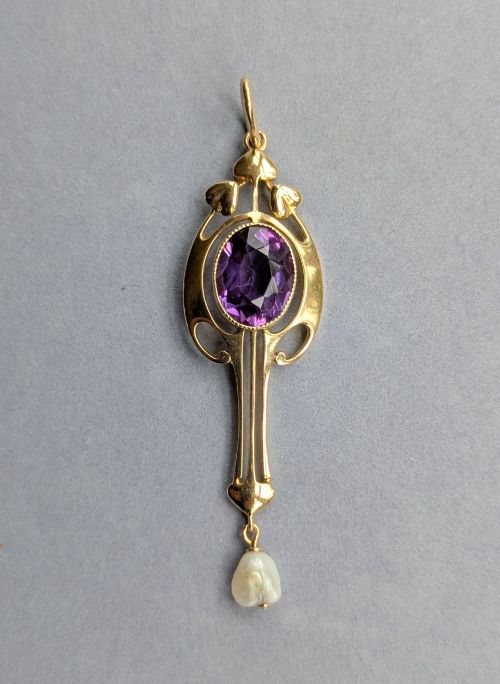
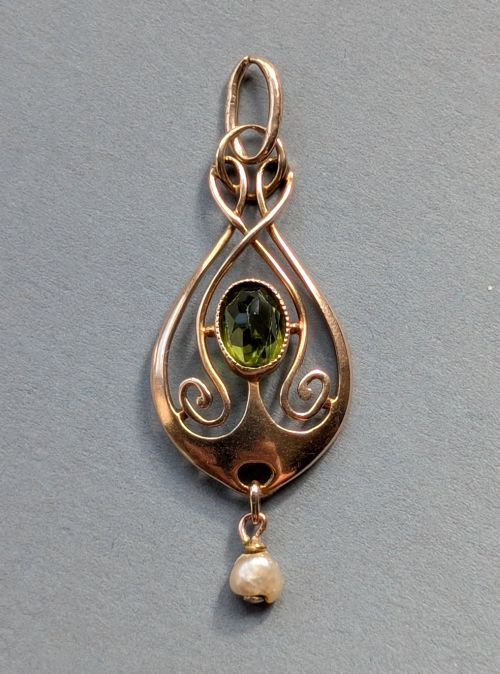
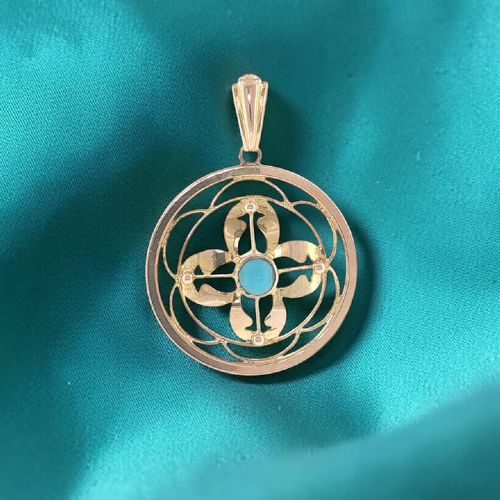
An arts and crafts gold pendant brings together fine metalwork and coloured stones from the turn of the twentieth century, offering a wearable piece of design history.
Arts and Crafts Gold Pendant
An arts and crafts gold pendant typically emerges from the decades around nineteen hundred, capturing the shift away from mass production toward handcrafted design. These pieces often take the form of pendants, necklaces, and lavalieres created during the Edwardian period and the early twentieth century.
You are most likely to encounter gold settings paired with pearls, turquoise, peridot, or tourmaline. The forms draw on styles from the arts and crafts movement and art nouveau, showing careful attention to line and natural motifs.
Materials and construction
The construction relies on worked gold, ranging from nine carat and fifteen carat gold to silver gilt, providing a rich metal base for the design. Makers set natural stones such as turquoise, garnet, chrysoprase, and aquamarine directly into the handmade frames.
Techniques involve careful hand-setting of gems and detailed metal manipulation, sometimes incorporating silver alongside gold to create contrasting tones within the pendant structure.
Arts and Crafts Gold Pendant Retail Price Guide 2026
Typical asking prices for arts and crafts gold pendant among the pieces listed under this phrase on Sellingantiques today, from the lower quarter to the upper quarter. They describe what is for sale here now, not the wider market.
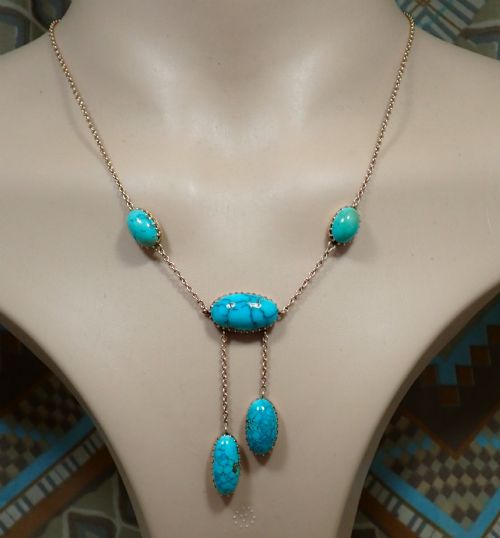
Some matrix turquoise stones retain enough host rock to look like tiny, blue-tinted islands floating in stone.
Evaluating the pieces
Quality separates through the subtlety of the metalwork and the choice of stones. Pieces attributed to notable designers show a distinct artistic vision in the arrangement of gold wire and gem placement.
The refinement of the hand-finishing marks the difference between standard production and exceptional studio work from the period.
Murrle Bennett·Dorrie Nossiter·Omar Ramsden and Alwyn Carr·John Paul Cooper·Levinger and Bissinger·Arthur and Georgie Gaskin·Liberty and Co·Artificers Guild
The Arts and Crafts Gold Pendant Glossary
- Lavalier
- A pendant featuring a dangling stone or drop suspended from a central motif. This style was particularly popular during the Edwardian era.
- Silver gilt
- Silver that has been coated with a thin layer of gold. It provides the appearance of gold while utilising a silver base.
- Matrix turquoise
- Turquoise stone that retains portions of its host rock within the gem. This creates distinctive webbed patterns across the blue surface.
- Plique-à-jour
- An enamelling technique where enamel is applied without a backing, resembling miniature stained glass. It allows light to pass directly through the colour.
Arts and Crafts Gold Pendant: Frequently Asked Questions
What defines an arts and crafts gold pendant?
These pendants are defined by their handmade aesthetic, characteristic of the late nineteenth and early twentieth centuries. They often feature natural gemstones set in yellow or rose gold.
The designs emphasise craftsmanship and artistic expression over machine-made uniformity, frequently incorporating motifs inspired by nature.
How do I care for my pendant?
Care requires gentle handling due to the delicate nature of antique settings and softer stones like pearls and turquoise. Avoid chemical cleaners and ultrasonic baths.
Store the piece individually in a lined box to protect the gold work and prevent scratching from other jewellery.
What stones appear in these pieces?
Common stones include turquoise, peridot, tourmaline, aquamarine, garnet, chrysoprase, and pearls. Makers selected these for their colour and texture rather than sheer monetary value.
The stones are frequently cut en cabochon or in simple facets to suit the handcrafted metal settings.
How can I tell the period?
Dating relies on stylistic markers such as the characteristic whiplash lines of art nouveau or the structural honesty of the arts and crafts movement. Hallmarks on the gold provide further chronological clues.
Comparing construction techniques with documented works from makers active around nineteen hundred helps confirm the era.