



Art Nouveau Caddy
An art nouveau caddy brings sinuous, organic lines and floral motifs to tea storage, offering both decorative charm and period utility.
Art Nouveau Caddy
When you search for an art nouveau caddy, you are looking at items designed during the height of the movement spanning the late nineteenth and early twentieth centuries, though related pieces stretch from the nineteenth century into the Edwardian era. The selection you meet here encompasses actual lidded tea caddies as well as associated spoons and canisters sharing the same aesthetic vocabulary.
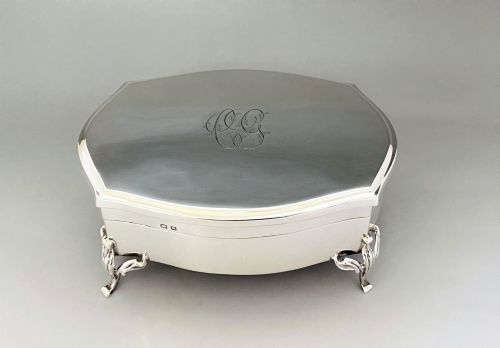
Makers across Britain, Europe and America applied these sinuous styles to containers made of sterling silver, silver, and various woods, often pairing them with related desktop accessories like revolving bookcases. The most literal interpretations take the form of an antique tea caddy from around nineteen ten, while smaller items like caddy spoons and preserve spoons carry the same unmistakable whiplash curves.
The objects span multiple decades, drawing on Edwardian sensibilities, Austrian Secessionist ideals, and Arts and Crafts principles. Whether you examine a lidded canister by Josef Margold or an anonymous wooden container, the underlying spirit remains rooted in organic forms and floral design.
Materials and construction
These pieces rely heavily on sterling silver and standard silver, shaped through casting, hammering, and repousse work to create swelling floral motifs and flowing plant tendrils. Silversmiths worked metal to achieve tactile surfaces that catch the light along curved handles and lidded rims.
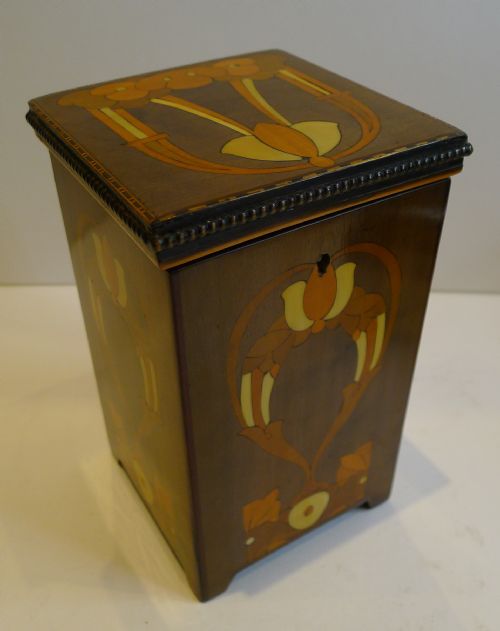
Wooden examples utilise mahogany, oak, fruitwood inlay, and satinwood, constructed with traditional joinery to house dry tea leaves securely. Brass and iron elements appear on functional accessories, providing sturdy hinges and mounts that complement the primary materials.
Art Nouveau Caddy Retail Price Guide 2026
Typical asking prices for art nouveau caddy among the pieces listed under this phrase on Sellingantiques today, from the lower quarter to the upper quarter. They describe what is for sale here now, not the wider market.
Materials represented include sterling silver, silver, mahogany, oak, iron, fruitwood inlay, brass, and satinwood.
Assessing quality in design and execution
Quality rests in the conviction of the design and the crispness of the execution, separating standard production from exceptional artistry. A superior piece shows purposeful hand-manipulation in silver or precise inlay in wood rather than a mere mechanical application of decorative motifs.
The weight of the metal and the snugness of the lidded fit dictate the tactile success of a container. Better examples maintain harmony between function and ornamentation, where hinges, handles, and structural joints integrate seamlessly with the organic style.
Oliver Barker·Georg Jensen·Josef Margold
The Art Nouveau Caddy Glossary
- Art Nouveau
- A decorative style popular from the late nineteenth century to the First World War, characterised by flowing, asymmetrical lines inspired by natural forms. It rejected historic revivalism in favour of dynamic, plant-like rhythms.
- Sterling silver
- A silver alloy containing ninety-two point five percent pure silver and seven point five percent other metals, usually copper, ensuring durability for functional items. It provides the bright reflective surface seen on many spoons and boxes.
- Austrian Secessionist
- A regional variant of the wider modern movement that rejected academic art in Vienna, focusing instead on geometric clarity combined with organic ornamentation. Josef Margold worked within this progressive milieu.
- Repousse
- A metalworking technique where the artisan hammers the front of the sheet to form a raised design, often refined from the reverse side. This method creates the characteristic low-relief floral swellings on metal containers.
- Inlay
- A technique where pieces of contrasting wood, such as fruitwood or satinwood, are inserted into recesses within a primary wood base to form a pattern. It adds subtle tonal variation to wooden surfaces.
Art Nouveau Caddy: Frequently Asked Questions
How were tea caddies used?
Tea caddies were originally high-status domestic objects used to store precious tea leaves under lock and key when tea was an expensive commodity. Servants or masters would dispense the leaves using matching spoons into teapots for guests.
Over time, as tea became widely accessible, caddies remained prized household accessories placed on sideboards or tables. Their lidded designs were engineered to protect the aromatic leaves from moisture and loss of flavour.
How do I date these pieces?
Dating relies on stylistic markers, hallmarks on silver, and construction methods characteristic of specific decades. Pieces created around nineteen hundred often display exuberant whiplash curves, whereas items from nineteen twenty or later may show cleaner geometric influences.
Silver components frequently bear hallmarks and maker marks that pinpoint the exact year and place of assay. Comparing the decorative motifs against documented periods helps establish whether a piece belongs to the Edwardian era or the interwar years.
How should I care for silver and wood?
Silver requires gentle cleaning with appropriate cloths to remove tarnish without wearing away delicate repousse details. Avoid harsh chemical dips that strip the natural patination built up over decades of existence.
Wooden items benefit from stable indoor humidity away from direct heat sources to prevent wood movement or splitting. Occasional light waxing preserves the finish of mahogany, oak, and inlaid satinwood.