


Art Deco Five Stone Diamond Ring
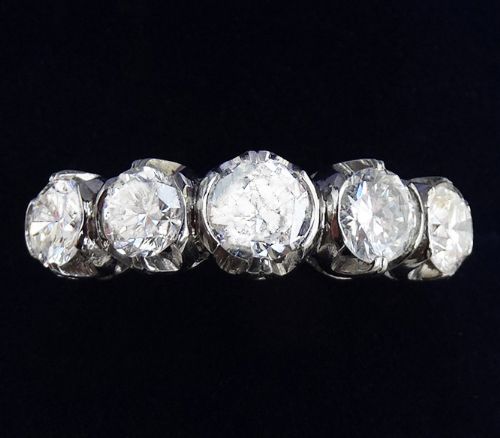
An art deco five stone diamond ring balances linear geometry with graduating stones across the hand, offering a distinct signature of twentieth-century design.
Art Deco Five Stone Diamond Ring
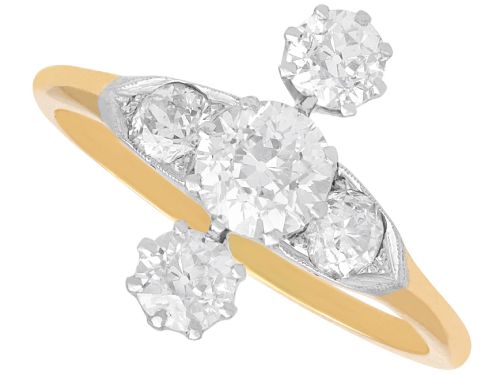
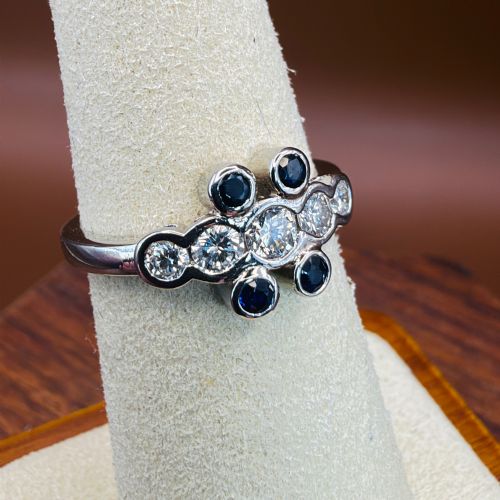
When searching for an art deco five stone diamond ring, a buyer encounters pieces arranged in a linear graduating row across the finger. The most common iteration on this page pairs diamonds with alternating sapphires, rubies, or emeralds, whilst all-diamond versions rely on the stepped layout characteristic of the period.
The periods represented span the 1920s and 1930s predominantly, with later mid-century revivals also appearing. Forms adhere strictly to the ring classification, utilising platinum, white gold, and yellow gold mounts.
How they were made
Craftsmen utilised platinum and white gold to create bright, reflective settings that enhanced the whiteness of old cut diamonds. Yellow gold bands combined with platinum-topped settings also frequently appear in the record, fusing traditional warmth with modern metalworking techniques.
Stones were typically set in claw or bezel arrangements designed to maximise light passage while maintaining the geometric lines demanded by the style. Old cut and old mine cut diamonds dominate the construction, often complemented by calibré-cut rubies, sapphires, or emeralds.
Diamond weights span from fractional fractions up to substantial multi-carat centre stones.
What varies in quality
The harmony of stone graduation dictates the overall visual success of the piece. Stones that diminish smoothly from the centre create a balanced profile, whereas abrupt size drops disrupt the rhythm of the design.
Metalwork execution separates standard production from finer examples. Crisp channel edges, precise claw placement, and minimal solder intervention indicate higher workshop proficiency.
The Art Deco Five Stone Diamond Ring Glossary
- Old cut
- A diamond cut predominant before the modern brilliant cut, characterised by a smaller table, higher crown, and open culet. These stones display a softer, candlelit sparkle under low light.
- Platinum
- A dense, strong white metal widely adopted during the period for its ability to hold intricate piercing and secure small pavé stones safely. It does not tarnish or fade with age.
- Calibré-cut
- Small gemstones cut specifically to fit a geometric channel or pattern within a mounting. This technique requires precise hand-shaping by the lapidary.
- Culet
- The tiny flat facet at the bottom of a gemstone where the pavilion facets meet. Older stones often feature a distinct open culet visible through the table.
- Half eternity
- A ring band featuring gemstones set across the upper half of the circumference. This design allows for easier resizing than a full eternity band.
Art Deco Five Stone Diamond Ring: Frequently Asked Questions
How do I wear a five stone ring daily?
These rings pair easily with wedding bands due to their straight linear profiles. Many buyers choose them specifically for daily engagement wear.
Prong and bezel settings sit comfortably against the hand, though platinum or gold bands benefit from periodic checks by a jeweller to ensure stone security.
What is the difference between old cut and modern stones?
Old cut diamonds feature hand-cut facets tailored to individual rough crystals rather than strict mathematical symmetry. This gives them a distinct charm under artificial light.
Modern brilliant cuts reflect light with intense white flashes, whereas older stones produce broader, softer patterns.
Are coloured gemstones common in these rings?
Sapphires, rubies, and emeralds frequently alternate with diamonds in multi-stone configurations. These coloured accents define the aesthetic of the era.
Gemstone selection often follows specific colour palettes favoured by makers during the 1920s and 1930s.
How can I date a ring accurately?
Stylistic markers such as geometric gallery work and platinum settings point towards the interwar decades. Hallmarks and assay marks inside the band provide official registration years.
Comparing the cut of the diamonds with known period styles helps narrow the manufacturing window further.