
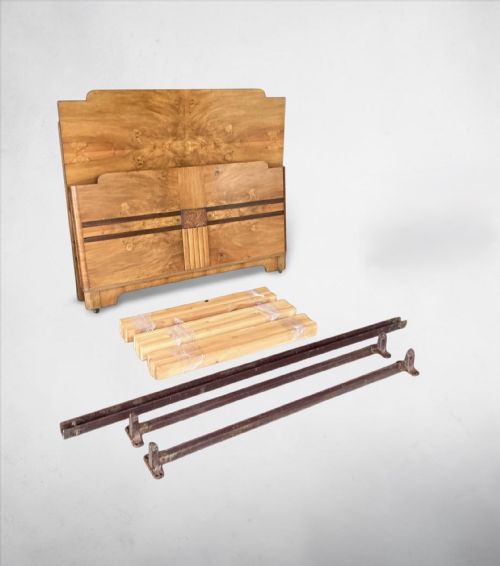
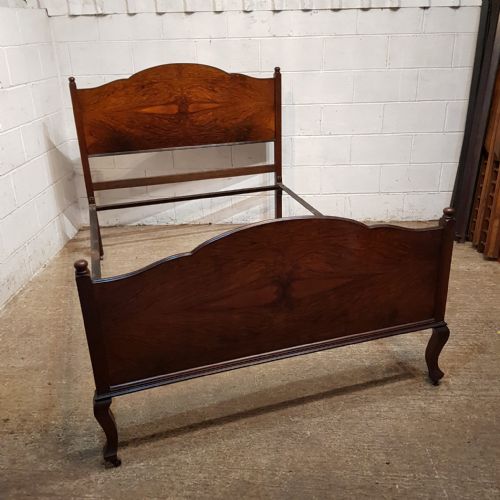


Art Deco Double Headboard
An art deco double headboard brings architectural lines and rich figured woods straight to the bedroom, grounding the room in period character.
Art Deco Double Headboard
When you search for an art deco double headboard, you are looking at the upper focal point of a sleeping frame designed during the interwar years. These pieces anchor the bed with bold geometric or curvaceous silhouettes typical of the period.
On this page, you are most likely to meet walnut and maple iterations originating from the nineteen-thirties. Many examples survive as complete bedsteads or full beds rather than detached panels, often incorporating matching bedside tables or integral cabinets.
The aesthetic ranges from streamlined skyscraper and Odeon forms to decorative fan and sunburst patterns. Originating widely from French workshops and British makers, these pieces showcase the era's fascination with dramatic grain patterns and symmetry.
Assessing quality in period pieces
The distinction between standard examples and the finest work lies in the choice and handling of the timber. Highly figured veneers, such as heavily marked burr walnut or meticulously matched bird's eye maple, command greater attention for their visual depth.
Design complexity also sets pieces apart, moving from simple rectangular boards to elaborate fan shapes, skyscraper steps, and compositions incorporating built-in bedside cabinets. The skill with which contrasting stringing and exotic woods are integrated reflects the maker's hand.
Listings feature pieces spanning from nineteen-hundred to nineteen-thirty, with walnut and maple dominating the material palette.
H.L. Epstein Brothers
The Art Deco Double Headboard Glossary
- Burr walnut
- A prized timber harvested from the wart-like growths on walnut trees, yielding turbulent and swirling grain patterns. It provides a luxurious surface texture highly favoured by period designers.
- Veneer
- A thin slice of decorative wood applied over a more stable secondary timber base. This technique allowed cabinetmakers to display expensive and heavily figured grain without warping risks.
- Skyscraper style
- A vertical design vocabulary inspired by early twentieth-century metropolitan architecture. Pieces utilise stepped vertical tiers to create height and drama.
- Macassar
- A dense, dark exotic wood featuring distinctive brown and black stripes. It was often utilised as a contrasting border inlay against lighter maple or satinwood.
Art Deco Double Headboard: Frequently Asked Questions
What size mattress fits these beds?
Most pieces listed are standard double sizes, though historical French proportions can occasionally vary slightly from modern UK dimensions. It is sensible to check the exact internal width and length before purchasing a new mattress.
Because many of these frames include attached bedside tables or integral cabinetry, the overall footprint of the bed is wider than a standard mattress alone. Measuring the entire wall space ensures the built-in units fit comfortably in your room.
How do I care for figured wood?
Period veneer requires protection from direct sunlight and excessive heat sources to prevent fading or lifting of the delicate wood surface. Regular dusting with a soft, dry cloth keeps the finish clean without introducing moisture.
Applying a traditional beeswax polish occasionally helps nourish the timber and maintain the natural lustre of the walnut or maple. Avoid silicone-based sprays, as they can penetrate older finishes and damage the grain.
Are bedside tables always attached?
While many designs incorporate integral cabinets or attached bedside tables as part of a unified framework, others remain standalone headboards or complete bedsteads without fixed storage. The configuration depends entirely on the specific model and its original commission.
Pieces with attached cabinetry offer a streamlined, architectural look that defines the sleeping space. When placing these in a bedroom, ensure you have sufficient wall clearance for the extended width.
How do I date an art deco bed?
Dating relies on stylistic cues, construction methods, and the specific materials popular during the interwar decades. Pieces from the nineteen-twenties often lean towards heavier proportions, while nineteen-thirties examples embrace streamlined Odeon and skyscraper silhouettes.
The use of specific veneers, such as blonde bird's eye maple paired with contrasting macassar, typically points towards the height of nineteen-thirties British and French cabinetmaking. Documentation or maker stamps, where present, provide definitive verification.