
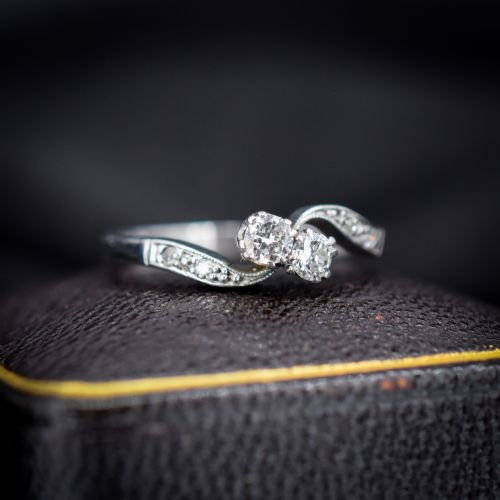
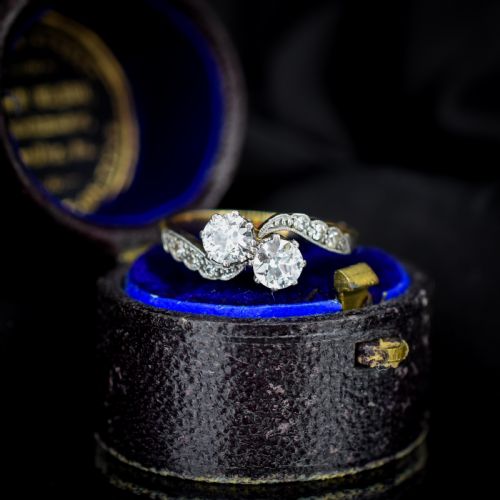


Art Deco Diamond Twist Ring
An art deco diamond twist ring curls two stones around the finger in a fluid sweep that defines period elegance.
Art Deco Diamond Twist Ring
An art deco diamond twist ring wraps the finger with asymmetrical grace, bringing together two or more gems in a continuous line. When you search for this phrase, you find rings that span the Edwardian era through the 1940s, though the 1920s and 1930s predominate.
These pieces frequently appear as two-stone 'toi et moi' designs, crossover styles, or trilogy arrangements where diamonds meet rubies, sapphires, emeralds, or additional diamonds. The forms bend and curve, departing from rigid symmetry to create movement across the hand.
Most examples combine platinum settings with 18ct gold, utilising white metals on the face to brighten the stones and yellow gold for the shank. You encounter everything from delicate low-carat solitaire twists to substantial multi-carat old cut diamond centerpieces.
Materials and Construction
Goldsmiths paired platinum with 18ct gold, fusing the durable white metal onto the upper face of the band to hold small claw or illusion settings securely. This technique allowed jewellers to work with finer metal thicknesses while keeping precious stones firmly anchored.
Stones feature old cut diamonds alongside calibrated rubies, sapphires, and Colombian emeralds, shaped specifically to follow the sweeping curves of the bypass or crossover shank.
The archive and active stock span four distinct decades, stretching from 1910 Edwardian beginnings through the 1940s.
Assessing Quality and Execution
The distinction between standard production and superior work lies in how smoothly the shoulders taper into the twist. Master jewellers ensured the transition from shank to stone appeared effortless without leaving bulky solder lines.
Stone matching dictates overall harmony in multi-gem pieces, where graduated or paired gems require identical colour saturation and cut proportions to maintain a balanced flow along the curve.
The Art Deco Diamond Twist Ring Glossary
- Twist ring
- A ring design where the band or settings curl around the finger in a crossover motion. This style creates a dynamic silhouette that hugs the finger closely.
- Toi et moi
- French for 'you and me', describing a two-stone ring where two gems sit side by side in a twist. The pairing often symbolises two souls united.
- Platinum
- A dense, strong white metal widely utilised in the 1920s and 1930s for fine jewellery settings. Its strength allowed for delicate wirework that secured diamonds safely.
- Old cut diamond
- A diamond cut by hand before modern machinery standardised facets, typically featuring a smaller table and larger culet. These stones catch candlelight with a softer, warmer gleam.
- Bypass ring
- A style where the ends of the shank pass each other rather than meeting centrally. It shares visual traits with the twist configuration.
Art Deco Diamond Twist Ring: Frequently Asked Questions
How do I wear a twist ring daily?
Pair your ring with a contoured wedding band if you wish to stack them, as standard straight bands leave a gap beside the curving shoulders.
Take the ring off during heavy manual tasks to protect the platinum claws and prevent the 18ct gold shank from wearing thin over decades.
What periods do these rings come from?
The majority hail from the 1920s and 1930s art deco movement, though examples stretch from 1910 Edwardian designs into 1940s retro pieces.
Art deco pieces favour geometric precision and platinum settings, whereas Edwardian precursors lean towards softer floral motifs and yellow gold twists.
Are coloured stones common in these rings?
Many designs feature vibrant rubies, sapphires, or emeralds set alongside diamonds to create striking contrast within the crossover shape.
These coloured gems are often calibre-cut to fit the tight curves of the bypass shoulders without interrupting the smooth line.
How do I determine the ring size accurately?
Consult a professional jeweller who can measure your finger with standard sizing tools, accounting for the wider profile of a crossover band.
Modifying the size of an antique twist ring requires care to preserve the platinum top and any delicate shoulder stones nearby.