


Art Deco Butterfly
Art deco butterfly pieces bring vibrant insect motifs into jewellery and glass from the 1920s and 1930s.
Art Deco Butterfly
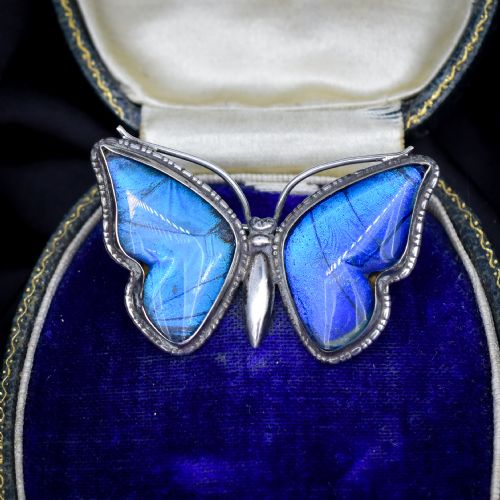
Art deco butterfly works encompass small decorative objects, tableware, and wearable items produced primarily during the 1920s and 1930s. Brooches and pendants dominate the selection, frequently utilising the distinctive iridescent blues of tropical butterfly wing panels set beneath protective glass.
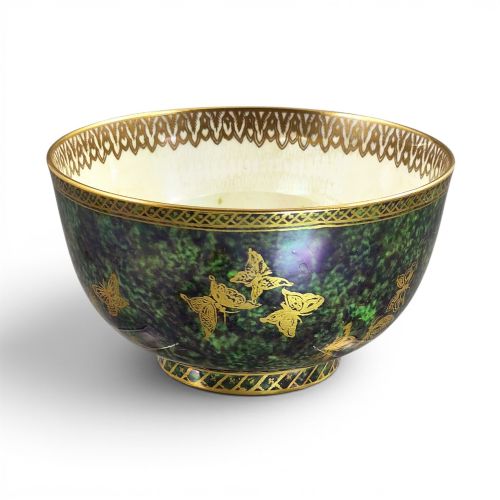
Beyond jewellery, collectors encounter opalescent glass scent bottles, lustre pottery bowls, and mirrors incorporating the motif. These pieces bridge the geometric lines of the period with the organic symmetry of insect forms.
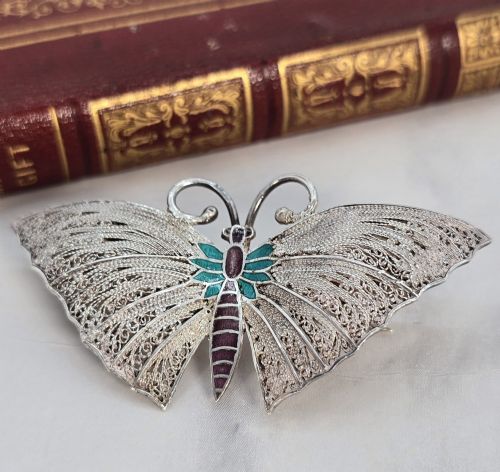
Continental workshops and British makers alike adopted the theme, resulting in diverse interpretations ranging from delicate silver filigree wings to bold ceramic glazes. The butterfly motif serves as a hallmark of modernist decorative design during the interwar decades.
How they were made
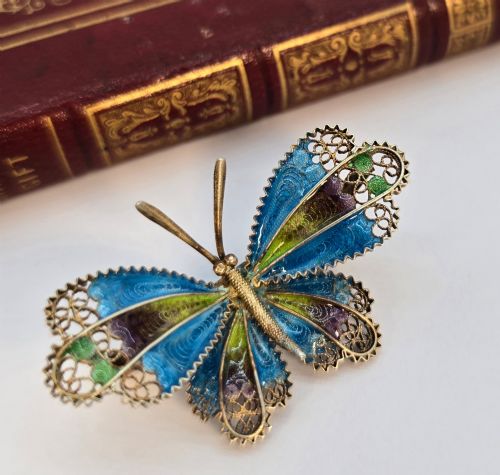
Craftsmen combined sterling silver mounts with genuine butterfly wings, sealing the delicate material under bevelled glass to preserve the natural blue pigments. Enamelling techniques, particularly translucent guilloche over engine-turned metal, added rich colour beneath geometric patterns.
Glassmakers utilised pressing and moulding methods, sometimes applying opalescent finishes to capture shifting light across relief-moulded insect shapes. Ceramic pieces relied on lustre glazes fired to produce metallic sheens on porcelain and bone china bodies.
Listings feature sterling silver, opalescent glass, porcelain, and genuine butterfly wing panels across brooches, pendants, and perfume bottles.
What varies in quality
Quality rests on the crispness of the metalwork, the clarity of the glass protecting fragile wing panels, and the precision of the enamel application. Well-preserved pieces retain vibrant wing colours without fading or moisture trapped beneath the glass surface.
Maker attribution elevates certain brooches and pendants, particularly marked silver pieces from established workshops. The depth of the opalescent glass mouldings and the complexity of the lustre glazes also distinguish standard production items from finer studio examples.
Rene Lalique·Daisy Makeig-Jones·Thomas Lyster Mott·Knoll and Pregizer·Argy Rousseau·Sabino·John Atkins·Henry Matthews·Walker and Hall·Charles Horner·Heinrich Hoffman
The Art Deco Butterfly Glossary
- Guilloche enamel
- A decorative technique where transparent enamel is layered over machine-turned metal engraving. This creates geometric patterns that shine through the coloured surface.
- Butterfly wing
- A technique using genuine Morpho butterfly wings arranged inside sterling silver frames under glass. The scales produce an intense natural iridescence.
- Opalescent glass
- A milky, translucent glass that displays milky blue or amber highlights when turned in the light. It was favoured by interwar French glassmakers.
- Lustre glaze
- A pottery finish incorporating metallic oxides that create a shimmering, iridescent surface when fired. It was used on porcelain bowls and vases.
- Filigree
- Ornamental work consisting of fine wire welded together in open tracery patterns. It forms delicate borders around enamel and wing panels on brooches.
Art Deco Butterfly: Frequently Asked Questions
Are butterfly wing pieces fragile?
The natural wings are sealed beneath glass, protecting them from normal handling. However, moisture can seep in over decades if the seals degrade.
Keep these items away from water and direct sunlight to preserve the brilliant blue colours.
How do I identify a period piece?
Look for hallmarks on the silver mounts, specific clasp styles like safety catches from the 1920s, and characteristic geometric framing. Maker marks help confirm the interwar timeline.
Material choices, such as opalescent glass and lustre glazes, also point directly to the interwar decades.
What is guilloche enamel?
It is a decorative method involving fine mechanical engraving beneath a translucent coloured glass coating. The underlying pattern creates depth and movement as light shifts across the object.
This technique appears frequently on Scandinavian and British silver brooches.
How should I display glass scent bottles?
Place them on stable surfaces where natural light can pass through the opalescent or moulded glass details. Avoid placing them near edges where accidental knocks might occur.
Dust them gently with a soft cloth without using liquid cleaners that could damage historic stoppers.